What is Kenojiru? A Complete Explanation of the History, Cooking Method, and Nutritional Value of this Traditional Tsugaru Dish from Aomori Prefecture
What is Kenojiru (Keno Shiru)?
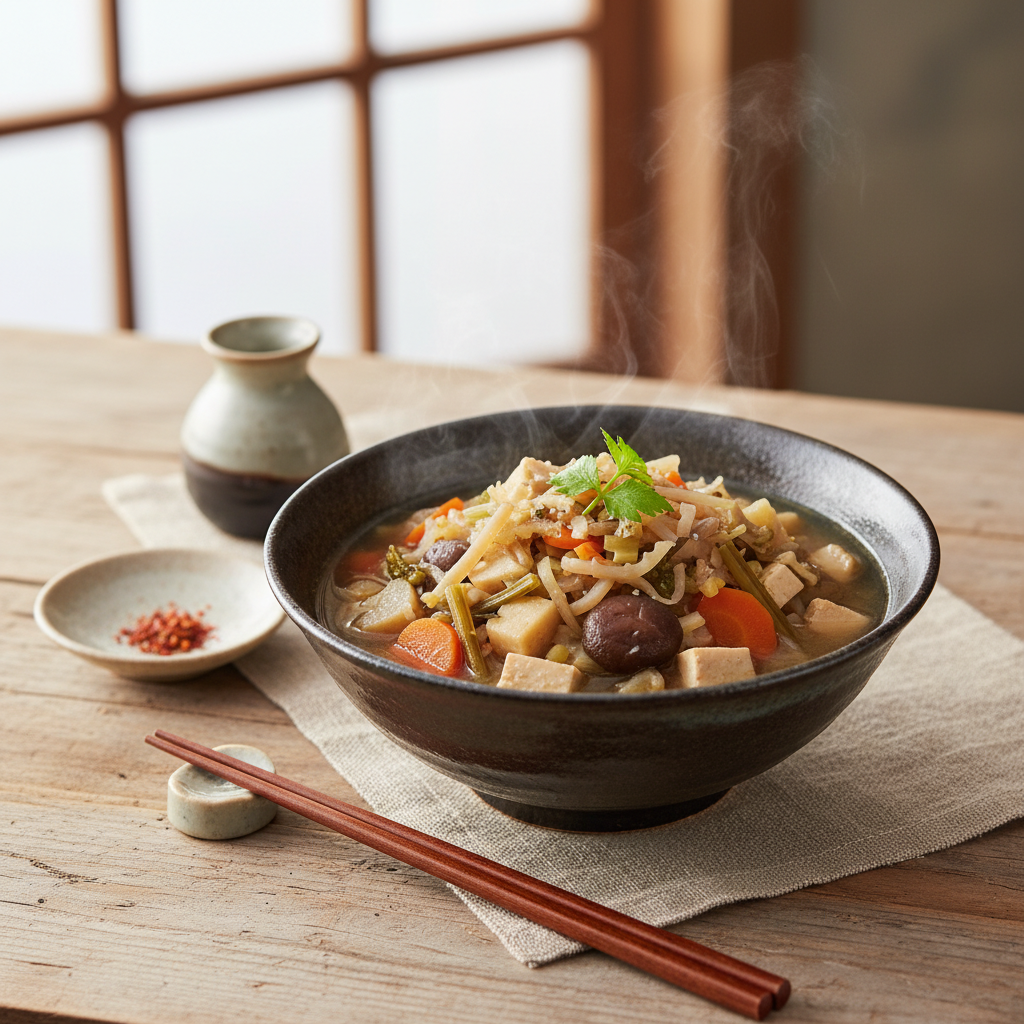
Kenojiru is a representative traditional dish from the Tsugaru region of Aomori Prefecture that has been passed down since ancient times. It is a hearty soup made by finely dicing root vegetables such as daikon radish, carrots, and burdock, along with wild vegetables, freeze-dried tofu, fried tofu, soybeans, and other ingredients into pieces approximately 7mm in size, then simmering them in kombu seaweed broth and seasoning with miso.
Also called “Tsugaru’s seven herbs rice porridge,” it is a vegetarian dish traditionally eaten on Little New Year (January 15th) to wish for good health throughout the year, and has been passed down through generations in Tsugaru households. The custom is to make large quantities in a big pot and eat it over 4-5 days by reheating it, with the characteristic that the flavors deepen and become more delicious as time passes.
History and Origins of Kenojiru
Origin of the Name
There are several theories about the origin of the name “kenojiru.” The most prominent theory is that in the Tsugaru dialect, “porridge” (kayu) is called “ke,” and thus “porridge broth” (kayu no shiru) became “kenojiru.”
In times when rice was precious, the Tsugaru region developed a practice of finely dicing ingredients and presenting them as a substitute for rice grains to conserve rice. Because these ingredients resembled porridge, the dish became known as “kenojiru.”
Other theories also circulate in the region, such as “broth made with spirit (ki)” or “household broth (ie),” with each family passing down its own interpretation.
Historical Background
The origins of kenojiru are said to trace back to the Edo period. The Tsugaru region experiences heavy winter snowfall and severe cold. Kenojiru was created by utilizing root vegetables harvested in autumn and preserved wild vegetables collected from spring to summer during winter months when fresh vegetables were scarce.
In particular, Little New Year was considered the one day of the year when women could rest properly. By preparing large quantities of kenojiru in advance, women were able to avoid cooking for several days. This preserved dish also served a practical purpose. This custom arose from the wisdom of busy women working in agriculture.
Occasions and Seasons for Eating
Kenojiru has traditionally been eaten at the following times and occasions:
Little New Year (January 15th): This is the most important time to eat it. On the morning of the 16th day of the old lunar calendar, after offering it before the family altar and paying respects, the family eats it together.
Throughout winter: Because it keeps well, it was also enjoyed as everyday food during winter months.
Funeral rites and gatherings: Because it can be made in large quantities, it is also served at funerals and gatherings when relatives come together.
Return home visits: Because it keeps well, it was also carried along when women returned to their hometowns during Little New Year.
Primary Ingredients Used and Nutritional Value
Primary Ingredients
While various ingredients are used in kenojiru depending on the region and household, the basic ingredients are as follows:
Root Vegetables
- Daikon radish: Rich in dietary fiber and aids digestion
- Carrots: Rich in beta-carotene and contributes to immune function
- Burdock: Rich in dietary fiber and polyphenols
Wild Vegetables
- Preserved bracken fern: Rich in minerals and dietary fiber
- Preserved royal fern: Adds unique texture and flavor
- Preserved butterbur: Rich in potassium with good aroma
Legumes and Legume Products
- Freeze-dried tofu (koya-dofu): High protein with excellent preservation
- Fried tofu (aburaage): Adds richness and umami
- Soybeans (zunda): Rich in protein and dietary fiber
- Kidney beans: Add sweetness and color
Other ingredients
- Konnyaku: Rich in dietary fiber with low calories
- Kombu seaweed: Provides umami and dietary fiber
- Miso: As a fermented food, helps balance intestinal flora
Characteristics of Nutritional Value
Kenojiru is a nutritionally well-balanced dish centered on plant-based foods.
Protein: Quality plant-based protein can be obtained from freeze-dried tofu, fried tofu, and soybeans.
Vitamins: Beta-carotene (Vitamin A) from carrots, B vitamins and Vitamin C from various vegetables are abundant.
Minerals: Diverse minerals including calcium, iron, potassium, and magnesium can be obtained from legume products and vegetables.
Dietary Fiber: Abundant dietary fiber from root vegetables, wild vegetables, konnyaku, and legumes supports improvement of intestinal health.
Low Calorie: Contains almost no animal fat and is centered on vegetables, making it low-calorie and healthy.
Since these nutrients can be obtained all at once, kenojiru can be considered an ideal traditional dish that aligns with modern health-conscious eating.
Main Regions of Transmission
Kenojiru has been transmitted primarily in the Tsugaru region of Aomori Prefecture.
Hirosaki City: The central city of the Tsugaru region where kenojiru is made in many households. It is also served at restaurants in Hirosaki and is popular with tourists.
Goshogawara City: Located in the northern part of the Tsugaru Plain, traditional kenojiru is passed down primarily in farming families.
Kuroishi City: A city in the southern part of the Tsugaru region where uniquely arranged variations of kenojiru are passed down in individual households.
Tsugaru City: Located at the base of the Tsugaru Peninsula, variations featuring seafood products are also seen.
Hirakawa City: A region known for apple cultivation where kenojiru is valued as a winter preserved food in farming families.
In these regions, kenojiru appears frequently in school lunches, providing opportunities for children to become familiar with local flavors from an early age.
How to Make Kenojiru
Ingredients (Serves 10)
Vegetables
- Daikon radish: 400g
- Carrots: 200g
- Burdock: 200g
- Konnyaku: 1 sheet (250g)
Wild Vegetables (preserved)
- Bracken fern: 150g
- Royal fern: 100g
- Butterbur: 100g
Legumes and Legume Products
- Freeze-dried tofu: 4 pieces
- Fried tofu: 2 pieces
- Soybeans (cooked or canned): 150g
- Kidney beans (cooked): 100g
Broth and Seasonings
- Kombu seaweed: 2 pieces (10cm square each)
- Water: 2 liters
- Miso: 6-8 tablespoons (adjust to taste)
- Sake: 2 tablespoons
- Soy sauce: 2 teaspoons (to taste)
Cooking Instructions
1. Preparation
Soak the kombu in water for at least 30 minutes to make dashi. Rehydrate the freeze-dried tofu in water and squeeze out all moisture thoroughly. Rinse the preserved wild vegetables and drain.
2. Cutting the ingredients
Cut all ingredients into uniform 7mm cubes. This uniform size is characteristic of kenojiru and creates both visual beauty and even cooking.
- Daikon and carrots: Peel and cut into 7mm cubes
- Burdock: Scrape off the skin with the back of a knife, cut into 7mm cubes, and soak in water
- Konnyaku: Cut into 7mm cubes and blanch
- Freeze-dried tofu: Cut into 7mm cubes
- Fried tofu: Pour hot water over to remove oil, then cut into 7mm cubes
- Wild vegetables: Cut into 7mm width pieces
3. Simmering
Pour the kombu dashi into a large pot and add the root vegetables (daikon, carrots, and burdock) first. Bring to a boil, carefully remove scum, and simmer over medium heat for about 10 minutes.
Once the root vegetables are partially cooked, add the konnyaku, freeze-dried tofu, fried tofu, and wild vegetables, and simmer for another 10 minutes.
4. Seasoning
Once the ingredients are tender, add sake and dissolve in the miso. Do not add all the miso at once; add it gradually while adjusting the taste. Add soy sauce to taste if desired.
5. Finishing
Add the soybeans and kidney beans and bring to a boil once more, then remove from heat. Let it cool once, then reheat; the flavors will blend better and taste even more delicious.
Serving Method and Storage Tips
How to eat: It is typically eaten with warm rice. It tastes good even when cooled, and is said to taste better the next day or later when the flavors have melded.
Storage method: Allow to cool to room temperature, then store in the refrigerator. Remove only the portion you wish to eat and reheat. It can be stored in the refrigerator for 4-5 days. Freezing is also possible, with storage lasting about one month.
Variations: You can add udon or soba noodles to make it a main dish, add mochi for a New Year’s soup style, or enjoy various other arrangements.
Regional Differences and Home Flavors
Kenojiru is known as “a flavor passed down in each household,” and there is considerable diversity in the ingredients used and seasoning methods.
Ingredient Variations
- In coastal regions, more kombu is used or dried scallops are added
- In mountainous areas, some households add mushrooms (shiitake, nameko, etc.)
- Some households add tofu, while others do not
- Some regions add taro or potatoes
Seasoning Differences
- The type of miso used (red miso, white miso, or mixed miso) creates different flavors
- Some households use more soy sauce, while others finish with miso alone
- Some households add sweetness with sugar or mirin
Cutting Differences
- Some households cut ingredients larger than the standard 7mm cubes
- Some ingredients may be cut larger than others
These differences become the individuality of each household and remain as “mother’s home cooking” in memory.
Preservation and Transmission Efforts
Use in School Lunches
Many elementary and junior high schools throughout Aomori Prefecture include kenojiru in school lunch menus as part of food education to learn about traditional local cuisine. The National Association of School Lunch Nutritionists also recommends it, and it has become an important opportunity for children to experience local food culture.
By explaining the history and nutritional value of kenojiru in lunch newsletters, it also becomes a conversation starter at home.
Serving at Local Events
In Hirosaki and other areas throughout the Tsugaru region, events such as “kenojiru festivals” and “local cuisine fairs” are held during winter months. At these events, members of local women’s groups and food life improvement volunteers cook kenojiru in large pots and serve it to visitors.
Such events provide valuable opportunities for younger generations and people moving to the prefecture from other areas to learn about kenojiru.
Activities of JA Women’s Groups
The women’s section of JA Aomori regularly holds cooking classes on how to make kenojiru. Experienced farm women serve as instructors, passing down traditional cooking methods to the next generation.
Through the publication of recipe collections and video demonstrations of cooking methods, while also incorporating modern techniques, they are working to preserve this tradition.
Product Development Efforts
In recent years, products that allow people to enjoy kenojiru easily have been developed.
Retort products: Retort packages of kenojiru that only need to be heated are sold at roadside stations and souvenir shops.
Dried ingredient sets: Products with pre-cut dried ingredients in a set are also available, requiring only rehydration and simmering to prepare homemade kenojiru.
Frozen products: Products with diced ingredients frozen can be thawed and simmered for just a few minutes to make authentic kenojiru.
These products are also popular among Aomori natives living outside the prefecture, becoming a way to reminisce about the taste of home.
Information Sharing on Social Media
Increasingly, young people share photos of their household kenojiru on social media platforms like Instagram and Twitter. Searching hashtags like “#kenojiru” or “#Aomori local cuisine” reveals numerous unique versions of kenojiru from different households.
Recipe videos of kenojiru preparation are also available on many video recipe sites, providing opportunities for younger generations to experience traditional local cuisine.
Provision in Restaurants
An increasing number of izakayas and local cuisine restaurants in Hirosaki are adding kenojiru to their menus. It is popular with tourists and is positioned as an important dish for experiencing Aomori’s food culture.
Some restaurants offer it as a seasonal menu item available only in winter, or as a “kenojiru set meal,” promoting the appeal of local cuisine.
Contemporary Value of Kenojiru
Value in Health
Kenojiru is being re-evaluated as a dish that aligns with modern health-conscious eating.
Plant-based food centered: Uses almost no animal products and is a cholesterol-low, healthy dish.
Rich in dietary fiber: Promotes intestinal health and helps prevent lifestyle diseases.
Low calorie: Being vegetable-centered and low in calories, it is safe to eat even while dieting.
Fermented food: Miso as a fermented food has the effect of increasing beneficial bacteria in the intestines.
Environmental Value
Reducing food waste: The custom of using preserved food ingredients, making large quantities, and eating over several days is one solution to the modern food waste problem.
Local production and consumption: Using locally grown vegetables and wild vegetables reduces energy spent on transportation.
Seasonal ingredient use: The wisdom of preserving seasonal ingredients for winter use is a model for sustainable eating.
Social Value
Family bonds: The practice of cooking in a large pot and eating together as a family promotes family communication.
Intergenerational exchange: Teaching the cooking method to one another creates exchange across generations.
Regional identity: Through local cuisine, affection and pride in one’s region are fostered.
Conclusion
Kenojiru is a traditional local cuisine that the Tsugaru region of Aomori Prefecture takes pride in, embodying the wisdom of ancestors who endured harsh winters. Though a simple dish of finely diced vegetables, wild plants, and simmered legume products, it contains many values including attention to nutritional balance, ingenuity in preservation, and care for family.
Beginning as a vegetarian dish eaten on Little New Year wishing for good health, kenojiru is now finding new value as a healthy everyday food and an important dish for transmitting regional food culture in modern times.
Various efforts to pass this tradition to the next generation are underway, including use in school lunches, serving at local events, product development, and information sharing on social media. As a local cuisine where tradition and innovation merge, it continues to develop.
Kenojiru has diversity in the unique flavors passed down in each household, characteristics particular to each region, and ways of eating according to season and occasion. Each “kenojiru” is deeply connected to the lives of Tsugaru people.
Using the recipe introduced in this article, please try making kenojiru in your own home. By adding your household’s own touches to the way ingredients are cut and seasoned, a new “our family’s kenojiru” will be born. We hope you will enjoy Aomori’s rich food culture at your daily table.