Kayaki-miso (貝焼き味噌) – History and Preparation of a Traditional Local Dish Boasted by Aomori Prefecture
What is Kayaki-miso?
Kayaki-miso (かやきみそ, かやぎみそ) is a traditional local dish that has been passed down for many years in the Tsugaru and Shimokita regions of Aomori Prefecture. In the Shimokita region, it is also called “miso-kayaki (味噌貝焼き),” and the variation in regional names is one of its distinctive characteristics.
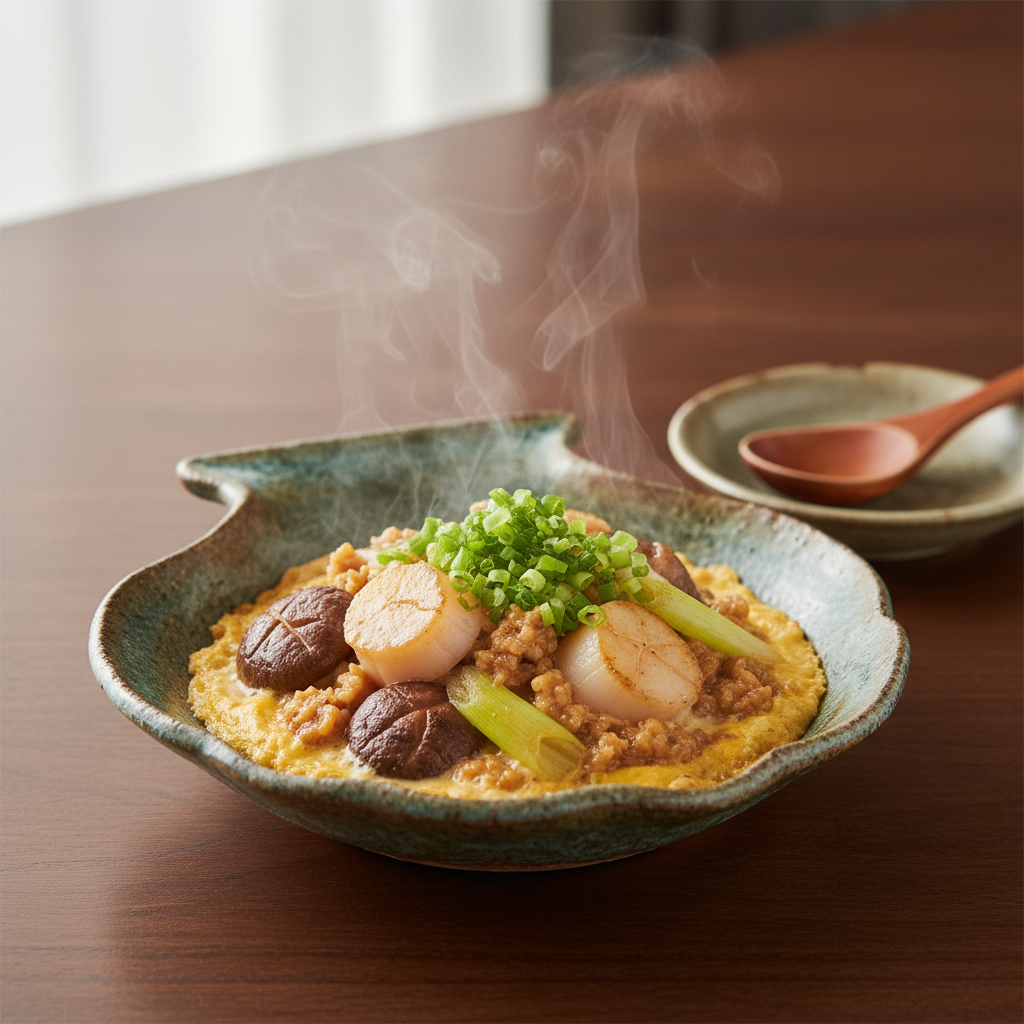
The greatest feature of this dish is the use of large scallop shells, 15-20 centimeters in diameter, harvested from Mutsu Bay as a cooking vessel instead of a pot. A miso-based broth is brought to boil inside the shell, and scallop adductor muscles, fish fillets, and vegetables are added, finally finishing the dish by wrapping it in egg—a simple yet profound cooking method that has been handed down through generations.
As a representative dish of Aomori’s food culture, it is served widely from home cooking to restaurants for tourists, and it is a must-try dish when visiting Aomori Prefecture.
History and Origins of Kayaki-miso
A Fisherman’s Cooking Tradition Continuing from the Edo Period
In the Tsugaruwan area, long known as a scallop-producing region, kayaki-miso has been eaten since the Edo period. In those days, when dragging nets along the sea floor would yield natural scallops aged 5-10 years, large shells measuring approximately 20 centimeters in diameter were abundant.
Fishermen invented a simple dish by using these large shells as pots, placing sardine or mackerel fillets and homemade miso on them and grilling. This became the prototype of kayaki-miso. At that time, the dish was more simple than today’s version—made without egg, simply grilling with miso, green onion, and dried fish stock broth.
Development into Home Cooking
As time progressed, kayaki-miso spread from fishermen’s cuisine to home cooking. Later, it took its current form with the addition of egg, and ingredients such as scallop adductor muscles, sardines, and mackerel fillets were added.
Particularly in the Tsugaru region, the dish became established as a winter comfort food to warm the body and, in areas where Mutsu Bay scallop fishing flourished, as an everyday home-style flavor. The type of miso, ingredients, and broth preparation varied from household to household, and the dish was passed down across generations as “mother’s cooking.”
Major Transmission Regions and Regional Characteristics
Kayaki-miso of the Tsugaru Region
In the Tsugaru region, it is called “kayaki-miso” or “kayaki-miso,” and is particularly beloved in areas around Tsugaruwan Bay, including Aomori City, Hiranai Town, and Sotogahama Town. The characteristic of the Tsugaru region is the use of Tsugaru miso and the enhancement with dried fish (niboshi) broth.
Tsugaru miso has a good balance of sweetness and saltiness, serving to highlight the sweetness of scallops. Also, in the Tsugaru region, the method of finishing with egg is the mainstream, offering a fluffy texture.
Miso-kayaki of the Shimokita Region
In the Shimokita region, it is called “miso-kayaki” or “miso-kayaki,” and is eaten in Mutsu City, Oma Town, and Sai Village. The characteristic of the Shimokita region is a tendency toward slightly stronger seasoning than in the Tsugaru region, with a preference for using abundant fresh seafood harvested locally.
Since the Shimokita Peninsula is surrounded by sea on three sides, the appeal is being able to enjoy kayaki-miso made with fish caught that day. Additionally, in some households, a style without egg remains, allowing one to feel the remnants of simpler fishermen’s cooking.
Primary Ingredients and Nutritional Value
Basic Ingredients
The basic ingredients for kayaki-miso are as follows:
Main ingredients:
- Scallop adductor muscle (Mutsu Bay product is ideal)
- Large scallop shell (as a cooking vessel)
- Miso (Tsugaru miso or local miso)
- Egg
- Long green onion
Broth:
- Dried fish (niboshi)
- Water or kombu broth
Other ingredients (depending on household and region):
- Tofu
- Mushrooms (shiitake, enoki, etc.)
- Sardine or mackerel fillets
- Leafy greens
Nutritional Characteristics
Kayaki-miso is a nutritionally well-balanced dish. Scallops are rich in protein and low in fat, and also contain minerals such as taurine and zinc. Miso, as a fermented food, has the effect of improving intestinal health, and eggs provide high-quality protein and vitamins.
Dried fish broth contains calcium, DHA, and EPA, and long green onion has the effect of warming the body. In this way, kayaki-miso is excellent in its ability to intake diverse nutrients in a single dish.
How to Make Kayaki-miso (Recipe)
Ingredients (per serving)
- Scallop adductor muscle: 2-3 pieces
- Large scallop shell: 1 piece
- Miso: 1-1.5 tablespoons
- Egg: 1
- Long green onion: 1/3 stalk
- Dried fish broth: 150 ml
- Tofu: 1/4 block (optional)
- Mushrooms: to taste (optional)
Preparation Steps
1. Prep Work
Wash the scallop shell thoroughly and remove any dirt. Cut the scallop adductor muscle into bite-sized pieces, and slice the green onion on the diagonal. If using tofu or mushrooms, cut them into bite-sized pieces.
2. Make the Broth
Prepare dried fish broth. Either soak dried fish in water overnight, or boil over low heat for about 10 minutes to extract the broth. While using dried fish broth is traditional in Aomori Prefecture, kombu broth or store-bought broth can be substituted.
3. Cooking in the Shell
Place the scallop shell over direct heat or a stovetop, and pour in the broth. Once it boils, dissolve in the miso. The key point here is to add the miso gradually while tasting, rather than all at once.
4. Add Ingredients
Once the miso is dissolved, add the scallop adductor muscle, tofu, mushrooms, and other ingredients. Simmer for 2-3 minutes until the ingredients are cooked through.
5. Finish with Egg
Once the ingredients are cooked through, add the green onion, then drizzle in the beaten egg. Stop the heat once the egg reaches a half-cooked state. For a fluffy texture, it is recommended to finish with the egg in a half-cooked state rather than fully cooked.
6. Complete
Serve in the shell itself. Enjoy while piping hot.
Cooking Tips and Points
- Handling the shell: Stabilizing the shell by placing it on a damp cloth makes cooking easier.
- Heat level: Avoid high heat as it may cause the shell to crack; cook over medium to low heat.
- Choosing miso: If Tsugaru miso is unavailable, using sweet rice miso will give a similar flavor.
- Broth concentration: If dried fish broth is too concentrated, it becomes bitter, so adjust to an appropriate strength.
Occasions and Seasons for Eating
As Everyday Home Cooking
Kayaki-miso is eaten regularly in Aomori households rather than as a special occasion dish. Particularly during the cold winter months, it is frequently served as a dish to warm the body.
While scallop fishing in Mutsu Bay occurs year-round, the season is particularly said to be from winter to spring, and kayaki-miso made with scallops from this period has exceptional deliciousness.
Provision at Special Occasions
It is also valued as a dish for family gatherings and entertaining guests. Additionally, restaurants throughout Aomori Prefecture serve it year-round as a local specialty, making it a popular menu item among tourists.
At regional festivals and food events, demonstrations and tastings of kayaki-miso are sometimes held, playing an important role in transmitting Aomori’s food culture.
How to Eat and Ways to Enjoy
Traditional Way of Eating
Kayaki-miso is traditionally served in the scallop shell itself. By scooping directly from the shell with a spoon, one can enjoy the scallop flavor that has permeated the shell as well.
Eating it while piping hot is most delicious, where the fluffy texture of the egg, the savory aroma of miso, and the sweetness of the scallop harmonize in the mouth.
Modern Arrangements
In recent years, when shells are difficult to obtain or for convenience in home cooking, methods using small pots or frypans have become more common. Products sold in microwave-safe containers are also available, making it easier to enjoy.
The variety of ingredients has also expanded, with seasonal vegetables and wild plants being added, or cheese toppings and other modern arrangements being enjoyed.
Good Pairings
Kayaki-miso is satisfying as a standalone dish, but it also works excellently as a side dish for rice. It pairs exceptionally well with Japanese sake, and combined with Aomori’s local sake, it offers a special flavor.
Preservation and Succession Efforts
Home Transmission
Kayaki-miso has been passed down across generations within families, from mother to daughter and grandmother to grandchild. Each household has its own unique flavor, and it is carefully preserved as “our family’s kayaki-miso.”
At community cooking classes and food education activities, the method of making kayaki-miso is taught, and efforts are being made to pass it on to younger generations.
Popularization Through Commercialization
Food manufacturers in Aomori Prefecture have developed and sold frozen and retort-packaged kayaki-miso products. Using Mutsu Bay scallops and Tsugaru miso, these products can be enjoyed with authentic taste by simply heating in a microwave, serving to bring Aomori’s flavor to people outside the prefecture.
These are also popular souvenirs, and products with recipes are sold so that tourists who visit Aomori can recreate Aomori’s flavors at home.
Restaurant Service and Tourism Resource Development
Many restaurants throughout Aomori Prefecture have incorporated kayaki-miso into their menus as a local specialty. Particularly in taverns and local cuisine restaurants in Aomori City, authentic kayaki-miso made with genuine scallop shells is served and has become a popular menu item among tourists.
Kayaki-miso is featured on tourism information sites and food sites, being promoted as representative of Aomori’s food culture both domestically and internationally.
Transmission via SNS and Media
In recent years, the charm of kayaki-miso has been widely shared through SNS. Photos and videos of the dish, home arrangement recipes, and other content are shared, increasing interest among younger generations.
Aomori Prefecture and local tourism associations actively introduce kayaki-miso through their official websites and SNS, making efforts to convey the appeal of Aomori’s food culture nationwide.
Places to Taste Kayaki-miso
Restaurants in Aomori Prefecture
Aomori City has numerous local cuisine restaurants serving authentic kayaki-miso. One can also taste kayaki-miso at the Aomori Gyosai Center, famous for its “nokkei-don.”
Throughout the Tsugaru region, such as at “Hotate Plaza” in Hiranai Town, and in the Shimokita region at local restaurants in Mutsu City, one can enjoy local flavors in each area.
Enjoying at Home
Even outside Aomori Prefecture, one can purchase Mutsu Bay scallops, Tsugaru miso, and kayaki-miso sets through online shops. When scallop shells are not available, one can adequately substitute small pots or heat-resistant containers.
Recipe sites and cooking videos feature numerous methods for making kayaki-miso, making it easier for beginners to attempt.
Conclusion: Kayaki-miso Supporting Aomori’s Food Culture
Kayaki-miso is a traditional local dish of Aomori Prefecture continuing from the Edo period and represents the food culture of both the Tsugaru and Shimokita regions. The unique cooking method of using a scallop shell as a cooking vessel was born from the wisdom unique to Mutsu Bay’s scallop-producing area.
From simple fishermen’s cuisine to its development as home cooking, kayaki-miso is now garnering attention as a tourism resource. While preserving its history and tradition, it is being passed on to new generations through modern arrangements and commercialization.
When visiting Aomori Prefecture, be sure to taste authentic kayaki-miso. Additionally, as it is a dish that can be easily made at home, it is recommended to try recreating Aomori’s flavor in your own kitchen. Through kayaki-miso, we hope you will experience the rich food culture and history of Aomori Prefecture.