A Complete Guide to Nagasaki Chanpon: Thorough Explanation from Its Origins to Authentic Preparation Methods
Nagasaki chanpon, known nationally as a representative local dish of Nagasaki Prefecture, is a voluminous noodle dish filled with abundant vegetables, seafood, and pork. Characterized by its distinctive thick noodles and rich broth, it has become a symbol of Nagasaki’s food culture as a nutritionally well-balanced dish. This article provides detailed explanations covering the historical background of chanpon, authentic preparation methods, and contemporary efforts to preserve this tradition.
What is Nagasaki Chanpon?
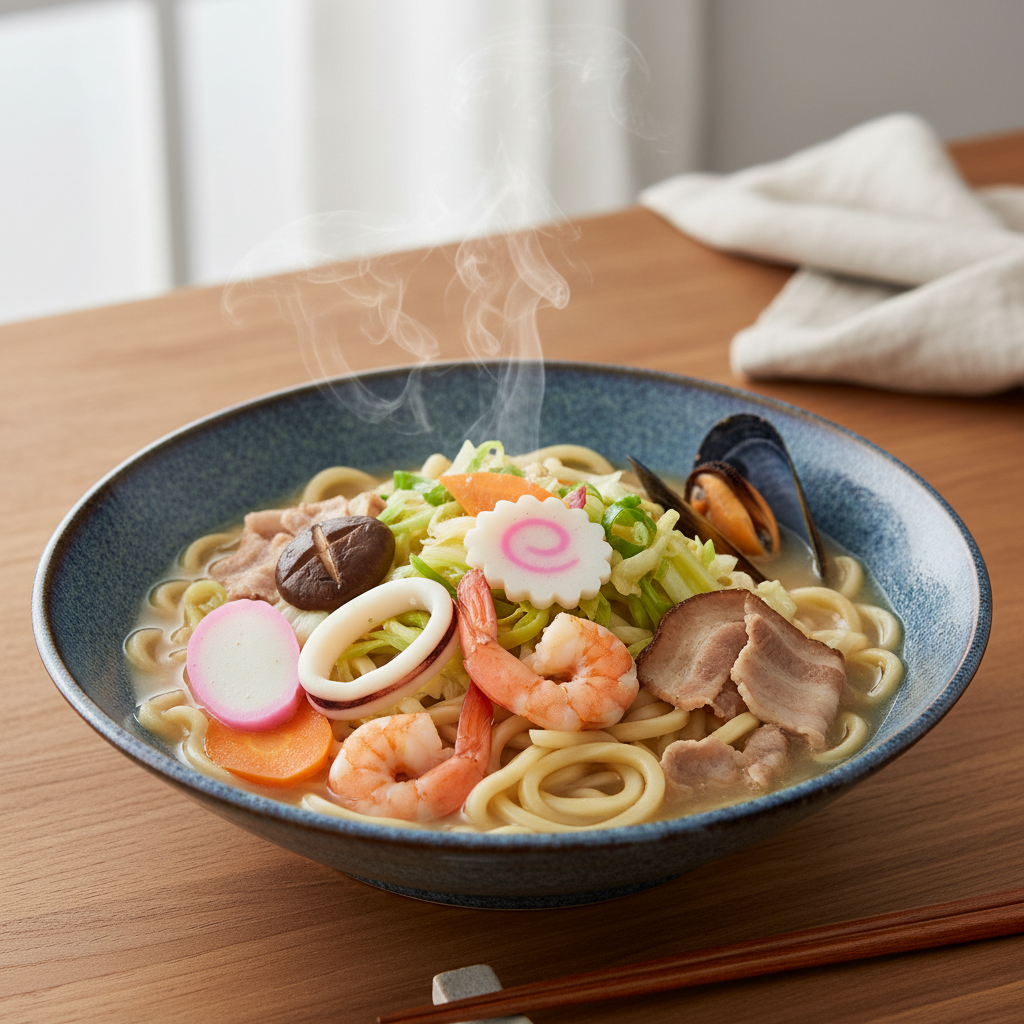
Nagasaki chanpon is a noodle dish made by stir-frying ingredients such as pork, seafood, and vegetables in lard, then simmering them in a milky white broth based on pork bones and chicken carcass, using thick Chinese noodles. Unlike typical ramen, where noodles and broth are prepared separately, chanpon is distinguished by simmering the ingredients and noodles together in the broth, allowing the umami of the ingredients to permeate the noodles and creating a unified flavor.
Main Characteristics
Noodle Characteristics
Nagasaki chanpon typically uses noodles of size 16 on the cutting blade scale, which are thicker than standard ramen noodles. They are characterized by a chewy texture. The use of tou-akku (唐灰汁), a unique kansui water traditional to Nagasaki, creates distinctive firmness and flavor.
Broth Characteristics
The broth is characterized by a rich, milky white color made from a base of pork bones and chicken carcass with the addition of seafood dashi. After stir-frying the ingredients and pouring in the broth to simmer together with the noodles, the umami from vegetables, meat, and seafood dissolves into the broth, creating a deep, complex flavor.
Ingredient Characteristics
It is common to include more than ten types of ingredients: pork, fish cake, shrimp, squid and other seafood, cabbage, bean sprouts, onions, carrots, and wood ear mushrooms. This abundance of ingredients creates both nutritional balance and a satisfying volume.
History, Origins, and Related Events
Background of Birth
Nagasaki chanpon was created in 1899 (Meiji 32nd year). It was devised by Chen Pingshun (陳平順), the first proprietor of the Chinese restaurant “Shikai-ro (四海樓)” in Nagasaki.
At that time, many Chinese students were studying in Nagasaki. Concerned that these students, far from home and living on limited budgets, were not getting sufficient nutrition, Chen Pingshun conceived the idea of providing food that was inexpensive yet nutritious and voluminous.
Development from Fujian Cuisine
Chanpon’s roots are said to lie in “Tang Rou Si Mian (湯肉絲麺),” a dish from Fujian cuisine in Fujian Province. Tang Rou Si Mian is a light soup noodle dish containing pork, shiitake mushrooms, bamboo shoots, and green onions.
Taking this Fujian dish as a base, Chen Pingshun created a Japanese adaptation with richer broth, more abundant ingredients, and noodles with distinctive firmness. The innovation lies in using relatively inexpensive ingredients—vegetable and meat scraps—while still ensuring nutrition and volume.
Origin of the Name
There are several theories about the origin of the name “chanpon.” The most prevalent theory is that it derives from the Chinese words “吃飯 (chifan),” meaning “eat rice” or “have a meal.” It is said that this phrase, used to invite the students to eat, became the name of the dish.
Additionally, “chanpon” can mean “to mix” or “a jumble,” which may refer to the dish’s characteristic of mixing various ingredients together.
Relationship to Nagasaki Food Culture
During the Edo period, Nagasaki was Japan’s sole open port, through which trade with the Netherlands and China occurred. From this historical background, Nagasaki developed a unique, internationally influenced food culture.
Chanpon developed as a Sino-Japanese dish representing the common people’s taste, symbolizing Nagasaki’s history and culture. From the Meiji period onward, it became widely offered at Chinese restaurants throughout Nagasaki and eventually gained recognition nationwide as a representative local dish.
Major Areas of Transmission
Nagasaki Prefecture, Centered on Nagasaki City
Although chanpon is enjoyed throughout Nagasaki Prefecture, specialist shops and established restaurants are particularly concentrated in Nagasaki City, the birthplace of the dish. In Nagasaki City alone, there are hundreds of establishments serving chanpon, each pursuing their own unique flavor.
Major Areas in Nagasaki City
- Around Nagasaki Chinatown: Gathering place for many Chinese restaurants, popular with tourists
- Around Oura Cathedral: The area where the originating restaurant “Shikai-ro” is located
- Around Hamachi and Shanoji: Historic establishments beloved by local residents
Expansion Throughout the Prefecture
In areas beyond Nagasaki City, chanpon has also become established as a regularly consumed dish. Various Nagasaki versions of chanpon exist in cities such as Sasebo, Isahaya, and Omura, each offering subtly different flavors characteristic of their region.
Main Ingredients Used
Noodles
Unique Noodles Using Tou-akku
Nagasaki chanpon noodles are made using tou-akku (唐灰汁), a unique kansui water. Tou-akku is an ancient noodle-making technique passed down in Nagasaki that creates distinctive flavor and firmness different from ordinary kansui. The standard thickness is approximately size 16 on the cutting blade scale, characterized by a chewy texture.
Meat
- Pork: Thinly sliced belly or loin meat is used. The fat’s umami dissolves into the broth
- Fish cake: A processed product made from fish surimi, adding visual appeal and textural accent
Seafood
- Shrimp: Usually peeled shrimp are used, characterized by a plump texture and sweetness
- Squid: Used in rings. The soft texture when simmered is enjoyable
- Shellfish: Some restaurants use clams or littleneck clams, enhancing the broth’s umami
Vegetables
Cabbage: The most widely used vegetable, providing sweetness and texture
Bean sprouts: Adding a crisp texture and volume
Onion: Adding sweetness and umami to the broth, an important ingredient
Carrot: Enhancing nutritional value and visual appeal
Wood ear mushroom: Characteristic crunchy texture
Green onion: Adding fragrance and flavor
Corn: Adding sweetness and visual appeal
These vegetables are selected with nutritional balance in mind, containing abundant vitamins, minerals, and dietary fiber.
Broth Ingredients
- Pork bones: Providing the rich dashi that forms the broth’s base
- Chicken carcass: Combined with pork bones, adding mildness and depth
- Seafood: Fish racks and dried scallops, etc., adding umami from the sea
- Lard: Used for stir-frying ingredients, creating savory aroma and flavor
Ingredients (Serves 2)
Noodles and Broth
- Chanpon noodles: 2 portions (approximately 200g)
- Pork bone broth: 600ml
- Chicken carcass broth: 200ml
- Milk: 100ml (for smoothness)
- Salt: 1 teaspoon
- Soy sauce: 1 tablespoon
- Sugar: 1/2 teaspoon
- White pepper: pinch
Ingredients
- Pork belly (thinly sliced): 80g
- Peeled shrimp: 6
- Squid: 50g
- Fish cake: 4 slices
- Cabbage: 150g (roughly chopped)
- Bean sprouts: 100g
- Onion: 1/2 (sliced)
- Carrot: 1/4 (cut into thin strips)
- Dried wood ear mushroom: 5g (rehydrated)
- Corn: 2 tablespoons
- Green onion: to taste (finely chopped)
- Lard: 2 tablespoons
Preparation Method
Prep Work
- Rehydrate wood ear mushrooms: Soak dried wood ear mushrooms in water for about 30 minutes, remove the hard stem, and cut into bite-sized pieces.
- Prepare vegetables: Roughly chop cabbage, slice onion, and cut carrots into thin strips. Rinse bean sprouts and drain well.
- Prepare meat and seafood: Cut pork into bite-sized pieces, remove the vein from shrimp. Cut squid into rings.
- Prepare broth: Combine pork bone and chicken broth and mix in milk.
Cooking Steps
Step 1: Stir-fry ingredients
Heat a wok or frying pan over high heat and melt the lard. Add pork first and stir-fry until it changes color. Next, add shrimp and squid and quickly cook through.
Step 2: Add vegetables
Add vegetables in order from those requiring longer cooking time: carrot, onion, cabbage, and wood ear mushroom. Stir-fry over high heat. When vegetables begin to soften, add bean sprouts and corn.
Step 3: Pour in broth
Once the oil is evenly distributed over all ingredients, pour in the prepared broth all at once. When it comes to a boil, adjust seasoning with salt, soy sauce, and sugar.
Step 4: Add noodles
Add chanpon noodles while the broth is boiling. Break apart the noodles while mixing them with the broth. Simmer for approximately 2-3 minutes until the noodles soften.
Step 5: Finishing touches
Add fish cake and warm through. Season with white pepper. Taste and adjust seasoning if necessary with salt or soy sauce.
Step 6: Plating
Place in a bowl and garnish with finely chopped green onion to complete.
Tips for Delicious Preparation
High heat and quick work: Stir-frying ingredients over high heat while working quickly preserves the vegetables’ crispy texture and umami.
Simmer noodles together with broth: This is chanpon’s greatest characteristic. By simmering noodles in the broth, the umami of the ingredients permeates the noodles, creating a unified flavor.
Utilizing milk: When authentic pork bone broth is unavailable, adding milk to commercial broth can approximate a smooth, milky broth.
Generous ingredient amounts: Using abundant ingredients is the secret to approaching authentic flavor. Maintain balance among vegetables, meat, and seafood while creating a satisfying volume.
Eating Occasions and Seasons
Chanpon as Everyday Food
In Nagasaki Prefecture, chanpon is not a special occasion dish but rather everyday fare enjoyed by ordinary people. It is frequently consumed as lunch or dinner in both homes and restaurants, having become the soul food of Nagasaki residents.
Weekday lunch: Many office workers and students choose chanpon for lunch. Its volume and nutritional balance make it satisfying as a complete meal.
Home dining: Frequently prepared as weekend home cooking. Because it provides abundant vegetables, it has become the standard menu for nutrition-conscious households.
Seasonal Variations
Summer chanpon: During hot seasons, more vegetables may be used with lighter seasoning. Chilled chanpon has also appeared as a variation.
Winter chanpon: In cold seasons, the hot broth and abundant ingredients warm the body. Increased use of root vegetables and other seasonal ingredients is also observed.
Tourism and Food Culture
For tourists visiting Nagasaki, chanpon is a must-try dish. Nagasaki Chinatown and the originating restaurant “Shikai-ro” attract many visitors from across the country who come to enjoy the authentic flavor.
How to Eat
Basic Eating Method
Since chanpon is a unified dish where noodles, ingredients, and broth are one, it is customary to eat while gently mixing everything together.
Steps:
- First, gently mix the noodles and ingredients with chopsticks
- Lift noodles with chopsticks while thoroughly coating them with broth
- Eat ingredients evenly while enjoying the broth together
- Using a Chinese spoon to drink the broth in which the ingredients’ umami has dissolved allows full appreciation of the soup
Condiments and Toppings
Vinegar: A small amount of vinegar placed on the table can add variation. Particularly effective in the latter part of the meal when the taste becomes monotonous, adding a refreshing quality.
Pepper: Adding white or black pepper creates a slight bite and fragrance.
Chili oil: Those who prefer spice can add chili oil for flavor variation.
Red pickled ginger: Some restaurants offer red pickled ginger as a topping to cleanse the palate.
Etiquette and Enjoyment
Eat while hot: Chanpon is most delicious when steaming hot, so it is recommended to begin eating immediately upon serving.
Enjoy the broth to the end: The broth in which the ingredients’ umami has dissolved is chanpon’s finest quality. Savor it completely without waste.
Slurping sounds are acceptable: In Japanese noodle culture, making sounds while slurping noodles is acceptable. Rather, it is accepted as a way of expressing deliciousness.
Nutritional Value and Health Benefits
Excellence of Nutritional Balance
Chanpon is an excellent dish allowing balanced intake of carbohydrates, proteins, vitamins, minerals, and dietary fiber in a single serving.
Carbohydrates: Noodles provide carbohydrates as an energy source.
Protein: Pork, shrimp, squid, and fish cake provide abundant high-quality protein.
Vitamins and minerals: Vegetables such as cabbage, bean sprouts, and carrots provide vitamin C, B vitamins, potassium, calcium, and other nutrients.
Dietary fiber: Vegetables and wood ear mushrooms provide dietary fiber that maintains intestinal health.
Health Benefits
Vegetable intake: A single bowl of chanpon contains approximately 200-300g of vegetables, supplementing more than half the daily vegetable intake requirement.
Fatigue recovery: Vitamin B1 found in pork is effective for fatigue recovery. When combined with allicin in vegetables, absorption improves.
Immune enhancement: Consuming diverse nutrients from various ingredients contributes to improved immunity.
Precautions
Salt content: Broth contains relatively high salt content, so those concerned about hypertension should consider not drinking all the broth.
Calories: Due to its volume, a single bowl contains approximately 600-800 kcal. Those dieting should be mindful of consumption frequency.
Preservation and Continuation Efforts
Role of “Shikai-ro,” the Originating Restaurant
“Shikai-ro,” established in 1899, continues operating in Nagasaki as the birthplace of chanpon. While maintaining the flavor of founder Chen Pingshun, it fulfills the role of transmitting chanpon’s history and culture to future generations.
The restaurant houses an attached “Chanpon Museum” where visitors can learn about chanpon’s history and culture. It serves not only tourists but also as a venue for school social studies field trips by local institutions.
Recognition as Local Cuisine by Nagasaki Prefecture
Nagasaki Prefecture has officially recognized chanpon as a representative local dish and undertaken efforts for its preservation and transmission. It is also listed in the Ministry of Agriculture, Forestry and Fisheries’ “Our Local Cuisine” database, with information disseminated nationwide.
Commercialization and National Expansion
Instant foods: Companies such as “Mirokuyaji” manufacture and sell instant chanpon allowing enjoyment of authentic flavor at home. Products packaged with noodles and broth are available at supermarkets nationwide, spreading Nagasaki’s flavor throughout the country.
Frozen foods: Recent advances in freezing technology have produced authentic-tasting frozen chanpon.
Retort products: Ingredient-inclusive retort chanpon has also been developed and is popular as a souvenir.
Proliferation via Chain Restaurants
National expansion by chanpon specialist chains such as “Ringer Hut” has made chanpon easily accessible in regions beyond Nagasaki. These chains also undertake measures responding to contemporary needs, such as domestically sourced vegetable sourcing and nutritional balance promotion.
Food Education Activities
In Nagasaki Prefecture school lunches, chanpon is occasionally offered as local cuisine, serving as an important opportunity for children to learn regional food culture.
Cooking classes and events teaching chanpon preparation methods are also conducted, with emphasis on transmitting cooking techniques within households.
SNS and Digital Marketing
In recent years, information dissemination via SNS has become active. Chanpon restaurants throughout Nagasaki City post daily business information and new menus on Instagram and Twitter, targeting younger generations.
Users themselves also disseminate information through hashtags such as “#長崎ちゃんぽん” and “#ちゃんぽん巡り,” contributing to chanpon culture’s expansion.
Utilization as Tourism Resource
Nagasaki Prefecture positions chanpon as an important tourism resource, undertaking initiatives coordinating tourism promotion such as “chanpon map” creation and “chanpon tour” planning.
At Nagasaki Chinatown, “chanpon tasting walks” at multiple establishments are popular, providing tourists opportunities to experience Nagasaki’s food culture.
Cooking Contests and Events
Periodic events such as “Chanpon Festivals” and “Chanpon Championships” are held, discovering new ideas and arranged recipes. This allows tradition preservation while enabling evolution suited to modern times.
Training of Successors
Culinary arts vocational schools in Nagasaki have incorporated chanpon cooking techniques into formal curricula, undertaking training of next-generation chefs. While learning traditional methods, students also acquire contemporary arrangement skills and nutritional science knowledge.
Regional Differences and Diversity
Variations Among Nagasaki City Restaurants
Even within Nagasaki City, chanpon flavor varies significantly between restaurants. Broth concentration, noodle thickness, ingredient types and quantities—each restaurant employs unique innovations.
Established restaurants’ taste: Restaurants preserving traditional methods, serving time-honored flavors
Creative style: Restaurants incorporating new ingredients and cooking methods, arranging modernized versions
Homestyle taste: Familiar, approachable flavors beloved by local residents
Regional Nagasaki Versions
Obama Chanpon (Unzen City, Obama Town): In the hot spring resort town of Obama, chanpon featuring abundant local seafood is characteristic.
Goto Udon-style Chanpon (Goto Islands): Chanpon using Goto udon, a famous local product of the Goto Islands, also exists.
Shimabara Chanpon (Shimabara City): Characterized by light chanpon using fresh vegetables and seafood from Shimabara Peninsula.
Modern Evolution and New Attempts
Responding to Health-Consciousness
Responding to heightened health awareness, low-calorie and low-sugar chanpon options have appeared. Innovations include reducing noodles while increasing vegetables and reducing fat content in broth.
Vegetarian and Vegan Adaptation
As an international tourist destination, Nagasaki has increasingly accommodated vegetarian and vegan visitors, with more restaurants offering chanpon without animal products.
Gluten-Free Adaptation
To accommodate those with wheat allergies, gluten-free chanpon using rice noodles has been developed.
Takeout and Delivery
Prompted by the pandemic, more restaurants now offer takeout and delivery. An environment enabling enjoyment of authentic chanpon at home is developing.
Conclusion
Nagasaki chanpon, originating as a dish created in the Meiji period for Chinese students and developing as Nagasaki’s local cuisine, has become a beloved noodle dish nationwide. Its nutritional balance from abundant vegetables, meat, and seafood, its satisfying volume, and its distinctive thick noodles and rich broth continue to captivate many.
Through the efforts of established restaurants including “Shikai-ro,” commercialization enabling national expansion, and information dissemination via SNS, tradition is being preserved while new attempts continue. When visiting Nagasaki, be sure to experience authentic chanpon and appreciate its history and culture. Alternatively, consider recreating Nagasaki’s flavor at home using this article’s recipe.
Chanpon is not merely a noodle dish but a culturally valuable local cuisine encompassing Nagasaki’s history, the spirit of international exchange, and the founder’s kindness in providing something “inexpensive yet nutritious.”