Anmochi Zoni is a Local Dish of Kagawa Prefecture | Comprehensive Explanation of History, Recipe, and Connection to Sanuki Three Whites
What is Anmochi Zoni?
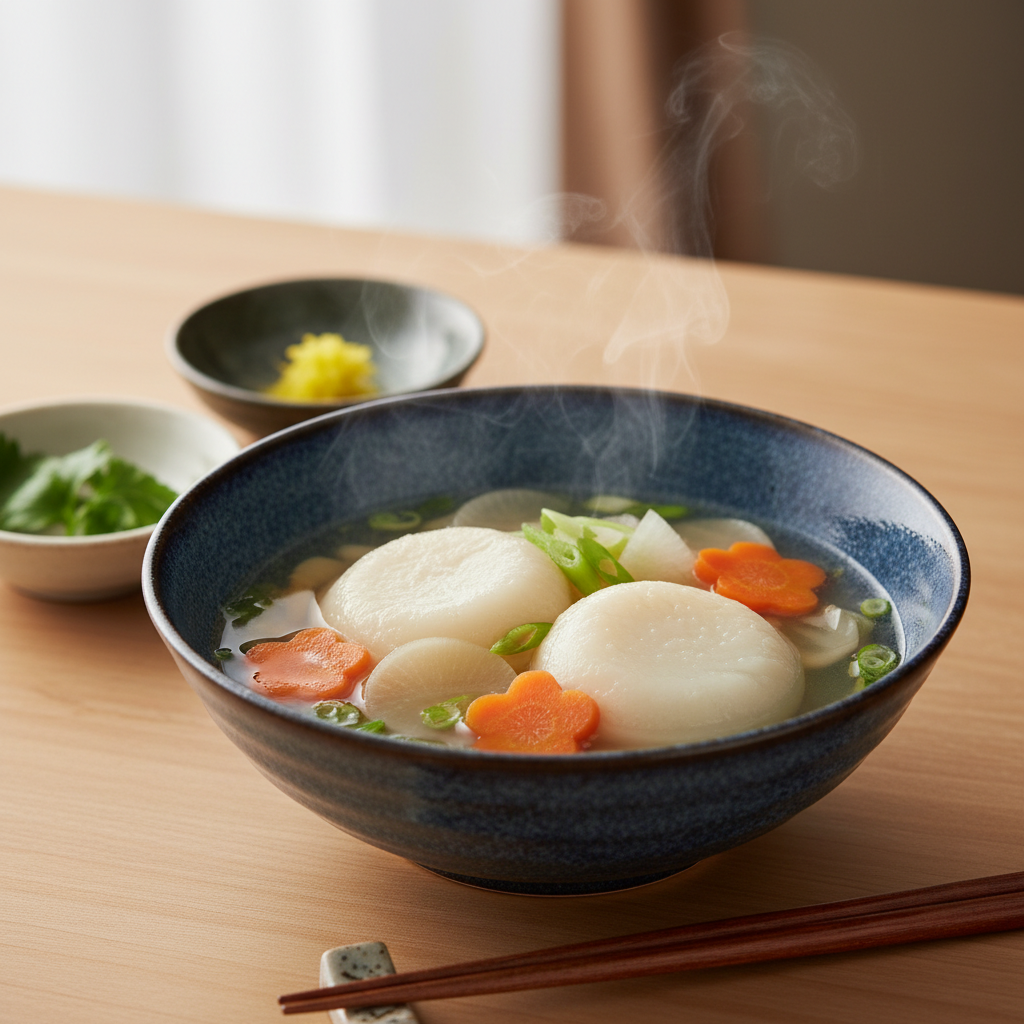
Anmochi zoni is a unique local dish eaten in Kagawa Prefecture during the New Year. It is known as a rare style of zoni nationwide, consisting of a white miso-based broth with sweet red bean paste-filled round mochi. Unlike general zoni, it is characterized by a sweet and salty taste, which often surprises first-time eaters.
Not all households in Kagawa Prefecture eat anmochi zoni, with it being particularly popular in the eastern plains region. It was selected in the Ministry of Agriculture, Forestry and Fisheries’ “Regional Dishes of Japan from Agricultural and Fishing Villages,” and has become nationally recognized as a representative food culture of Kagawa Prefecture.
The gentle sweetness of white miso and the sweetness of red bean paste harmonize perfectly, with the flavor of dashi made from dried small fish tying everything together. Radish sliced into rings, golden carrots, and other vegetables are added, making it a beautiful dish to behold.
History and Origins of Anmochi Zoni
Sanuki Three Whites and Sugar Culture
The emergence of anmochi zoni is deeply connected to Kagawa Prefecture’s specialty products, the “Sanuki Three Whites.” The Sanuki Three Whites refer to three white specialty products: cotton, salt, and sugar.
During the Edo period, in Kagawa Prefecture, which has a warm climate with little rain, sugarcane cultivation was encouraged as part of promoting industry and commerce. White sugar produced in the Sanuki region was highly valued for its white color and smooth taste, becoming a representative specialty product. The abundant production of this sugar nurtured the unique food culture of anmochi zoni.
Luxury in an Era When Sweetness Was Precious
From the Edo through Meiji periods, sugar was an important industry in Kagawa Prefecture, but for common people, sweets remained a luxury item. It was difficult to enjoy sweetness in daily life, and it was during the special season of New Year that the custom of putting sweet red bean paste-filled mochi in zoni emerged.
Anmochi zoni, which embodied the family’s wish to “indulge at least during New Year’s,” was passed down in households as an annual treat. In an era with little sweetness, anmochi zoni eaten at New Year was the finest delicacy imaginable.
Legend Related to Emperor Sutoku
In some regions, legends remain about Emperor Sutoku, who was defeated in the Hogen Rebellion and exiled to Sanuki. There is also a theory that warm zoni with red bean paste-filled mochi was offered during the cold winter months, and there are various theories about the origins of anmochi zoni.
Ingredients and Preparation of Anmochi Zoni
Ingredients (Serves 5)
Mochi
- Red bean paste-filled round mochi: 5 pieces (frozen commercially available anmochi may be used)
Dashi
- Dried small fish (iriko): 30g
- Water: 1000ml
Vegetables
- Radish: 300g (sliced into rings or ginkgo leaf cuts)
- Golden carrot: 1 (sliced into rings or ginkgo leaf cuts)
- Taro: 5 pieces (optional)
- Tofu: 1 block (optional)
Seasonings
- White miso: 100g-120g
- Salt: to taste
Preparation Method
- Preparing the dashi: Soak the dried small fish in water the night before. By leaving it overnight, the umami flavor of the fish is thoroughly extracted. Using Ibuki iriko, processed from Japanese anchovy caught off Ibuki Island in Kagawa Prefecture, will create a more authentic flavor.
- Preparing vegetables: Slice the radish and golden carrot into rings or ginkgo leaf cuts. Ring slices are considered a shape that embodies wishes for family harmony. Peel the taro and parboil it beforehand.
- Taking the dashi: Heat the water in which the dried small fish has been soaked, and remove the fish just before it comes to a boil. If you prefer a stronger dashi, you may leave the fish in and simmer for several minutes.
- Cooking the vegetables: Add the radish, golden carrot, and taro to the dashi and simmer until tender. When the radish becomes translucent, the vegetables are done.
- Dissolving the white miso: Lower the heat and gradually dissolve the white miso. Traditionally, white miso is prepared immediately after the autumn harvest, by mixing steamed soybeans with a large amount of rice koji and minimal salt, then aging for 1-2 months.
- Adding the anmochi: In a separate pot, bring water to a boil and cook the red bean paste-filled round mochi. If using commercially available frozen anmochi, follow the package instructions. Pour the white miso broth and vegetables into a bowl with the cooked anmochi.
- Finishing: Add tofu if desired, sprinkle with aonori (seaweed powder) if you like, and it is complete.
Major Traditional Regions and Differences in How It’s Eaten
Regional Differences Within Kagawa Prefecture
Anmochi zoni is not eaten in all of Kagawa Prefecture. It is particularly popular in the eastern plains (around Takamatsu City, Sanuki City, and Higashikagawa City), while many households in the western and mountainous regions do not eat it.
The ratio of Kagawa Prefecture residents who eat anmochi zoni to those who don’t is said to be about fifty-fifty, making it a dish where preferences differ. While some households consider “mochi with red bean paste heretical,” others believe “New Year’s doesn’t start without anmochi zoni.”
Similar Dishes in Other Prefectures
In fact, anmochi zoni is not unique to Kagawa Prefecture. Similar anmochi zoni is eaten along the coast of Kumamoto Prefecture. However, the Kumamoto version may differ somewhat in seasoning and ingredients from the Kagawa version.
Occasions and Seasons for Eating
Anmochi zoni is primarily eaten during the first three days of the New Year. It typically appears on the breakfast table on New Year’s Day or alongside osechi (New Year’s food). Some households continue eating it throughout the New Year period even after the first three days.
In recent years, it is also served outside the New Year period as a local dish in restaurants and in school lunch programs as an opportunity to learn about regional food culture.
Dining Method and Taste Characteristics
The greatest characteristic of anmochi zoni is its sweet and salty flavor. The gentle sweetness and saltiness of white miso, the umami of dried small fish, and the sweetness of red bean paste blend in the mouth to create a unique harmony.
First-time eaters are often surprised by the combination of red bean paste and miso, but many say they become addicted after eating it several times. The sweetness of the red bean paste is brought out by the saltiness of the white miso, creating a surprisingly well-balanced flavor.
The typical way to eat it is to first taste the broth, then break the anmochi with chopsticks and gradually dissolve the red bean paste into the broth while eating. As the red bean paste dissolves into the broth, the sweetness increases.
Vegetables such as radish and golden carrot absorb the sweet and salty broth well and serve to freshen the palate.
Preservation and Succession Efforts
Use in School Lunch Programs
In school lunch programs throughout Kagawa Prefecture, anmochi zoni is sometimes served as an opportunity to learn about local food culture. It particularly appears in lunches after New Year or as a special menu for learning about local dishes.
In school lunches, frozen white dumplings with red bean paste are used, with abundant Ibuki iriko creating a concentrated dashi, to which sliced or ginkgo-cut radish and golden carrot are added. For children, this becomes a valuable opportunity to learn that their region has a unique food culture.
Commercialization and Modern Initiatives
In recent years, to make anmochi zoni easier to enjoy, products have been sold that package frozen anmochi together with dashi-flavored white miso. People originally from Kagawa Prefecture who live outside the prefecture or tourists visiting Kagawa can purchase these through online shopping to recreate the dish at home.
Additionally, efforts to promote anmochi zoni through social media have become increasingly active. Particularly during the New Year season, many posts are seen with the hashtag “#anmochizoni,” contributing to increased national awareness.
Use as a Tourism Resource
For tourists visiting Kagawa Prefecture, anmochi zoni has become a notable local dish second only to udon. Some restaurants incorporate it into their menus year-round, offering it as a dining experience unique to Kagawa Prefecture.
Roadside stations and tourism facilities sometimes hold panel exhibitions and tasting events featuring anmochi zoni, playing an important role in conveying regional food culture.
Main Food Ingredients Used in Anmochi Zoni
Red Bean Paste-Filled Round Mochi
The star of anmochi zoni is round mochi filled with red bean paste. Rather than ordinary white mochi, a special mochi with koshian (smooth red bean paste) or tsubuain (chunky red bean paste) inside is used. Using commercially available frozen anmochi is common, though some households make it by hand before New Year.
The mochi skin is made relatively thin, ideally allowing the red bean paste inside to be somewhat visible. When boiled, the mochi becomes soft and the sweetness of the red bean paste dissolves into the broth.
White Miso
Kagawa Prefecture’s traditional white miso uses a large amount of rice koji, minimal salt, and is aged for a short period. It is characterized by strong sweetness and white color, and is an important element supporting the gentle flavor of anmochi zoni.
Some households use an even sweeter variety of white miso than typical, and each home creates its own unique flavor by adjusting the miso proportions and aging period.
Dried Small Fish (Iriko)
Ibuki iriko, processed from Japanese anchovy caught off Ibuki Island in Kagawa Prefecture, is a representative dashi ingredient of Kagawa Prefecture. It is characterized by rich umami flavor and is essential for the dashi in anmochi zoni.
Compared to ordinary dried small fish, Ibuki iriko is larger, has good fat content, and has minimal bitterness. By soaking it in water the night before, a clear, refined dashi can be obtained.
Radish and Golden Carrot
Radish sliced into rings is used as a good omen embodying wishes for family harmony. Golden carrot is characterized by its vibrant red color, adding color to the zoni.
Both are vegetables cultivated in Kagawa Prefecture, and their sweetness increases during the winter months, making them ideal for New Year’s zoni. By slicing them into rings or ginkgo leaf cuts, they absorb the dashi well and become tender.
Controversy Surrounding Anmochi Zoni
Anmochi zoni is a dish where preferences are sharply divided even within Kagawa Prefecture. While some say “the combination of sweet red bean paste and miso doesn’t work,” others say “this is the true taste of New Year’s in Kagawa.”
Particularly, people who have moved to Kagawa Prefecture from other prefectures or who have entered Kagawa households through marriage often recount their shock upon first encountering anmochi zoni. However, many people begin to like it after eating it several times.
Among Kagawa Prefecture natives, voices are heard saying “I disliked it as a child but understood its deliciousness as an adult” and “I missed it after moving away from the prefecture.”
Including such differing opinions, anmochi zoni can be said to be a dish that symbolizes the diversity and individuality of Kagawa Prefecture’s food culture.
Conclusion
Anmochi zoni is a local dish in which Kagawa Prefecture’s history and culture are concentrated. Born from an idea unique to a region producing sugar, one of the Sanuki Three Whites, it has been passed down as a luxurious dish to be savored with family during the special season of New Year.
Its unique style of white miso-based broth with sweet red bean paste-filled mochi is rare nationwide and strongly expresses the individuality of Kagawa Prefecture’s food culture. The harmony of the umami of dried small fish, the gentle sweetness of white miso, the sweetness of red bean paste, and the texture of vegetables creates a flavor that leaves an unforgettable impression once tasted.
In modern times, various preservation and succession efforts are being carried out through school lunches, commercialization, and promotion via social media, ensuring it is passed on to future generations. When visiting Kagawa Prefecture, be sure to try this unique local dish. Restaurants serving it outside the New Year period and products available through online shopping also allow you to experience Kagawa Prefecture’s food culture at home.
Anmochi zoni is the crystallization of food culture born from a region’s climate, history, and industry, and is a source of pride for Kagawa Prefecture residents. Through its uniquely sweet and salty flavor, why not contemplate the history and lives of the people of Sanuki?