
Sanuki Udon: A Comprehensive Explanation of the Charm and History of Kagawa Prefecture’s Local Specialty Cuisine
Sanuki udon is widely known nationwide as a local specialty dish representative of Kagawa Prefecture. This udon, characterized by its strong chewiness and smooth texture, was selected for the Ministry of Agriculture, Forestry and Fisheries-designated “100 Selected Local Dishes of Rural Villages,” and is deeply rooted in Kagawa Prefecture residents’ food culture. This article comprehensively conveys the charm of Sanuki udon, from its history and preparation methods to its diverse ways of eating.
What is Sanuki Udon?
Sanuki udon is a general term for udon noodles made in Kagawa Prefecture. Its greatest characteristic lies in its strong chewiness and smooth texture. Made from simple ingredients—wheat flour, salt, and water—the texture created through its unique manufacturing method sets it apart from udon in other regions.
Kagawa Prefecture is known as “Udon Prefecture” to the extent that udon culture has permeated the region, with reportedly 800 to over 1,000 udon restaurants within the prefecture. The per capita udon consumption among Kagawa residents is the highest in Japan, making it truly an indispensable food in the lives of Kagawa residents.
The Deep Connection Between Kagawa Prefecture and Sanuki Udon
Kagawa Prefecture’s Geographic Characteristics
Kagawa Prefecture faces the Seto Inland Sea and has a warm climate, belonging to the Seto Inland Sea maritime climate with low precipitation. This climatic characteristic had a major impact on the development of Sanuki udon culture. Due to low rainfall and frequent droughts, the land was unsuitable for rice cultivation, which requires large amounts of water.
Consequently, Kagawa Prefecture has historically had many tenant farms, and instead of rice production, the cultivation of drought-resistant wheat was actively practiced. This wheat-growing tradition became the foundation of Sanuki udon culture.
An Environment Suitable for Udon Making
Kagawa Prefecture’s development as an udon production area was not solely due to wheat cultivation. The region was blessed with an environment where all materials necessary for udon making could be obtained locally.
High-quality Japanese anchovy (niboshi/iriko) was abundantly caught in the Seto Inland Sea, serving as the basis for broth. Additionally, salt production has been established in Kagawa Prefecture since ancient times, making salt—essential for udon dough preparation—readily available. Furthermore, the remote island of Shodoshima has been known since the Edo period as a major soy sauce production center, allowing soy sauce used in the broth to be procured locally as well.
Thus, all materials necessary for Sanuki udon—wheat, salt, niboshi, and soy sauce—could be obtained within the prefecture, making it precisely “a place suited for udon making,” which nurtured the Sanuki udon culture.
History, Origins, and Related Events
The Origins of Sanuki Udon
There are several theories about the origins of Sanuki udon, but the most famous legend involves Kobo Daishi Kukai. During the Nara to early Heian periods, when Kukai traveled to China (Tang Dynasty), he is said to have learned the prototype of udon and brought it back to Japan.
According to a legend remaining in Takimiya, Ayagawa Town, Kagawa Prefecture, around the early 9th century, Chisen (智泉), a disciple who was taught the method of making “hakutaku”—a prototype of udon—by Kukai, is said to have served it to his parents in Takimiya, marking the beginning of Sanuki udon. Due to this legend, Takimiya in Ayagawa Town is known as one of the birthplaces of Sanuki udon.
Development Since the Edo Period
From the Edo period onward, wheat cultivation in the Sanuki region flourished even more, and udon became established as everyday food for common people. Among farming households, a custom developed of making udon during breaks in farm work and at celebrations and memorial services, passing it down as home cooking.
From the Meiji period onward, with improvements in milling technology and advances in distribution, the number of udon restaurants increased. From the Showa period onward, udon restaurants opened throughout Kagawa Prefecture, with unique flavors and styles developing by region.
The Modern Sanuki Udon Boom
From the late 1980s through the 1990s, Sanuki udon became a nationwide boom. Self-service style “self-service udon restaurants” and restaurants directly operated by noodle manufacturers attracted attention, showcasing Kagawa Prefecture’s unique udon restaurant styles.
In 2011, when Kagawa Prefecture declared itself “Udon Prefecture” and focused on tourism promotion, Sanuki udon became widely known nationwide as synonymous with Kagawa Prefecture. Currently, many tourists visit Kagawa Prefecture to enjoy Sanuki udon, giving rise to a phenomenon called “udon tourism.”
Major Traditional Regions
Sanuki udon is made and consumed throughout Kagawa Prefecture, but certain regions retain particularly strong traditions.
Takamatsu City and Surrounding Areas
Takamatsu City, the prefectural capital, and its surrounding areas are known as densely packed udon restaurant zones. Numerous udon restaurants line the streets from the city center to suburban areas, each offering their own unique flavors and styles.
Marugame City and Zentsuji City
Located in the center of the Sanuki Plain, this region is a place where udon culture has flourished since ancient times. Marugame City in particular is also known as “Marugame Udon,” with many renowned establishments.
Takimiya, Ayagawa Town
As mentioned previously, this region retains legends of being one of the birthplaces of Sanuki udon, and efforts to cherish udon culture continue today.
Kotohira Town
Having prospered as a gate town for Konpira Shrine, Kotohira Town also has a history of providing udon to pilgrims, and a unique udon culture has developed there.
Main Ingredients Used
Noodle Materials
Wheat Flour: Sanuki udon noodles are primarily made with medium-strength flour. An increasing number of restaurants use locally produced wheat such as “Sanuki no Yume” from Kagawa Prefecture. High-quality wheat flour produces the distinctive chewiness and flavor characteristic of Sanuki udon.
Salt: Salt from the Seto Inland Sea has traditionally been used. Salt plays an important role in promoting gluten formation in the dough and strengthening the chewiness.
Water: Water in Kagawa Prefecture is mostly soft to medium-hard water, suitable for udon making. Water quality significantly impacts the finished quality of the noodles.
Broth Materials
Niboshi (Dried Anchovy): Dried Japanese anchovy (Katakuchiwashi) caught in the Seto Inland Sea forms the basis of Sanuki udon broth. High-quality niboshi broth is the key to the flavor of Sanuki udon.
Kelp: Used alongside niboshi, it adds depth and umami to the broth.
Soy Sauce: Soy sauce from Shodoshima has traditionally been used. Light-colored soy sauce is predominantly used in Sanuki udon broth.
Condiments and Toppings
Green Onion: Sliced green onion is an indispensable condiment for Sanuki udon.
Ginger: Grated or minced ginger is used.
Grated Radish: Added to bukkake udon and similar dishes.
Tenkasu (Fried Flour Bits): Provided free at many restaurants and a standard topping for Sanuki udon.
Fried Tofu: Used in kitsune udon and shippoku udon.
Seasonal Vegetables: Radish, carrot, taro, Chinese cabbage, and other seasonal vegetables are used depending on the season.
Preparation Methods
Basic Method for Hand-Made Udon
Creating the strong chewiness characteristic of Sanuki udon requires careful preparation.
Ingredients (Serves 5)
- Medium-strength flour: 500g
- Salt: 25g (increase in summer, decrease in winter as needed)
- Water: Approximately 225ml (adjust according to temperature and humidity)
- Dusting flour: As needed
Steps
- Make Salt Water: Dissolve salt in water, stirring well until completely dissolved.
- Knead the Dough: Place wheat flour in a large bowl, gradually add salt water while mixing by hand. Mix until the whole mixture becomes granular, then gather into a single mass.
- Foot Treading: Place the dough in a vinyl bag and stretch it by stepping on it with your feet. Repeating this process forms gluten and creates chewiness. In traditional Sanuki udon manufacturing, this foot-treading step is crucial.
- Let Rest: Form the dough into a ball, place it in a vinyl bag, and let it rest at room temperature for 1 to 2 hours. In winter, it may rest for 2 to 3 hours.
- Tread Again: Tread on the rested dough with your feet once more to further strengthen the chewiness.
- Stretch: On a board dusted with flour, use a rolling pin to stretch the dough to approximately 3 to 4mm thickness.
- Cut: Fold the stretched dough and cut it with a knife into uniform thickness (approximately 3mm).
- Boil: Cook in plenty of boiling water for 12 to 15 minutes. Once cooked, rinse in cold water to remove any sliminess.
How to Make Broth
- Prepare Niboshi: Remove the head and internal organs from the niboshi (to suppress bitterness).
- Water Infusion: Soak niboshi and kelp in water overnight.
- Heat: Gently heat over low heat, removing the kelp just before it comes to a boil. Then simmer for about 10 minutes while skimming off any scum.
- Season: Adjust taste with soy sauce, mirin, and salt.
Ways of Eating: Diverse Variations in How to Enjoy
One of the great charms of Sanuki udon is the variety of ways it can be enjoyed. It can be savored in many different styles depending on the season and mood.
Kake Udon
The simplest and most basic way to eat it. Boiled udon is topped with hot broth and garnished with condiments such as green onion and ginger. This method allows you to most directly experience the chewiness of Sanuki udon and the flavor of the broth.
Bukkake Udon
Cold udon topped with thick, cold broth. Often garnished with grated radish, lemon, or sudachi citrus. Particularly popular in summer. A warm version also exists.
Kamaage Udon
Boiled udon is served hot without being rinsed in water, placed in a bowl, and dipped in a dipping sauce. This offers a chewy texture and allows you to savor the original wheat flavor of the udon.
Kamatama Udon
A raw egg is dropped on kamaage udon, then soy sauce or broth is added and mixed together. The creaminess of the egg perfectly complements the chewiness of the udon.
Shippoku Udon
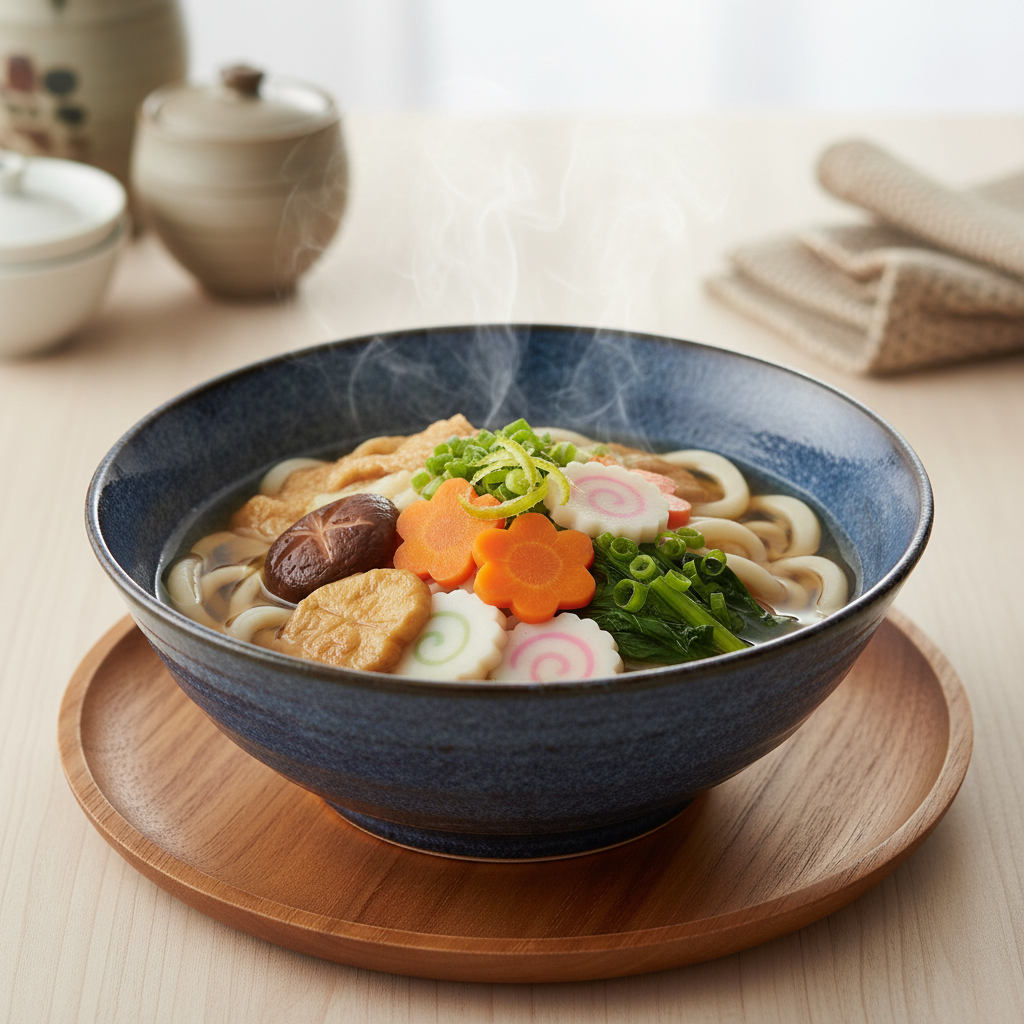
A representative winter local specialty dish of Kagawa Prefecture. Seasonal vegetables such as radish, carrot, taro, and Chinese cabbage along with fried tofu are simmered in niboshi broth and poured over boiled udon along with the ingredients. The sweetness and umami of the vegetables combined with the flavor of fried tofu make this a warming winter dish. Loved by local people as a representative winter dish that makes use of seasonal local vegetables while exemplifying the strong chewiness and smooth texture characteristic of Sanuki udon.
Uchikomi Udon
Raw udon is simmered in a pot with vegetables and other ingredients. The wheat flavor from the udon dissolves into the broth, resulting in a thickened finish. Cherished as winter home cooking.
Yudame Udon
Boiled udon is once rinsed in cold water, then passed through hot water again to warm it, and topped with hot broth. This allows you to maintain the chewiness while enjoying it warm.
Kitsune Udon
Udon topped with fried tofu simmered in sweet-savory broth. The juicy flavor of the fried tofu melts into the broth, creating a satisfying dish.
Toshikoshi Udon / New Year’s Udon
As a relatively new food culture, “New Year’s Udon”—white udon topped with red ingredients such as pickled plum, shrimp tempura, and golden sweet potato—is eaten on New Year’s Day as a lucky food to wish for happiness in the coming year. It is gradually becoming established.
Occasions and Seasons for Eating
As Everyday Food
In Kagawa Prefecture, Sanuki udon is not a special dish but something eaten regularly. It is eaten for breakfast, lunch, and dinner alike, making “going out for udon” a common choice for everyday dining out.
Seasonal Enjoyment
Spring: Udon made with new onions and spring vegetables can be enjoyed.
Summer: Cold bukkake udon and light udon dishes topped with sudachi citrus are popular.
Autumn: Udon featuring mushrooms and autumn vegetables appear.
Winter: Warm, hearty simmered udon such as shippoku udon and uchikomi udon are preferred.
As Festival Food
New Year: Some households eat “Year-End Udon” instead of year-end soba. The custom of eating New Year’s Udon on New Year’s Day is also spreading.
Memorial and Celebratory Services: In some regions, the custom of serving udon at weddings, funerals, and other important occasions remains.
During Farm Work: In the past, there was a custom of making and eating udon during breaks in farm work or upon completion.
Efforts for Preservation and Transmission
Training Successors
Efforts are being made throughout Kagawa Prefecture to pass on Sanuki udon manufacturing methods to the next generation. Through udon schools and training programs at noodle factories, the transmission of traditional hand-making techniques is being promoted.
Initiatives in School Education
Elementary and junior high schools throughout the prefecture conduct udon-making experiences as part of local learning. Classes are designed so children can learn about their region’s food culture and develop pride in it.
Administrative Support
Kagawa Prefecture, as “Udon Prefecture,” is putting effort into tourism promotion utilizing Sanuki udon. Multilayered support is provided through official information dissemination, creation of udon restaurant maps, and event hosting.
Activities of Industry Organizations
Industry organizations such as the Kagawa Prefecture Noodle Manufacturing Business Cooperative are working to maintain and develop tradition through establishing quality standards, protecting the Sanuki udon brand, and holding technical seminars.
Utilization of SNS and Digital Media
In recent years, udon restaurant owners and enthusiasts are promoting the appeal of Sanuki udon through SNS. Photos, videos, and restaurant information are shared on Instagram, Twitter, YouTube, and other platforms, contributing to outreach to younger generations and increasing international recognition.
Product Development and New Initiatives
Sanuki udon is distributed nationwide as dried noodles and semi-fresh noodles, making it easy to enjoy at home. With advances in freezing technology, frozen Sanuki udon that recreates authentic local flavors has also become popular.
Furthermore, development of new menu items featuring Sanuki udon is progressing, with innovative attempts such as curry udon and pasta-style udon being made while maintaining tradition.
Utilization as a Tourism Resource
Tourism services supporting udon restaurant tours, such as “udon taxi” and “udon bus,” have emerged. Additionally, facilities offering udon-making experiences are increasing, expanding opportunities for tourists to experience Sanuki udon culture.
International Expansion
Sanuki udon is drawing attention overseas, with Sanuki udon specialist restaurants opening primarily in Asia. International recognition of it as representative of Japanese food culture is also growing.
Nutrition and Health Aspects of Sanuki Udon
Since Sanuki udon’s main ingredient is wheat flour, it is primarily a carbohydrate-based food. It excels as an energy source and is easily digested and absorbed, making it suitable for breakfast and lunch.
However, udon alone tends to create nutritional imbalance. Nutritional balance can be improved by eating udon in ways that use many vegetables, such as shippoku udon, or by adding protein such as eggs or tempura.
Regarding salt content, it is contained in the broth and dipping sauce, so consuming all the broth increases intake. When conscious of health, it is recommended to leave some broth.
Etiquette and Tips for Enjoying Sanuki Udon
How to Order
Kagawa Prefecture udon restaurants have unique styles in addition to standard restaurant formats, including self-service style and noodle factory style. When visiting for the first time, confirm the restaurant’s system before ordering.
At self-service restaurants, the typical flow is to first order noodles, pour the broth yourself, select side menu items such as tempura, and finally pay at the register.
Tips for Eating
Sanuki udon is said to taste best when freshly cooked. It is recommended to start eating immediately after it is served.
To fully enjoy the chewiness, it is important to chew thoroughly. Also, to simultaneously enjoy the broth’s flavor and the udon’s taste, add condiments in small amounts at a time.
Local Rules
Udon restaurants in Kagawa Prefecture have fast turnover, and popular shops often have lines. After finishing, it is good etiquette to leave your seat promptly. Also, at self-service restaurants, follow established rules such as returning dishes.
Conclusion
Sanuki udon is a representative local specialty of Japan, nurtured by Kagawa Prefecture’s climate, geography, history, and culture. With its strong chewiness and smooth texture born from simple ingredients, diverse ways of eating, and deep roots in the daily lives of local people, it continues to evolve even now.
When visiting Kagawa Prefecture, be sure to taste authentic Sanuki udon and experience its profound charm. Additionally, by attempting to make hand-pulled udon at home, you can develop a deeper understanding and greater enjoyment of this traditional local specialty.
Sanuki udon is not merely food, but Kagawa Prefecture’s source of pride and a mirror reflecting the lives and culture of its people. May this wonderful food culture continue to be carefully passed down and loved by many people.