Mimi (Yamanashi Prefecture Local Cuisine) Complete Guide | Traditions and Cooking Methods of Jukoku, Fujikawa Town
While “houtou” is the nationally famous local cuisine of Yamanashi Prefecture, the Jukoku (十谷) region of Fujikawa Town has long preserved a unique local dish called “mimi.” This dish, made by kneading wheat flour and shaping the dough to resemble a “mi” (箕), a traditional winnowing basket, and simmered with seasonal vegetables in miso broth, is a special creation deeply connected to the region’s history and beliefs.
This article provides a comprehensive explanation of this precious local cuisine, from its historical background to specific cooking methods, and efforts for preservation and transmission in modern times.
What is Mimi? | Traditional Cuisine of Jukoku, Fujikawa Town, Yamanashi Prefecture
“Mimi” is a local dish passed down through generations in the Jukoku district of Fujikawa Town, Minami-Koma County, Yamanashi Prefecture. Wheat flour is kneaded and rolled thin, cut into bite-sized squares, and two adjacent corners on one side of each square are pinched together and attached at the center, creating a three-dimensional triangular shape. This unique shape is said to resemble a “mi” (箕), a winnowing tool used in farm work, which is how it came to be called “mimi.”
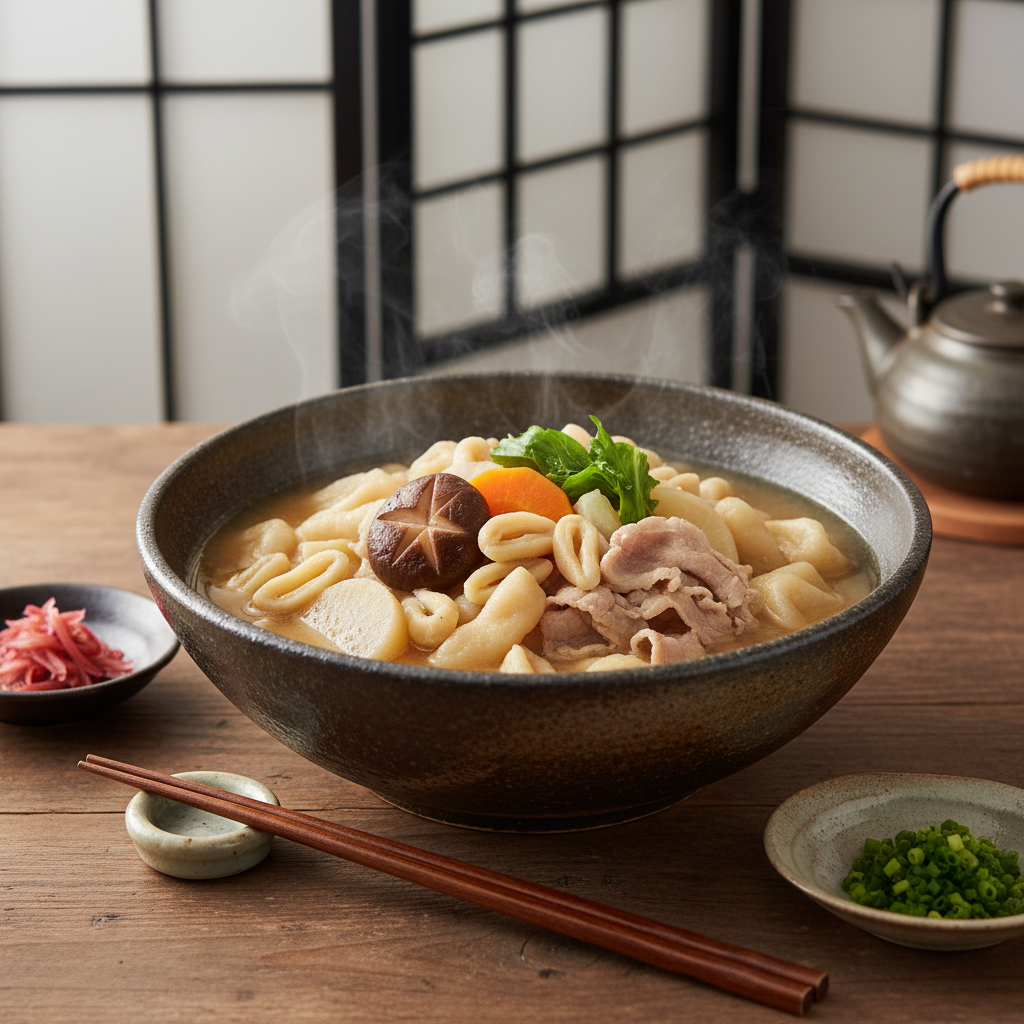
The completed “mimi” is simmered in a miso-based broth made with dashi from dried small fish, along with root vegetables such as burdock, taro, pumpkin, carrot, and radish. While similar to houtou, mimi differs significantly in the shape of the dough, the cooking method, and the unique cultural background rooted in the region.
Main Areas of Transmission
Mimi is transmitted primarily in the Jukoku district of Fujikawa Town, Minami-Koma County, Yamanashi Prefecture, within a limited geographical area. Jukoku is a mountain village located in the upper reaches of the Fuji River, where unique culture and traditions have been cultivated since ancient times. As a dish unique to this region, it has been prepared on special occasions such as New Year’s and festivals, serving to deepen community bonds.
Fujikawa Town was established in 2010 through the merger of Kamoizawa Town and Masho Town, and the Jukoku district belonged to the former Kamoizawa Town, making it an important area that preserves the local food culture of the Kyonan region.
Main Ingredients Used
The basic ingredients for mimi are as follows:
Dough Ingredients:
- Wheat flour (medium or cake flour)
- Water
- Salt (small amount)
Vegetables (Serves 4-5):
- Burdock: 1 stalk
- Radish: 1/3
- Carrot: 1
- Taro: 5-6 pieces
- Pumpkin: 1/8
- Dried small fish: approximately 20g
- Miso: 3-4 tablespoons
- Water: as needed
The vegetables used vary by season, with root vegetables harvested in local gardens forming the core. Burdock in particular is considered an essential ingredient, its aroma and texture deepening the flavor of mimi.
History and Origins of Mimi | A Dish Born from a Promise to a Deity
An interesting legend is passed down about mimi. Long ago, when the Jukoku district was in a boundary dispute with a neighboring village, it is said that villagers promised to “dedicate a blessed winnowing basket (fukumi) to the deity if we are victorious.” After winning the dispute, the villagers kept their promise, and from then on, it became customary to offer “mimi,” shaped after a winnowing basket, to the household shrine on New Year’s morning and eat it as a family.
The “mi” (箕) is a farm tool used to sort grains or remove trash, and has long been treasured as an auspicious tool for scooping up good fortune. By making food shaped after this “blessed winnowing basket,” prayers for family prosperity and abundant harvests are embodied.
Origin of the Name
There are multiple theories about the origin of the name “mimi.”
- Farm Tool “Mi” Theory: The most credible theory holds that “mi” transformed into “mimi” because the shape of the dough resembles the farm tool called a winnowing basket.
- Ear Shape Theory: Another theory suggests it was called “mimi” because the completed dough shape resembles a human ear.
- Dialect Theory: There is also a theory that the region’s dialect used “mimi” to refer to a winnowing basket.
All theories are passed down in the region, and it is likely that multiple origins have overlapped to establish the current name.
How to Make Mimi | Detailed Recipe and Cooking Instructions
Here we introduce a detailed recipe for mimi that can be made at home. The recipe is based on serving 4-5 people.
Ingredients (Serves 4-5)
Dough:
- Wheat flour: 300g
- Water: approximately 150ml (adjust according to dough consistency)
- Salt: 1/2 teaspoon
Vegetables:
- Burdock: 1 stalk (approximately 150g)
- Radish: 300g
- Carrot: 1 (approximately 150g)
- Taro: 5-6 pieces (approximately 300g)
- Pumpkin: 200g
- Dried small fish: 20g
- Water: 1.5 liters
- Miso: 3-4 tablespoons (adjust to taste)
- Soy sauce: 1 teaspoon (as subtle flavoring, optional)
Cooking Method
1. Preparing the Dough
Mix salt into the wheat flour and gradually add water while kneading thoroughly. Knead well for about 10 minutes until the dough reaches the texture of an earlobe, then wrap in plastic wrap and rest for at least 30 minutes. Resting the dough allows gluten to settle and makes it easier to stretch.
2. Shaping the Dough
Place the rested dough on a floured surface and use a rolling pin to stretch it to approximately 2-3mm thick. Cut the stretched dough into squares of 3-5cm on each side. Pinch the two adjacent corners on one side of each square together at the center, creating a basket-like shape (resembling a triangular pyramid). This shaping process is the defining characteristic of “mimi.”
3. Preparing the Dashi
Pour 1.5 liters of water into a pot, add dried small fish with the head and entrails removed, and let soak for approximately 30 minutes before placing over heat. Once boiling, simmer over low heat for about 10 minutes to extract the flavor, then remove the fish. A clear, well-flavored dashi infused with the aroma of dried fish is complete.
4. Preparing the Vegetables
Slice burdock thinly using a julienne peeler or diagonal cuts, then soak in water to remove bitterness. Cut radish and carrot into ginkgo leaf shapes, peel taro and cut into bite-sized pieces, and remove seeds from pumpkin and cut into bite-sized pieces.
5. Simmering
Add vegetables to the dashi broth in order from those requiring longer cooking. First add burdock and taro and simmer for about 5 minutes, then add radish, carrot, and pumpkin and continue simmering for approximately 10 minutes. Once the vegetables are tender, gently add the shaped “mimi” pieces one at a time.
6. Seasoning
Once the mimi floats to the surface (after approximately 5-7 minutes), dissolve miso into the broth. Add the miso gradually, tasting as you go, rather than all at once. Add soy sauce as a subtle flavoring to taste for added depth. Bring to a boil once and it is complete.
Cooking Tips
- Dough Consistency: If too soft, the dough is difficult to shape; if too hard, the texture becomes poor. Aim for the texture of an earlobe.
- Shaping Technique: When pinching the corners together, press firmly so they don’t separate during simmering.
- Simmering Time: If the mimi simmers too long after being added, it will dissolve. Proceed to seasoning once it floats to the surface.
- Vegetable Selection: Using seasonal vegetables is traditional. Incorporate seasonal ingredients: wild greens in spring, eggplant in summer, and root vegetables in autumn and winter.
Occasions and Seasons for Eating | Special Cuisine for Festive Days
Mimi is not eaten on a daily basis but is positioned as a “hare no hi” (festive day) dish eaten on special occasions.
Main Occasions for Eating
New Year’s (Morning of January 1st)
This is the most important occasion for eating mimi. On the morning of New Year’s Day, mimi is offered to the household shrine before the family eats it, with prayers for blessings throughout the year. Some households add especially auspicious ingredients to their New Year’s mimi.
Festivals and Memorial Services
Mimi is made in large quantities when relatives and neighbors gather for local festivals or memorial services. Served as a communal hot pot dish, it has played a role in deepening community bonds.
Life Milestones
Mimi may be served at weddings, funerals, and other significant life events.
Seasonal Variations
While typically eaten in winter, mimi can be enjoyed year-round by varying the vegetables used. Winter features root vegetables primarily, spring includes wild vegetables and bamboo shoots, and summer vegetables are added in the warmer months, reflecting attention to seasonal awareness.
How to Eat and Enjoy Mimi
Mimi is traditionally made in a large pot and shared among family members or those gathered, with each person serving themselves.
How to Eat
Served piping hot in a bowl, it is eaten with the broth. The chewy texture of mimi and the umami of vegetables dissolving into the miso-based broth blend together perfectly. The clear flavor from the dried fish dashi is characteristic, creating a lighter impression than houtou.
Modern Arrangements
Beyond the traditional miso flavor, the following arrangements are enjoyed:
- Soy Sauce Base: Substitute soy sauce for miso for a lighter finish
- With Pork: Add pork for more volume
- Adding Mushrooms: Enhance umami by adding shiitake or shimeji mushrooms
- With Chili: Serve with shichimi togarashi or ichimi togarashi for a spicy kick
Preservation and Succession Efforts | Passing to the Next Generation
As a regionally limited local cuisine, mimi faces challenges in transmission due to depopulation and aging populations. However, various preservation and succession activities are being undertaken by community residents, local government, and private organizations.
Fujikawa Town’s Initiatives
Fujikawa Town actively promotes mimi as a local cuisine and leverages it as a tourism resource. The town’s official website and tourism brochures feature mimi, working to introduce it to visitors from outside the town.
Experience Classes
Facilities such as “Tsukutabe-kan” regularly hold mimi-making experience classes (by reservation). Participants learn the cooking method directly from local experts and can actually prepare and eat the dish. Through such experiences, not only cooking techniques but also the history and culture behind the dish are transmitted.
Use in School Education
Some local elementary and middle schools have incorporated mimi-making into their comprehensive learning curricula or food education programs. By exposing children to regional traditional foods, it is hoped that attachment to and pride in their hometown will be cultivated.
Activities of Tradition Bearers
Groups of tradition bearers, primarily senior residents of the Jukoku district, are engaged in recording recipes and instructing cooking techniques. The dough shaping technique in particular is difficult to convey through words alone, making direct instruction through demonstration especially important.
Media Coverage
Public institution recording and dissemination is progressing, such as registration in the Ministry of Agriculture, Forestry and Fisheries’ “Our Regional Cuisine” database. Additionally, efforts to introduce mimi through regional social media and blogs are expanding, contributing to increased awareness among younger generations.
Commercial Development
Some efforts are being considered to commercialize mimi as frozen food or semi-prepared products. However, rather than large-scale commercialization, direct sales at small scales and sales through farmers’ markets are prioritized to preserve the warmth of homemade cooking and regional character.
Differences Between Mimi and Houtou
As both are local dishes of Yamanashi Prefecture, mimi is often compared with houtou. While they share commonalities, clear differences also exist.
Similarities
- Use wheat flour-based dough
- Cooked with vegetables
- Often seasoned with miso
- Local cuisines of Yamanashi Prefecture
Differences
Dough Shape
- Houtou: Flat, wide noodle-like form
- Mimi: Three-dimensional basket shape made from squares
Regionality
- Houtou: Widely eaten throughout Yamanashi Prefecture
- Mimi: Limited to the Jukoku district of Fujikawa Town and surrounding areas
Cultural Background
- Houtou: Eaten as everyday food
- Mimi: Special festive day dish with strong connections to religious practices
Dashi Preparation
- Houtou: Often made without preparing dashi
- Mimi: Traditionally prepared with thoroughly extracted dried fish dashi
Fame
- Houtou: Nationally famous
- Mimi: Limited regional recognition with low nationwide fame
Places to Experience Mimi
For those wishing to taste mimi, here are some places where it can be enjoyed.
Tsukutabe-kan (Fujikawa Town)
A facility where regional cuisine can be enjoyed, serving mimi. Mimi-making experience classes are also held by advance reservation, allowing visitors to actually prepare and eat the dish. Local residents serve as instructors, teaching the cooking method carefully.
Regional Events
Mimi may be served at food events and festivals held in Fujikawa Town and surrounding areas. Particularly at autumn harvest festivals and regional cuisine fairs, it is commonly featured as a traditional local dish.
Inns and Farm Stays
Inns and farm stays around the Jukoku district may serve mimi to lodging guests. It is advisable to inquire in advance.
Nutritional Value and Health Benefits of Mimi
Mimi is a nutritionally well-balanced dish.
Main Nutrients
Carbohydrates: Wheat flour provides adequate energy sources.
Dietary Fiber: Root vegetables such as burdock, radish, and taro provide abundant dietary fiber, supporting intestinal health.
Vitamins and Minerals: Multiple vegetable varieties provide balanced intake of vitamins A and C, potassium, calcium, and other nutrients.
Protein: Good quality protein and calcium dissolve from the dried fish dashi.
Health Benefits
- Easy to Digest: With vegetables simmered until soft, the dish is easy to digest and gentle on the stomach and intestines.
- Warms the Body: As a hot soup, it warms the body thoroughly from the core.
- Salt Reduction: The umami from dried fish dashi and vegetables creates satisfying flavor with reduced salt.
- Vegetable Intake: Multiple varieties of vegetables can be consumed at once, creating balanced nutrition.
Conclusion | Mimi is a Hidden Treasure of Yamanashi
“Mimi,” a local dish transmitted in the Jukoku region of Fujikawa Town, Yamanashi Prefecture, is a unique creation featuring dough shaped to resemble a winnowing basket, simmered with seasonal vegetables in miso broth. With a legend of its origin in a promise to a deity, it has been carefully passed down through generations as a special dish eaten on festive occasions such as New Year’s and festivals, deepening community bonds.
While not as nationally famous as houtou, mimi maintains its value as an authentic local cuisine rooted in the region. Despite facing challenges from depopulation and aging populations, various preservation and succession activities are being undertaken, including experience classes, school education integration, and media coverage.
Mimi is not merely a dish but a cultural heritage embodying the region’s history, beliefs, and community bonds. When visiting Yamanashi Prefecture, be sure to taste this hidden local cuisine and touch the rich story behind it. Additionally, as the dish is relatively easy to make at home, why not try recreating the traditional taste of Yamanashi using the recipe in this article?
We hope that mimi, a precious regionally limited local cuisine, will be reliably passed down to the next generation and become known to more and more people.