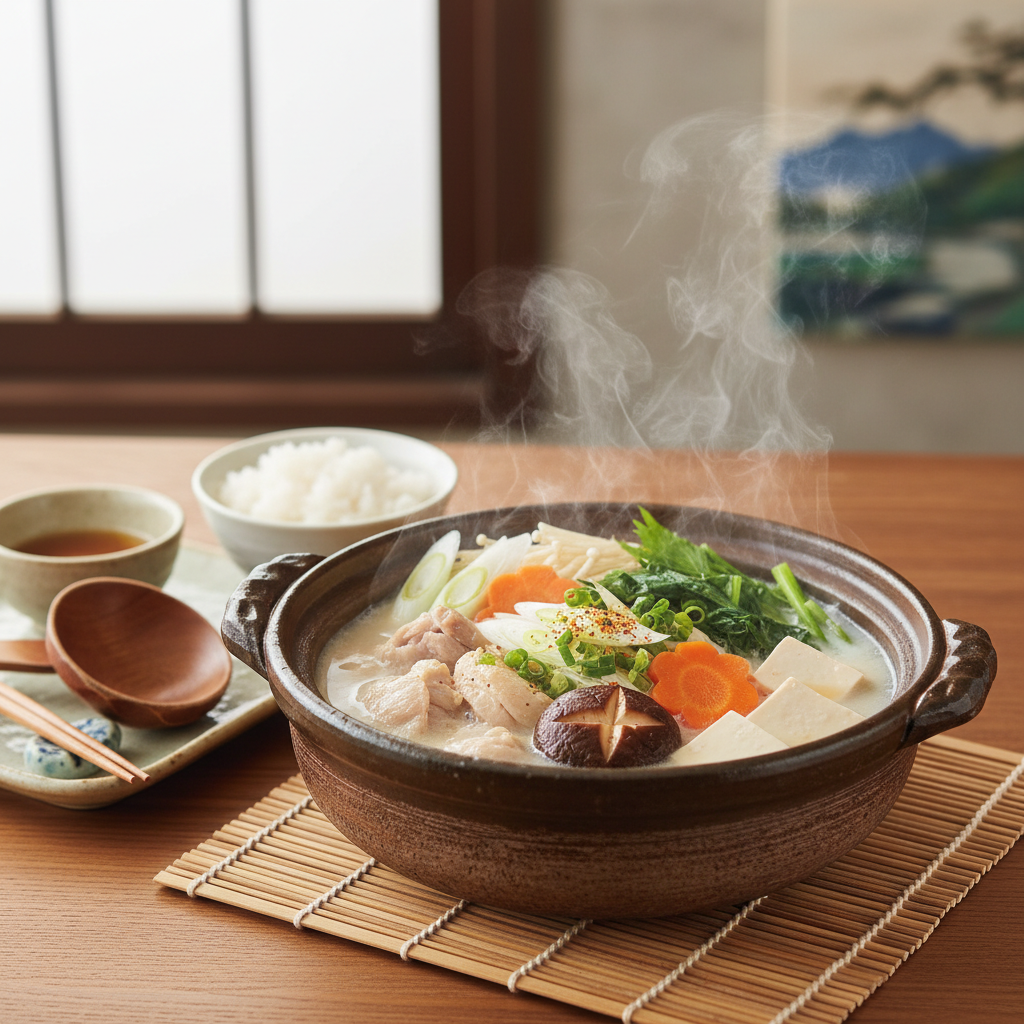

Complete Guide to Nara Nottspe | History, How to Make, and Cultural Background of Nara Prefecture’s Representative Local Dish
What is Nara Nottspe (Nara Nottspe)?
Nara nottspe is a traditional local dish representative of Nara Prefecture. It is a hearty stew centered on root vegetables such as taro, daikon radish, and carrots, with the distinctive characteristic that natural thickening occurs as the taro breaks down during cooking.
While dishes called “nottspe” or “nottspe-jiru” (nottspe soup) exist throughout Japan, Nara nottspe is unique in being a vegetarian dish that uses kombu and dried shiitake mushroom broth as stock. Without any animal-based ingredients, it embodies a Nara tradition of flavor where the natural umami of vegetables and the deep taste of the broth are in harmony.
The name “nottspe” originally referred to “nottspe-i” and is sometimes written as “濃餅” (concentrated mochi). This name is thought to express the thick, viscous texture of the dish. Whereas nottspe-jiru in the Tohoku and Hokuriku regions uses potato starch for thickening, Nara nottspe is characterized by natural thickening achieved from the stickiness of taro, making this a major distinction from other regions.
Major Regions of Transmission in Nara Prefecture
Nara nottspe is a local dish enjoyed throughout Nara Prefecture, but is particularly deeply rooted in areas centered on Nara City. The areas around Kasuga Taisha shrine have deep connections with the “Kasuga Wakamiya On-Matsuri” held every December, during which many households and restaurants prepare this dish.
In shopping districts and community organizations within Nara City, the serving of Nara nottspe occurs during the Daisukusho Festival on December 15th, continuing the tradition as a regional food culture. Additionally, it has been incorporated as a standard menu item in school lunches, making it a familiar taste of Nara tradition for younger generations as well.
Even in rural areas of Nara Prefecture, slightly different variations exist in each region, with unique flavors passed down through individual households. Particularly in the Yamato region, the use of taro known as “doroimo” (mud taro) is considered traditional.
History, Origins, and Related Events
Deep Connection with Kasuga Wakamiya On-Matsuri
The history of Nara nottspe is closely connected with the “Kasuga Wakamiya On-Matsuri” of Kasuga Taisha. This festival is said to have begun in 1136 (Houen 2), during the late Heian period, and is a traditional event with nearly 900 years of history.
During the festival period (December 15-18), it is said that “nottspe-jiru” was served at lodgings to people gathered from throughout Kuni-naka (Nara Basin) to participate in the festival. As a “special dish” served to worshippers and those called Yamato samurai who assisted with the festival, Nara nottspe has played an important role throughout history.
Development as Vegetarian Cuisine
Nara, as an ancient capital, is home to many temples, and Buddhist culture is deeply rooted in the land. Therefore, traditions of vegetarian cuisine remain strong, and Nara nottspe developed under this influence. The technique of drawing out umami using plant-based stocks like kombu and dried shiitake mushrooms, without animal-based ingredients, is precisely an application of vegetarian cooking wisdom.
There is a history of stew dishes similar to nottspe being served as meals for monks in training at major temples such as Todai-ji and as dishes prepared for Buddhist services, which subsequently spread to the general population and became established as Nara nottspe.
Origins of Stew Cuisine
Nara nottspe is also said to be “the origin of stew cuisine.” While employing simple cooking methods, it brings out the natural flavors of vegetables to their fullest and uses the natural thickening from taro to unify the ingredients—a technique that embodies the fundamentals of Japanese cuisine. This simple yet profound taste is the reason it has been passed down to the present day over many years.
Main Ingredients Used
The ingredients used in Nara nottspe are simple, centered on seasonal vegetables. Understanding the role and characteristics of each ingredient allows for making even more delicious Nara nottspe.
Taro (Doroimo)
The most important ingredient in Nara nottspe is taro. Sticky taro called “doroimo” in Nara dialect is traditionally used. The natural thickening created by the breakdown of taro during cooking is the greatest characteristic of this dish. Without the need for artificial thickening such as potato starch, the mucilaginous components of taro—galactan and mucin—smoothly bring together the entire dish.
Daikon Radish
Daikon radish is an indispensable root vegetable in Nara nottspe. Particularly, a local variety called “iwai daikon” (celebration daikon) is sometimes used. The sweetness and texture of daikon add depth to the dish, absorbing the stock well and becoming delicious.
Carrots (Kintoki Carrots)
Carrots are an important ingredient adding color and sweetness. Particularly when preparing it as a New Year’s dish, using brightly red kintoki carrots makes the appearance more festive.
Fried Tofu
Fried tofu is an ingredient that adds richness and substance while maintaining the vegetarian nature of the dish. By properly removing the oil, the umami of tofu can be added without compromising the taste of the stock.
Kombu
Kombu is the foundation of stock for Nara nottspe. Glutamic acid, the umami component of kombu, supports the overall flavor of the dish. By slowly drawing stock from kombu starting with water, a clear and refined taste is created.
Dried Shiitake Mushrooms
Dried shiitake mushrooms are also important material for the stock. Guanylic acid, the umami component of shiitake, combines with the glutamic acid of kombu to create a synergistic effect, producing deep umami. It is important not to discard the rehydration liquid but to use it as stock.
Other Ingredients
Root vegetables such as konnyaku, burdock, and lotus root are also added depending on season and household preference. Adding green vegetables such as green beans or snow peas at the end provides accents of color and texture.
Ingredients (Serves 4) and Detailed Instructions
Ingredients (Serves 4)
- Taro: 300g (6-8 medium pieces)
- Daikon radish: 200g (about 1/4)
- Carrot: 100g (1 medium)
- Fried tofu: 1 piece (about 150g)
- Konnyaku: 1/2 sheet (100g)
- Dried shiitake mushrooms: 4-5
- Kombu: 1 piece (10cm square)
- Water: 800ml
- Soy sauce: 2-3 tablespoons
- Mirin: 2 tablespoons
- Sake: 1 tablespoon
- Salt: 1/2 teaspoon
- Green beans (for color): as needed
Preparation
- How to rehydrate dried shiitake mushrooms: Soak dried shiitake mushrooms in water the day before and rehydrate in the refrigerator. If time is short, they can be soaked in lukewarm water for about 30 minutes, but slowly rehydrating in cold water produces stronger umami. Keep the rehydration liquid without discarding it.
- Kombu stock preparation: Wipe the surface of kombu lightly with a tightly wrung cloth and soak in water for 30 minutes or longer.
Instructions
- Making the stock: Place water and kombu in a pot and heat over medium heat. Remove the kombu just before boiling (boiling will release sliminess and bitterness from the kombu). Strain the rehydration liquid of the dried shiitake mushrooms through gauze and add it, making approximately 800ml of stock total.
- Vegetable preparation:
- Peel taro and cut into large bite-sized pieces. Remove the sliminess by rubbing with salt and rinsing with water.
- Cut daikon into 2cm-thick ginkgo-leaf or half-moon shaped pieces.
- Cut carrots to roughly the same size as the daikon.
- Tear konnyaku by hand or with a spoon into bite-sized pieces (this allows better absorption of flavor than cutting with a knife).
- Remove the hard base of the rehydrated shiitake mushrooms and cut in half if large.
- Removing oil from fried tofu: Pour hot water over the fried tofu to remove excess oil, then cut into bite-sized pieces. Performing this step carefully allows the stock flavor to stand out.
- Begin cooking: Bring the stock to a boil and add daikon and carrots first, simmering over medium heat for about 5 minutes. If scum appears, remove it carefully.
- Add taro: Once the daikon and carrots are slightly cooked, add the taro. Since taro breaks down easily during cooking, adding it later helps maintain its shape while allowing appropriate breakdown to create thickening.
- Add other ingredients: Add konnyaku, dried shiitake mushrooms, and fried tofu, place a drop lid on top, and simmer over medium-low heat for 15-20 minutes.
- Season: Add soy sauce, mirin, sake, and salt to adjust flavor. Continue simmering for about 10 more minutes to allow the flavors to blend. When the taro has appropriately broken down and thickening has occurred throughout, the dish is ready.
- Finishing touches: Blanch green beans, cut diagonally, and add for color. Turning off the heat and letting it sit for a while allows the flavors to meld and become even more delicious.
Cooking Tips
- Adjusting thickness: The degree of breakdown of the taro determines the thickness. For a lighter consistency, cut taro larger; for stronger thickening, cut smaller or increase cooking time.
- Flavor intensity: Season lightly if serving as a soup, or somewhat more strongly if serving as a stew.
- Storage method: Can be refrigerated for 3-4 days. From the next day onward, the flavors blend deeper, making it even more delicious.
Occasions and Seasons for Eating
Nara nottspe is eaten year-round, but is particularly favored during cold seasons. As a warm stew that warms the body, it is valued as a winter home-cooked dish.
Kasuga Wakamiya On-Matsuri (December)
The most important occasion for eating this dish is the Kasuga Wakamiya On-Matsuri held annually from December 15-18. Particularly during the Daisukusho Festival on December 15th, with cooperation from local shopping districts, Nara nottspe is served to many worshippers who enjoy this traditional taste. For those participating in the festival and related parties, Nara nottspe is an essential dish.
As New Year’s Cuisine
Many households in Nara Prefecture have the custom of preparing Nara nottspe as one dish in New Year’s osechi (celebratory) cuisine. Along with white miso soup, it is an important dish that colors the Nara New Year. Using kintoki carrots makes the appearance more festive, befitting a celebratory occasion.
At the Everyday Table
Beyond special events, it frequently appears on everyday dining tables. As a nutritionally balanced dish full of vegetables, and as a convenient dish that can be prepared in advance, it remains beloved in modern households.
School Lunches
Nara nottspe is served in school lunches throughout Nara Prefecture as part of local cuisine education. It provides an opportunity for children to encounter the food culture of their region and plays an important role in transmitting culture to younger generations.
Ways of Eating and Enjoyment
Enjoying as a Soup
The traditional style is to prepare with plenty of broth and enjoy as a warm soup. On cold winter days, it becomes a dish that warms from the core of the body. It is satisfying not only as a side dish with rice but also as a single course. The thick broth maintains warmth and can be enjoyed hot to the very end, which is also appealing.
Enjoying as a Stew
It can also be finished as a hearty stew with less liquid. In this case, ingredients become more concentrated in flavor and richly absorbed with taste. It is suitable as a bento box side dish and remains delicious even when cooled.
Choice of Serving Vessels
Serving in a deep bowl or rice bowl highlights its appeal as a soup. Serving in warm ceramic dishware harmonizes well with the simple taste of the dish. Adding green vegetables as a garnish also results in a beautiful presentation.
Adaptation Methods
Variations can be enjoyed by adding seasonal vegetables or increasing mushrooms as a base for the basic recipe. It is also possible to adapt it as a main dish, such as making “nottspe udon” by adding udon noodles.
Nutritional Value and Health Benefits of Nara Nottspe
Nara nottspe is a nutritionally balanced and healthy dish.
Rich in Dietary Fiber
Many ingredients used are rich in dietary fiber, including taro, daikon radish, carrots, and konnyaku. These help regulate the intestinal environment and are effective for constipation relief and prevention of lifestyle-related diseases.
Low Calorie with Satisfying
As a vegetarian dish without animal fats, it is kept low in calories. Yet through the thickening from taro and the variety of ingredients, it provides satisfaction, making it suitable even for those on diets.
Rich in Vitamins and Minerals
B vitamins, vitamin C, potassium, and other minerals found in root vegetables can be obtained. Daikon in particular contains digestive enzymes that aid in digestion.
Immune System Enhancement
β-glucan contained in dried shiitake mushrooms is said to enhance immunity. Additionally, fucoidan in kombu contributes to health maintenance.
Efforts in Preservation and Transmission
Transmission Through Community
Shopping districts and neighborhood associations in Nara City conduct serving events of Nara nottspe during the Kasuga Wakamiya On-Matsuri period, working to transmit it as a regional food culture. It provides an opportunity for not only local residents but also tourists to experience the traditional taste of Nara.
Efforts in School Education
The Nara Prefecture School Lunch Nutrition Research Association provides Nara nottspe as a school lunch menu while also educating about its history and cultural background. Some schools offer the opportunity to actually prepare it during cooking practice, allowing children to learn about local cuisine through experience.
Activities of Nutritionist Associations
The Public Interest Incorporated Association Nara Prefecture Dietitian Association publicizes recipes for Nara nottspe and recommends home cooking. While scientifically explaining its nutritional value, it works to transmit the traditional dish.
Registration in the Ministry of Agriculture, Forestry and Fisheries’ “Our Local Cuisine” Database
Nara nottspe is registered in the “Our Local Cuisine” database operated by the Ministry of Agriculture, Forestry and Fisheries and is introduced nationally as a representative local dish of Nara Prefecture. This broadens opportunities for people outside the prefecture to learn about Nara’s food culture.
Provision at Restaurants
Some restaurants in Nara City include Nara nottspe as a local cuisine menu item. Particularly during the December On-Matsuri season, many restaurants offer it as a limited-time menu, making it popular with tourists.
Modernization of Recipes
While preserving tradition, modernized adaptation recipes have also been developed. Efforts include pressure cooker methods for saving time and small-portion recipes for those living alone, adapting to changes in lifestyle.
Information Sharing on Social Media
Through regional information sites such as “Nara Core” and social media, recipes and food culture of Nara nottspe are disseminated. Using photographs and videos to present easy-to-understand cooking methods shows efforts to generate interest among younger generations.
Product Commercialization Efforts
Some food manufacturers are moving toward commercializing Nara nottspe as retort food. By allowing busy modern people to easily enjoy traditional flavors, this contributes to the promotion of local cuisine.
Differences Between Nara Nottspe and Nottspe from Other Regions
Dishes called “nottspe” or “nottspe-jiru” exist throughout Japan, but each region has distinct characteristics.
Nottspe from Niigata Prefecture
Niigata’s nottspe is characterized by the use of chicken, salmon, and salmon roe, with thickening from potato starch. It is widely enjoyed as New Year’s cuisine and is characterized by luxurious ingredients.
Nottspe-jiru from Toyama Prefecture
In Toyama, it is prepared as a hearty soup with chicken and seafood. Potato starch is used for thickening, and it is typically eaten as a warm soup.
Uniqueness of Nara Nottspe
Nara nottspe’s distinctiveness lies in being vegetarian cuisine without animal-based ingredients, utilizing the natural thickening of taro, and basing its stock on kombu and dried shiitake mushrooms. This uniqueness can be said to be a reflection of food culture deeply connected to Buddhist culture of the ancient capital Nara.
Conclusion
Nara nottspe is a representative local dish of Nara Prefecture, passed down alongside the Kasuga Wakamiya On-Matsuri, which has nearly 900 years of history. Characterized by the natural thickening of taro, the deep umami of kombu and dried shiitake mushroom stock, and the subtle flavors of vegetarian cuisine, it remains a rich and delicious dish beloved by many people today as something that warms the body during the cold season.
Transmission efforts are being conducted in various settings including community organizations, school education, and restaurants, continuing to develop while maintaining tradition and adapting to modern eating habits. When preparing at home, careful stock preparation and proper handling of taro are key points.
When visiting Nara, why not experience this traditional flavor firsthand or try making it at home to touch upon Nara’s rich food culture and history.