Sea Bream Rice | Complete Explanation of Ehime Prefecture’s Local Cuisine! History and How to Eat 2 Types of Sea Bream Rice
“Sea bream rice,” a representative local dish of Ehime Prefecture, is a luxurious cuisine unique to Ehime, blessed with the Seto Inland Sea and the Uwa Sea. In fact, there are actually two completely different types of sea bream rice depending on the region within Ehime Prefecture, each with its own unique history and appeal. This article provides detailed information about Ehime Prefecture’s sea bream rice, including its types, history, preparation methods, and restaurants where you can enjoy it deliciously.
What is Ehime Prefecture’s Sea Bream Rice? Characteristics as a Local Dish
Ehime Prefecture boasts Japan’s highest aquaculture production of sea bream, earning it the title of “Sea Bream Kingdom.” True sea bream raised in fast-flowing sea areas such as the Kurushima Strait in the Seto Inland Sea and the Uwa Sea are known for their firm flesh and good fat content, resulting in high-quality fish. “Sea bream rice” is a local dish made using this abundant sea bream.
The greatest characteristic of Ehime Prefecture’s sea bream rice is that the cooking method varies greatly depending on the region. Broadly speaking, there are two types:
- Cooked-in type (Tōyo and Chūyo regions): A dish eaten in Imabari City and the Hojo district of Matsuyama City, where a whole sea bream is cooked in with the rice
- Marinated type (Nanyo region): A dish eaten mainly in Uwajima City in the Nanyo region, where sea bream sashimi is marinated in a special sauce and served over rice
While both are beloved local dishes in Ehime Prefecture, their cooking methods and ways of eating are completely different, with deep history and culture rooted in each.
“Cooked-in Sea Bream Rice” from Imabari and Matsuyama | A Hearty Dish with Whole Sea Bream Cooked In
Characteristics and Cooking Method of Cooked-in Sea Bream Rice
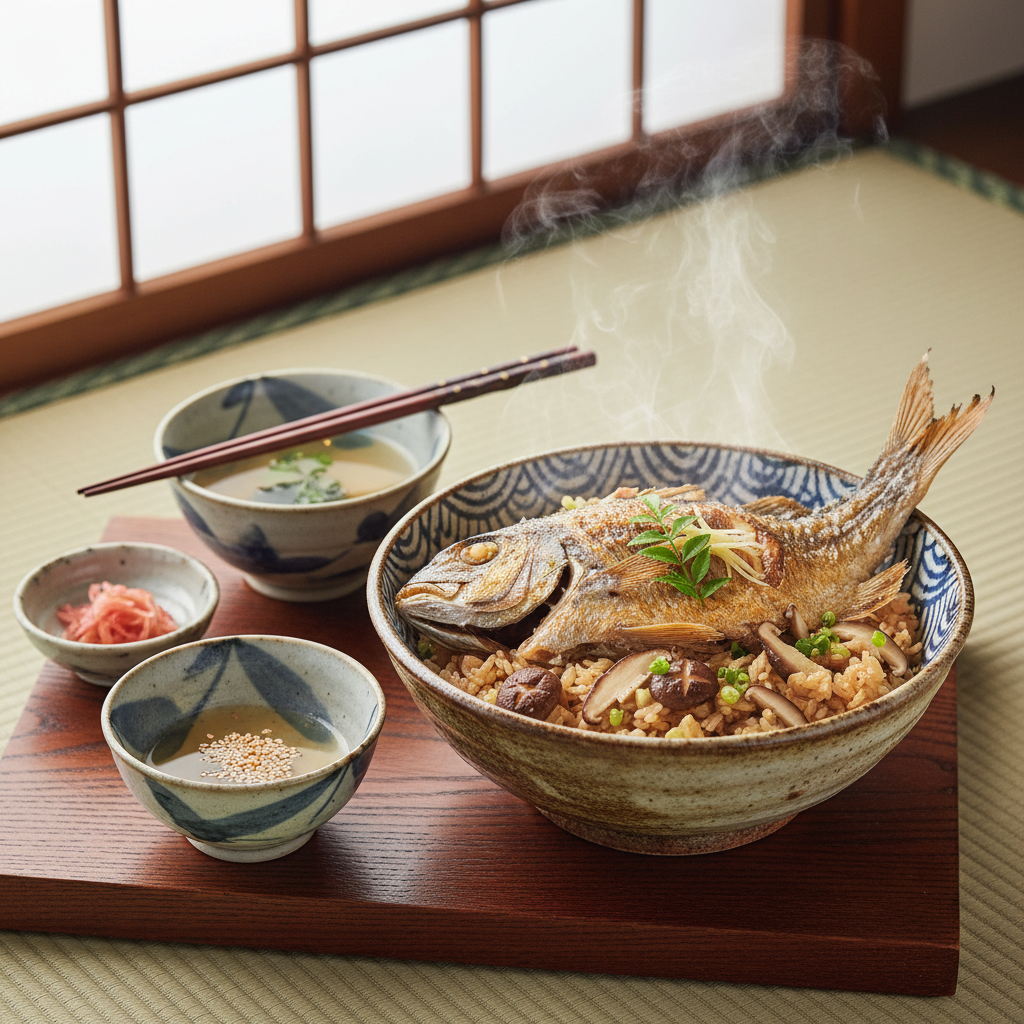
The “cooked-in sea bream rice” eaten in the Tōyo and Chūyo regions of Ehime Prefecture, such as in Imabari City and the Hojo district of Matsuyama City, is a hearty local dish using a whole sea bream. The cooking method involves placing rice and the sea bream together in an earthenware pot or kettle and cooking them together, resulting in a luxurious flavor where the umami of the sea bream soaks into each grain of rice.
The basic flow of preparation is as follows:
- Remove the scales and internal organs from the sea bream, then salt and prepare it
- Rinse the rice, adjust the water content, and season with soy sauce, sake, kelp, and other ingredients
- Place the whole sea bream on top of the rice and cook in a rice cooker or earthenware pot
- Once cooked, shred the sea bream meat and mix it with the rice
The cooked sea bream rice benefits from the dashi extracted from the sea bream’s head and bones spreading throughout, providing a deep umami flavor and aroma. The sea bream meat is fluffy and tender, and the deliciousness it achieves as one with the rice is exceptional.
History and Cultural Background of Cooked-in Sea Bream Rice
The origins of cooked-in sea bream rice are ancient, and particularly in the Hojo district of Matsuyama City, it is said to be connected to Empress Jingu. Legend has it that when Empress Jingu passed through the Hojo area during her Three Korean Campaigns, local fishermen presented her with a sea bream that she cooked in rice and ate.
In Imabari City, sea bream rice made with true sea bream raised in the intense tidal currents of the Kurushima Strait has been eaten since ancient times. As a fishing town that thrived, Imabari had a tradition of cooking sea bream rice for celebrations and special occasions, and it became established both as a home-cooked meal and as a local dish.
Sea bream has been cherished since mythological times as a lucky fish for Japanese people. Due to the wordplay with “medetai” (auspicious), it is an indispensable ingredient at celebratory occasions. In Ehime Prefecture, a culture of enjoying this auspicious dish regularly with abundant sea bream has taken root.
Recommended Restaurants for Cooked-in Sea Bream Rice in Imabari and Matsuyama Cities
There are many restaurants serving cooked-in sea bream rice centered in Imabari and Matsuyama cities. At specialty restaurants, sea bream rice cooked in earthenware pots is served, and the moment the lid opens to reveal the sea bream presiding in the center is spectacular.
In Matsuyama city, there are specialty shops such as “Akiyoshi” where you can enjoy Matsuyama sea bream rice alongside local sake. In Imabari City, there are scattered restaurants serving sea bream rice made with fresh true sea bream caught in the Kurushima Strait, popular with both locals and tourists.
Many restaurants offer not only cooked-in sea bream rice but also other Ehime Prefecture local dishes such as jako-ten and sea bream somen on their menus. Cooked-in sea bream rice can usually be ordered for 2-3 people at most restaurants, and its generous portions make it perfect for sharing with family and friends.
“Marinated Sea Bream Rice” from Uwajima | Fisherman’s Dish with Sea Bream Sashimi Over Rice
Characteristics and How to Eat Marinated Sea Bream Rice
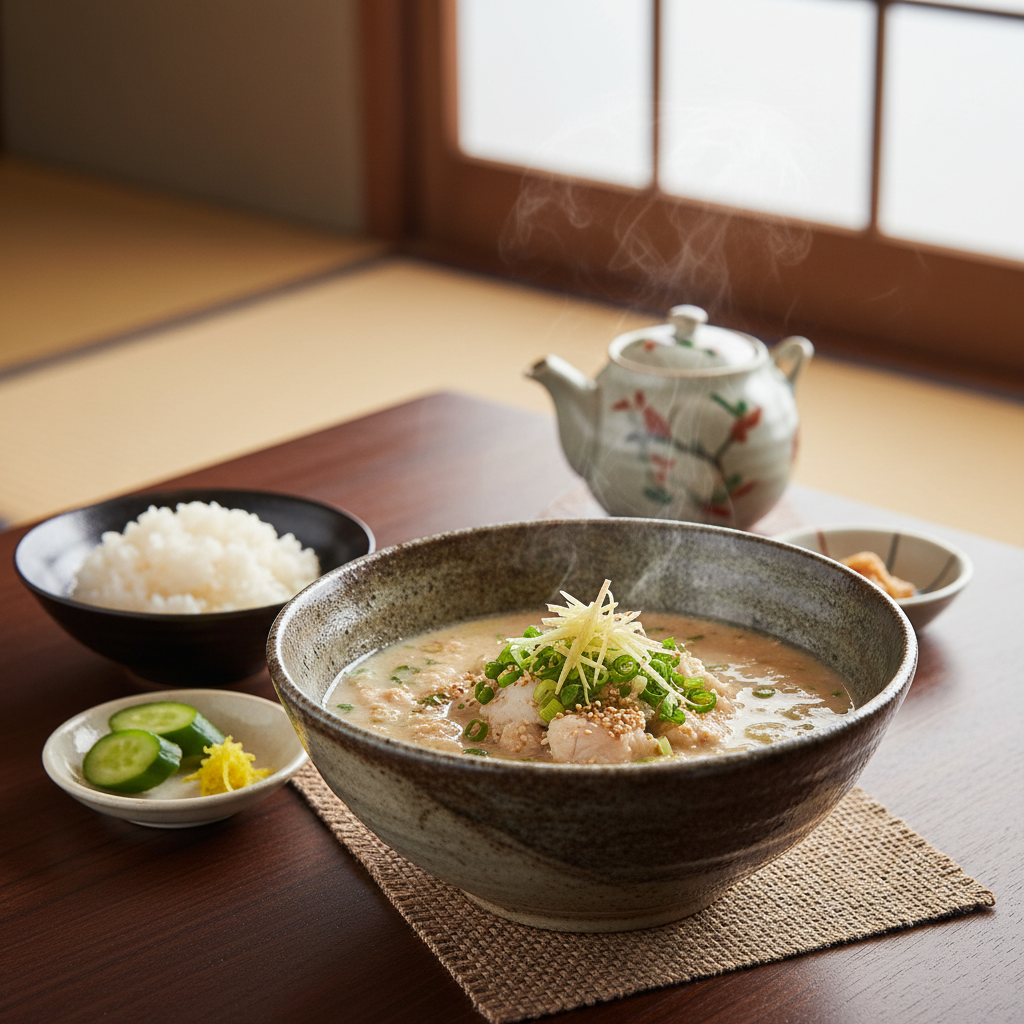
The “marinated sea bream rice” eaten mainly in Uwajima City in the Nanyo region is a local dish completely different from the cooked-in type. Fresh true sea bream sashimi is marinated in a special sauce made from a combination of soy sauce, mirin, raw egg, sesame, and dashi, and this sauce is poured over hot rice to eat—a “living” sea bream rice.
The basic way to eat marinated sea bream rice is as follows:
- Prepare fresh true sea bream cut thinly into sashimi
- Make a special sauce by mixing soy sauce, mirin, dashi, and raw egg
- Marinate the sea bream sashimi in the sauce (about 5-10 minutes)
- Place hot rice in a rice bowl
- Pour the marinated sea bream and sauce over the rice
- Top generously with condiments (green onion, shiso leaves, sesame, seaweed, etc.)
- Mix everything together and eat
The sauce with raw egg gently envelops the sea bream sashimi and rice, creating a smooth and rich flavor. The aroma of the condiments stimulates the appetite, making it a deliciousness you could eat bowl after bowl.
History of Marinated Sea Bream Rice | Origins in Fishermen’s “Boat Meals”
The origins of Uwajima sea bream rice are said to lie in “boat meals” eaten by naval warriors and fishermen aboard ships. Fishermen working in the Uwa Sea devised this dish to quickly prepare and eat freshly caught sea bream aboard their boats.
Since no fire was needed for cooking, it could be eaten safely on a ship, and most importantly, it allowed them to enjoy the deliciousness of fresh sea bream as is. The practical dish born from fishermen’s wisdom and ingenuity has now become known nationwide as a representative local dish of Ehime Prefecture.
The Uwa Sea is a rich fishing ground influenced by the Kuroshio Current, where high-quality true sea bream have been landed since ancient times. This blessed environment is precisely what allowed the unique food culture of marinated sea bream rice using fresh sea bream sashimi to develop.
Recommended Restaurants for Marinated Sea Bream Rice in Uwajima City
There are many specialty restaurants for marinated sea bream rice throughout Uwajima City, with each shop showcasing its individuality through unique special sauces and condiments. At long-established shops like “Uwajima Sea Bream Rice Motoyama,” you can enjoy authentic marinated sea bream rice using fresh true sea bream caught in the Uwa Sea.
At most restaurants, the sea bream sashimi, sauce, condiments, and rice are served separately, allowing you to adjust quantities to your preference. Staff will explain how to eat it carefully for first-time visitors, so you can feel at ease.
More restaurants in Matsuyama City have begun serving Uwajima-style sea bream rice, and when traveling through Ehime Prefecture, you can compare both the cooked-in and marinated types. By tasting sea bream rice that showcases the characteristics of each region, you can develop a deeper understanding of Ehime Prefecture’s rich food culture.
Thorough Comparison: Differences Between Cooked-in and Marinated Sea Bream Rice
Differences in Cooking Method
Cooked-in sea bream rice is fundamentally a heat-cooked dish using a whole sea bream that is cooked together with rice. The sea bream’s umami soaks into the rice, and after cooking, the meat is shredded and mixed with the rice. Cooking takes 30 minutes to an hour, and when making at home, you use earthenware pots or rice cookers.
Marinated sea bream rice, on the other hand, uses sea bream sashimi, so no heating is required. Simply marinating the sashimi in the special sauce completes it, taking only about 10 minutes—making it quick and easy to prepare. However, fresh sea bream is absolutely essential, as freshness greatly influences the taste.
Differences in Flavor and Texture
Cooked-in sea bream rice is characterized by deep umami flavor and aroma, as the sea bream’s dashi spreads throughout the rice. Since the sea bream meat is heated, it has a fluffy, tender texture that is one with the rice. The seasoning is typically fairly strong, with soy sauce and kelp flavors prominent.
Marinated sea bream rice features the crisp texture unique to raw sea bream sashimi and the smoothness of sauce made with raw egg. The fresh sweetness of the sea bream, the rich flavor of the sauce, and the refreshing aroma of condiments come together as one in a complex flavor profile. Compared to the cooked-in type, it has a lighter impression and is easier to eat even in summer.
Differences in Historical Background and Cultural Significance
Cooked-in sea bream rice strongly bears the character of a “hare no hi” (auspicious occasion) dish eaten at celebrations and special occasions, with a history connected to mythology and legend. The sight of family and relatives gathered around a large earthenware pot of cooked sea bream rice is symbolic of Ehime Prefecture’s household culture.
Marinated sea bream rice developed from the practical meals of fishermen, bearing the character of a “ke no hi” (ordinary day) dish eaten daily. What began as a contrivance for fishermen to eat quickly aboard ship has become a local dish popular with tourists, symbolizing Uwajima’s food culture.
Recipe and Ingredients for Making Sea Bream Rice at Home
How to Make Cooked-in Sea Bream Rice (Serves 4)
Ingredients
- True sea bream (1 whole fish, approximately 500-600g)
- Rice (3 cups)
- Kelp (one 10cm square piece)
- Soy sauce (3 tablespoons)
- Sake (3 tablespoons)
- Mirin (2 tablespoons)
- Salt (as needed)
- Ginger (3-4 thin slices)
Preparation
- Remove scales and internal organs from the sea bream, rinse thoroughly, and pat dry
- Salt both sides of the sea bream and let sit for about 15 minutes to remove any fishy smell
- Rinse the rice and soak in water for about 30 minutes, then drain in a colander
- Place rice in an earthenware pot or rice cooker, add soy sauce, sake, and mirin, and fill with water to the 3-cup mark
- Add kelp and ginger, then place the whole sea bream on top
- Heat over high heat, and once boiling, reduce to low heat and cook for 15-20 minutes (for rice cookers, use normal mode)
- Remove from heat and steam for about 10 minutes
- Remove the sea bream and shred the meat, removing any bones
- Return the shredded meat to the rice and mix everything together
- Serve in rice bowls and garnish with mitsuba or chopped seaweed as desired
How to Make Marinated Sea Bream Rice (Serves 2)
Ingredients
- True sea bream sashimi (150-200g)
- Cooked rice (2 bowls’ worth)
- Egg yolk (2)
- Soy sauce (3 tablespoons)
- Mirin (2 tablespoons)
- Dashi broth (4 tablespoons)
- White sesame (1 tablespoon)
- Condiments (green onion, shiso leaves, seaweed, wasabi, etc., as desired)
Preparation
- Heat mirin in a small pot to cook off the alcohol, then cool
- In a bowl, mix soy sauce, cooked mirin, dashi, egg yolks, and white sesame
- Slice the sea bream sashimi thinly (in a sogi-giri cut) and place in the sauce, marinating for 5-10 minutes
- Place hot rice in a rice bowl
- Pour the marinated sea bream with sauce over the rice
- Top generously with condiments
- Mix everything together well and eat
Tips: Use fresh sea bream sashimi. Adding egg yolk makes the sauce creamier and helps it coat the sea bream and rice better. Prepare condiments generously, as their aroma enhances the dish and increases appetite.
Why Ehime Prefecture’s Sea Bream is Delicious | Aquaculture Technology and Marine Environment
Ehime Prefecture Boasts Japan’s Highest Sea Bream Aquaculture Production
Ehime Prefecture leads Japan in sea bream aquaculture production, accounting for approximately 50% of the national market share. In particular, the Uwa Sea coastline and areas around the Kurushima Strait are major sea bream aquaculture bases. The history of sea bream aquaculture in Ehime Prefecture is long, beginning in earnest in the 1960s, with advanced aquaculture techniques now firmly established.
Aquaculture operators in Ehime Prefecture maintain strict quality control throughout the entire process from fingerling selection to feed management to shipment. In particular, feeds contain not just fish meal but specially formulated feed with well-balanced vitamins and minerals, raising healthy and delicious sea bream.
The Blessed Environment of the Kurushima Strait and Uwa Sea
The Kurushima Strait is counted among Japan’s three major fast currents, with tidal speeds reaching up to 18 km per hour. Sea bream raised in these intense tidal currents develop firm flesh, good fat content, and concentrated flavor. The ability to ensure natural exercise levels in such an environment is the secret to producing high-quality farmed sea bream.
The Uwa Sea features a complex ria coastline influenced by the Kuroshio Current, with stable water temperature and nutrient-rich seawater flowing in—ideal aquaculture conditions. The intricate coastline functions like a natural pen, providing conditions where sea bream can grow without stress.
Quality Management and Sales Strategy for Ehime Prefecture’s Sea Bream
Ehime Prefecture sells high-quality farmed fish under the “Ai-iku Fish” brand, with sea bream as a main product. Only sea bream meeting strict quality standards are shipped under this brand name and receive high evaluations in markets nationwide.
Additionally, fishing cooperatives and aquaculture operators in Ehime Prefecture perform procedures such as live spiking and neural spiking on sea bream before shipment to preserve freshness. This ensures that sea bream shipped outside the prefecture maintains high freshness and remains sashimi-grade quality.
Local Dishes to Enjoy Alongside Ehime Prefecture’s Sea Bream Rice
Jako-ten | Processed Fish Cake Made with Small Uwa Sea Fish
Jako-ten is a representative Ehime Prefecture local dish made by mincing small fish caught in the Uwa Sea (primarily hotaru jako) and frying them. Because the bones are ground together, it is rich in calcium and highly nutritious, featuring unique flavor and texture. Eating it alongside sea bream rice allows you to enjoy fish umami in multiple layers.
Sea Bream Somen | A Must-Have Dish at Celebrations
Sea bream somen is a dish where somen noodles are simmered in dashi from cooked sea bream, appearing at celebrations such as weddings and memorial services throughout Ehime Prefecture. Somen soaked in abundant sea bream umami has a gentle flavor, allowing you to experience the appeal of sea bream dishes different from sea bream rice.
Iyo Satsuma | Ehime Prefecture’s Version of Satsuma-age
Iyo satsuma is Ehime Prefecture’s unique fried fish cake made by combining minced fish with tofu and deep-frying. Adding tofu creates a fluffy texture and gentle flavor. It’s perfect as a palate cleanser with sea bream rice or as an accompaniment to alcohol.
Recommended Sightseeing Spots When Visiting Ehime Prefecture to Eat Sea Bream Rice
Matsuyama City | Dogo Onsen and Castle Town Strolling
Matsuyama City is Ehime Prefecture’s prefectural capital, home to Dogo Onsen, one of Japan’s oldest hot springs. The Dogo Onsen Main Hall is designated an Important Cultural Property and offers an experience of historic architecture and hot spring culture. Matsuyama Castle is one of Japan’s 12 original castles, and you can stroll through the castle town’s traditional streets while visiting restaurants serving cooked-in sea bream rice.
Imabari City | Shimanami Kaido and Towel Industry
Imabari City is the starting point of the Shimanami Kaido, which connects Honshu and Shikoku, with cycling through the Seto Inland Sea islands popular. Also known for Imabari towels, it has towel industry attractions like the Towel Art Museum. Savoring cooked-in sea bream rice made with locally caught sea bream while viewing the spectacular Kurushima Strait is exceptional.
Uwajima City | Uwajima Castle and Pearl Culturing
Uwajima City is the center of the Nanyo region and home to Uwajima Castle, one of Japan’s 12 original castles. The ria coastline facing the Uwa Sea is beautiful, and pearl cultivation flourishes here. After viewing Uwajima Castle, you can enjoy authentic flavors in marinated sea bream rice specialty shops scattered throughout the castle town, experiencing the tradition of fishermen’s cooking.
How to Enjoy Ehime Prefecture’s Sea Bream Rice as a Souvenir
Frozen and Retort Sea Bream Rice Sets
Souvenir shops, airports, and stations throughout Ehime Prefecture sell frozen and retort sea bream rice sets for easy home enjoyment. Cooked-in sea bream rice sets include pre-prepared sea bream and seasonings, allowing you to make authentic sea bream rice easily in your home rice cooker.
Marinated sea bream rice sets include special sauce and condiments, allowing you to recreate Uwajima-style sea bream rice if you prepare fresh sea bream sashimi. Some products include frozen sea bream sashimi as well, offering authentic flavors simply by thawing.
Purchases Through Online Shops
Online shops selling Ehime Prefecture specialties offer abundant sea bream rice bases and sea bream rice sets. Many products are direct shipments from producers, with items combining freshly farmed sea bream and special seasonings popular as gifts.
Sea bream rice-related products are also available at Ehime Prefecture antenna shops, making it possible to obtain Ehime Prefecture local cuisine in major cities like Tokyo and Osaka.
New Form of Sea Bream Rice | Western-Style Grilled Sea Bream Rice from Tōyo
In recent years, the Tōyo region of Ehime Prefecture has seen the emergence of a new style of “grilled sea bream rice,” different from traditional cooked-in or marinated sea bream rice. This dish involves either grilling sea bream until fragrant before cooking it in with the rice or pairing grilled sea bream with rice seasoned in Western sauce, adding new arrangements to traditional sea bream rice.
Western-style grilled sea bream rice uses butter or olive oil, flavoring sea bream with herbs and spices. By combining with tomato sauce or cream sauce, it takes on a Western cuisine-like flavor, gaining attention as a dish more easily accepted by younger generations and foreign tourists.
This emergence of new sea bream rice demonstrates Ehime Prefecture’s flexible food culture—preserving traditional local cuisine while also evolving with the times. Ehime Prefecture’s sea bream rice culture, where tradition and innovation coexist, will likely continue developing.
Summary | Ehime Prefecture’s Sea Bream Rice: Local Flavors Woven from Two Traditions
Ehime Prefecture’s sea bream rice, despite sharing the name “sea bream rice,” has developed as two completely different dishes depending on the region. The cooked-in sea bream rice from Imabari and Matsuyama cities is a hearty dish featuring whole sea bream with deep umami flavor, symbolizing a warm food culture where families gather at celebrations and special occasions.
On the other hand, marinated sea bream rice centered in Uwajima City in the Nanyo region originates from fishermen’s cooking, using fresh sea bream sashimi in a special sauce. Despite being easy to make, it offers profound flavor and is beloved by locals as a local dish delicious even in summer, characterized by the smoothness of sauce made with raw egg and the refreshing aroma of condiments.
Both types of sea bream rice originate from Ehime Prefecture’s rich marine resources, aquaculture techniques developed over many years, and the wisdom and ingenuity of local people. When visiting Ehime Prefecture, be sure to taste both styles of sea bream rice side by side and experience the unique appeal of each.
Sea bream rice made with high-quality true sea bream raised in the Kurushima Strait and Uwa Sea is a special dish found nowhere else but Ehime Prefecture. When making it at home, using Ehime Prefecture-produced sea bream allows you to approach the authentic taste. Ehime Prefecture’s sea bream rice culture, maintaining traditional cooking methods while also generating new arrangements, will undoubtedly continue being cherished by many people.
Through Ehime Prefecture’s local dish of sea bream rice, may you feel the richness of Japan’s food culture, regional history, and gratitude for the sea’s blessings.