Sweetened Carp (Koi no Kanroni) | History and Preparation of a Traditional Local Dish Representing Fukushima Prefecture’s Koriyama City
Sweetened carp (koi no kanroni), a signature local dish representing Fukushima Prefecture’s Koriyama City, is a historic dish with roots dating back to the Edo period. Carp raised in water rich with minerals from Lake Inawashiro is slowly simmered with sugar, maltose syrup, and soy sauce, resulting in a dish with deep umami flavor and no unpleasant smell. This article provides detailed explanations of this traditional dish’s history, preparation method, and current efforts toward preservation and transmission.
What is Sweetened Carp | A Representative Local Dish of Koriyama City, Fukushima Prefecture
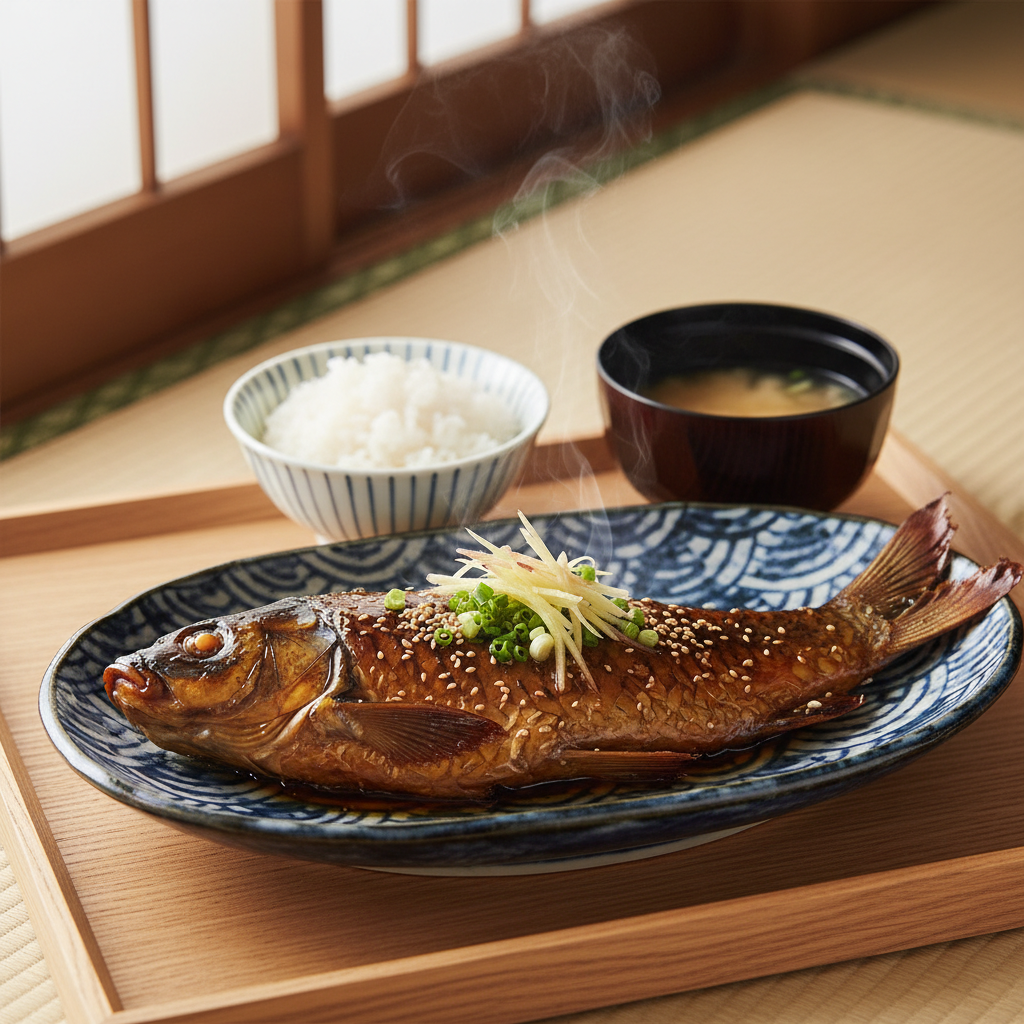
Sweetened carp is a local dish long cherished in Koriyama City, Fukushima Prefecture. Fresh carp is cut into chunks and slowly simmered with seasonings such as soy sauce, sake, sugar, and maltose syrup, characterized by a sweet and salty flavor profile. By simmering for several hours, the distinctive smell of carp disappears, and the fish becomes soft enough to eat even the bones.
Koriyama City, while located inland, is blessed with abundant water resources from Lake Inawashiro, and carp farming has been actively conducted there since ancient times. Particularly after the Meiji era, with the construction of reservoirs by drawing water from Lake Inawashiro, large-scale carp farming began, making carp dishes a central part of Koriyama’s food culture.
Sweetened carp has been valued as a dish for special occasions and as a hospitality dish for guests. Today, it continues to be prepared in restaurants and homes throughout Koriyama City, cherished as a dish symbolizing the region’s food culture.
History and Origins | Tanaka Harunaka and Koriyama’s Carp Culture
Origins in the Edo Period
The origins of sweetened carp trace back to the late Edo period. It is said that Tanaka Harunaka (田中玄宰), a senior retainer of the Koriyama clan, had this dish created. Tanaka Harunaka is known as a person who devoted himself to the development of Koriyama, focusing his efforts on agricultural promotion and irrigation projects.
At that time, seafood was precious in the inland region of Koriyama, and freshwater fish played an important role as a protein source. Carp had long been considered an auspicious fish, and because farming was relatively easy, it was recognized as an ingredient suited to Koriyama’s climate and geography.
Development from the Meiji Era Onward
From the Meiji era, water was drawn from Lake Inawashiro through the Asaka Water Channel, greatly improving Koriyama’s water infrastructure. Taking advantage of this abundant water supply, reservoirs were constructed in various locations, and carp farming became large-scale.
The water of Lake Inawashiro is rich in minerals and clear, so carp raised in this water came to have the characteristic of little unpleasant smell and good fat content. With high-quality carp becoming available in stable supply, sweetened carp became widely established as a representative local dish of Koriyama.
Positioning in the Region
Sweetened carp has been positioned not as an everyday food but as a dish for special occasions. It is an essential dish on auspicious days such as weddings, celebrations, and New Year’s, and is also a representative dish for entertaining guests.
Because the cooking method for sweetened carp, handed down from the Edo period, requires time and careful preparation, it was valued as a dish demonstrating culinary skill in the household. Passed down from mother to daughter through generations, it has supported the region’s food culture as a family flavor.
Main Transmission Areas and Ingredients Used
Areas of Transmission
Sweetened carp has been transmitted as a local dish centered in Koriyama City, Fukushima Prefecture. It was particularly actively prepared in former Koriyama Town and surrounding rural areas. In regions close to Lake Inawashiro, various carp dishes developed because fresh carp was easily available.
Today, it is offered and sold in restaurants, inns, souvenir shops, and other establishments throughout Koriyama City and has become a local dish popular with tourists. It continues to be prepared in homes for special occasions, and is reliably being transmitted as a regional food culture.
Main Ingredients Used
The main ingredients used in sweetened carp are as follows.
Carp: Fresh carp raised in Koriyama is used. Carp raised in water rich with minerals from Lake Inawashiro is characterized by little unpleasant smell and firm flesh. Usually, carp weighing around 1kg is used, cut into chunks for cooking.
Seasonings: Soy sauce, sake, sugar, and maltose syrup are the basic seasonings. Particularly by using generous amounts of sugar and maltose syrup, the result achieves a sweet and salty taste and a glossy finish. Maltose syrup adds viscosity and depth to the broth and gives a beautiful sheen to the carp’s surface.
Other ingredients: Ginger is added to remove the carp’s distinctive smell and add flavor. Depending on the region or household, mirin or miso may be added.
Ingredients (For 20–25 Servings) ※Reference Recipe for Dining Establishments
The ingredients for preparing sweetened carp for a large group are as follows. When preparing at home, adjust this amount to approximately one-fifth.
- Carp: 5kg (approximately 3–4 fish)
- Soy sauce: 1 liter
- Sake: 800ml
- Sugar: 1.5kg
- Maltose syrup: 500g
- Ginger: 200g (thinly sliced)
- Water: as needed (enough to submerge the carp)
This amount is a reference recipe for service in restaurants or inns. When preparing at home, use approximately 200ml soy sauce, 160ml sake, 300g sugar, 100g maltose syrup, and 40g ginger per one carp (approximately 1kg).
Preparation Method | Traditional Cooking Technique
Preliminary Preparation
Careful preliminary preparation is essential for delicious sweetened carp.
- Preparing the carp: Obtain fresh carp and carefully remove the scales. Remove the internal organs and rinse thoroughly with running water. It is particularly important to rinse the blood areas thoroughly.
- Cutting into chunks: Cut the carp into 3–4cm wide chunks. Since you cut through the bones, use a heavy, sharp knife. Clean cuts prevent the fish from falling apart during simmering.
- Blanching: Briefly dip the cut carp in boiling water for 10–15 seconds, then immediately place in cold water. This process removes surface slime and unpleasant smells.
Simmering
Once preliminary preparation is complete, proceed to the simmering process.
- Preparing the broth: In a large pot, add water and bring to a boil with soy sauce, sake, sugar, maltose syrup, and thinly sliced ginger. Stir well until the sugar and maltose syrup are completely dissolved.
- Adding the carp: Once the broth comes to a boil, add the prepared carp. Add water as necessary to ensure the carp is completely submerged in the broth.
- Skimming: Bring to a vigorous boil and carefully remove any scum that rises to the surface. Thorough skimming results in a dish without unpleasant smells.
- Simmering on low heat: Once scum stops appearing, reduce heat and place a drop lid on top. Simmer gently for 2–3 hours. If the broth reduces during simmering, add water to maintain the carp submerged in broth.
Method for Flavor Absorption
The key to producing the finest sweetened carp lies in how to achieve flavor absorption.
- Removing from heat: After simmering for 2–3 hours, turn off the heat once. At this point, the flavor has not yet fully absorbed.
- Cooling while spooning broth over the carp: Remove the pot from heat and, as it cools, continue spooning the broth over the carp. Through this action, the broth permeates the carp’s flesh.
- Letting it sit overnight: Ideally, let it sit as is overnight. As it cools, the flavor thoroughly absorbs, and when reheated the next day, the taste becomes even deeper.
- Reheating: Before eating, place back on heat and reheat. At this point, the broth has reduced and become concentrated, so adjust with water as needed.
Finishing
Reheat and reduce the broth until a gloss appears. Once the carp’s surface achieves a beautiful sheen, it is complete. Plate and serve with an appropriate amount of broth.
Occasions and Seasons for Eating
Sweetened carp is eaten throughout the year, but is particularly prepared for the following occasions.
Dishes for Auspicious Occasions
New Year: Sweetened carp is essential as part of New Year’s cuisine. Based on the story of the Dragon Gate, carp is regarded as a symbol of success and promotion and has been valued as an auspicious fish. Serving sweetened carp with the New Year’s feast carries the meaning of wishing for family prosperity.
Weddings and celebrations: At wedding receptions, sixtieth birthday celebrations, housewarming parties, and other celebratory feasts, sweetened carp is almost always served. Because it is a dish made with time and effort, it is positioned as a dish showing respect for guests.
Memorial services: In addition to celebrations, sweetened carp is also served at memorial services. While not a Buddhist vegetarian dish, it is sometimes served at gatherings honoring the deceased as a regional tradition.
Seasons and Carp’s Best Season
Carp is farmed year-round, but the cold season from autumn through winter is considered most delicious. Carp during this period has good fat content and firm flesh, making it ideal for sweetened preparation.
At autumn harvest festivals and during winter year-end holidays, more households prepare sweetened carp. Additionally, preservability increases during the cold season, so it is common to prepare large batches at once for storage.
Consumption Method | How to Enjoy Deliciously
Basic Way of Eating
Sweetened carp is fundamentally eaten warm as is. It can be enjoyed as a side dish with rice or as an accompaniment to alcohol.
Pairing with rice: The sweet and salty flavoring of sweetened carp pairs excellently with white rice. It is even more delicious when the broth is poured over the rice and eaten together.
Eating even the bones: Because of the long simmering time, the bones become soft and can be eaten whole. It is a highly nutritious dish rich in calcium.
Delicious Even When Cold
Sweetened carp is delicious even when cold. Rather, cooling allows the flavor to penetrate further and the flesh to become firm, improving the texture.
It is ideal as a bento box side dish and suitable for carrying. Additionally, if refrigerated, it remains delicious for several days, making it a convenient prepared dish for storage.
Adaptation Methods
Beyond traditional consumption, adding modern adaptations can reveal new deliciousness.
Tea over rice: Sweetened carp can be flaked and served over rice with hot tea or dashi poured over it to make a tea rice bowl. The sweet and salty flavor harmonizes with the dashi’s umami for a gentle taste.
Rice cooked with ingredients: Sweetened carp can be finely flaked and rice cooked with it along with the broth. The carp’s umami spreads throughout the rice, creating fragrant mixed rice.
Preservation and Transmission Efforts
Community Transmission Activities
Koriyama City prioritizes the transmission of local dishes including sweetened carp.
Cooking classes: Local community centers and food education centers regularly hold local cuisine classes. Opportunities are provided for elderly community members to teach younger generations how to prepare sweetened carp, ensuring traditional cooking methods are reliably transmitted.
School lunch offerings: Schools throughout Koriyama City undertake efforts to incorporate local dishes into school lunches. Sweetened carp is regularly offered, providing children opportunities to experience their community’s food culture.
Commercialization and Sales Channel Expansion
Sweetened carp is commercialized and widely sold.
Sale as souvenirs: Vacuum-packed and canned sweetened carp are sold in souvenir shops, roadside stations, and station kiosks throughout Koriyama City. Products allowing room-temperature storage have been developed, making them popular as gifts to distant locations.
Online sales: In recent years, sweetened carp is delivered nationwide through internet shopping. Long-established restaurants and food processors in Koriyama offer their signature flavors online, increasing opportunities for people outside the region to enjoy local tastes.
Service at Dining Establishments
Koriyama City is home to numerous restaurants specializing in carp dishes and inns offering local cuisine. At these establishments, sweetened carp prepared using traditional methods can be enjoyed.
Particularly in long-established restaurants founded over 100 years ago, secret sauces passed down through generations are used, allowing diners to enjoy unique flavors not found elsewhere. For tourists, it has become a must-try menu item when visiting Koriyama.
Information Dissemination Using SNS
As a modern undertaking, information dissemination using SNS is actively conducted.
Koriyama City’s tourism association and regional restaurants share the appeal of sweetened carp on Instagram, Facebook, and other platforms. By introducing the cooking process, eating methods, and history alongside beautiful photographs, efforts are made to generate interest among younger generations.
Additionally, local residents posting photographs of sweetened carp prepared in their homes demonstrates SNS being used to share and transmit regional food culture.
Training of Transmitters
With fewer elderly people possessing sweetened carp cooking skills, transmission of technique has become an issue. Consequently, communities are actively working to train transmitters.
Master certification system: Koriyama City has established a certification system recognizing people with local cuisine cooking skills as “local cuisine masters.” Certified masters contribute to skill transmission by serving as cooking class instructors and participating in food education activities at schools.
Creation of video records: Video recordings documenting the cooking process in detail are created and efforts are made to preserve techniques for the future. These videos are made available for viewing at community centers and libraries, allowing anyone to learn traditional cooking methods.
Other Carp Dishes in Fukushima Prefecture
In Koriyama City, various carp dishes other than sweetened carp are enjoyed.
Carp Sashimi (Koi no Arawi)
Carp sashimi is a dish of fresh carp sliced thin, firmed in cold water, and eaten raw. Carp raised in Lake Inawashiro’s clear water has little distinctive smell and can be eaten fresh like sashimi. It is typically eaten with vinegar-miso or mustard vinegar-miso and is particularly popular during hot summer months.
Fried Carp (Koi no Karaage)
Carp cut into bite-sized pieces, coated with potato starch, and deep-fried. The outside is crispy and the inside is fluffy in texture. It can be eaten with lemon or salt, or served with sweet vinegar sauce in various variations.
Carp with Sauce (Koi no Ankake)
Carp that has been fried or grilled is served with vegetables and sauce. The flavoring is often Chinese-style and is popular as a hearty single-dish meal.
These dishes also support Koriyama’s carp culture as important dishes and, alongside sweetened carp, comprise the region’s food culture.
Conclusion | The Flavor of Koriyama Passed Down
Sweetened carp, a local dish of Koriyama City, Fukushima Prefecture, is a historic dish continuing from the Edo period and is a masterpiece created through the abundant water resources of Lake Inawashiro and the wisdom of regional people.
The sweet and salty flavor achieved with generous use of sugar and maltose syrup and the soft texture created by slow simmering over time represent a taste unique to Koriyama not found in other regions. Long cherished by regional residents as a dish for auspicious occasions and as an everyday side dish, it has supported the area’s food culture.
Today, transmission efforts continue in various forms including cooking classes, school lunches, commercialization, and SNS information sharing, being reliably passed to the next generation. When visiting Koriyama, be sure to experience this traditional flavor. Attempting it at home allows deeper understanding of Koriyama’s food culture.
Sweetened carp is not merely a dish but a precious local treasure in which the region’s history, culture, and people’s livelihoods are concentrated.