Okkirikami Complete Guide | History, How to Make, and Famous Restaurants Serving Gunma Prefecture’s Representative Local Cuisine
“Okkirikami,” which adorns Gunma Prefecture’s winter dining tables, is a simple and warm local dish made by simmering wide fresh noodles and seasonal vegetables. Selected for the Ministry of Agriculture, Forestry and Fisheries’ “Local Dishes of Agricultural, Forestry and Fishing Villages Hundred Selections,” this dish was designated as a Gunma Prefecture selected intangible folk cultural property in 2014 and continues to be loved as a soul food by prefectural residents. This article introduces the full charm of this local cuisine, from its historical background and manufacturing characteristics to how to make it at home and famous restaurants where it can be enjoyed throughout the prefecture.
What is Okkirikami/Okirikami? Gunma Prefecture’s Representative Local Cuisine
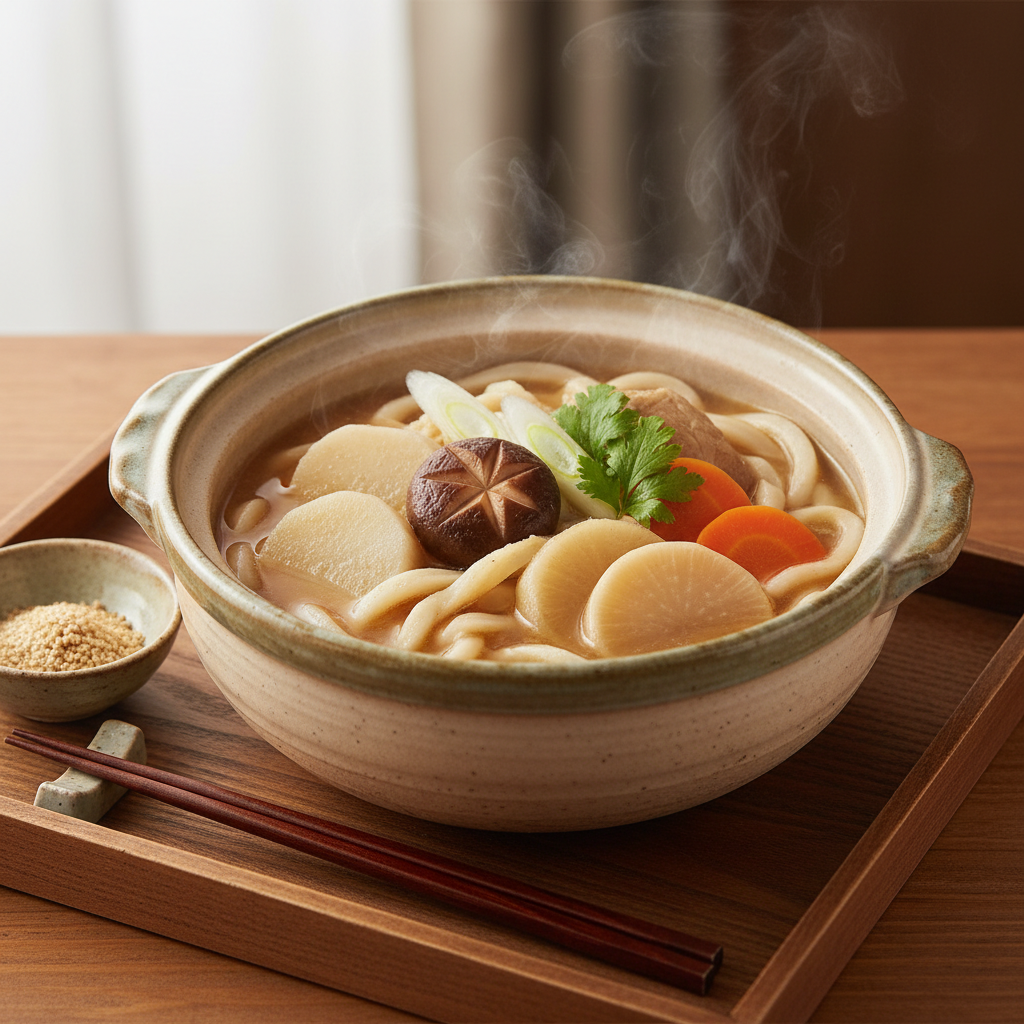
“Okkirikami” (or “okirikami”) is a traditional local dish enjoyed throughout Gunma Prefecture. It is made by placing wide fresh noodles made from wheat flour without salt into a large pot along with seasonal vegetables such as daikon radish, taro, mushrooms, Chinese cabbage, carrots, and green onions, and simmering them directly in a broth based on soy sauce or miso, without boiling. The characteristic feature of this dish is that the noodles are simmered raw without being boiled first. Since the fresh noodles are made without salt, the coating powder on the noodles dissolves into the broth, creating a natural thickening. This thickening warms the body from its core and has been treasured as a nutritional source for getting through Gunma’s cold winters.
Origin of the Name and Regional Variations in How It Is Called
The unique name “okkirikami” is said to have naturally come about from the cooking method of repeatedly “cutting and adding, cutting and adding” noodles. The way it is called varies by region within Gunma Prefecture, with the eastern part of the prefecture also calling it “Niboutou (Simmered Noodles).” Additionally, there are multiple ways to write it as “okirikami” and “okkirikami,” but both refer to the same dish.
Gunma Prefecture’s Deep Connection with Okkirikami
Gunma as a Land of Wheat and Sericulture
Gunma Prefecture has long been known as a land of sericulture and wheat production. In Gunma, where sericulture flourished, the practice of growing wheat between mulberry fields for sericulture was common, and a food culture using wheat flour developed. Along with the prosperity of the sericulture industry, exemplified by the Tomioka Silk Mill, noodle dishes made with wheat flour became established as everyday food.
Gunma Prefecture continues to be a major wheat producer today, with high-quality wheat varieties such as “Norin 61” being cultivated. Noodles made with wheat grown in this region have a unique chewy texture and flavor, becoming an important element supporting the taste of okkirikami.
Major Transmission Areas and Spread Throughout the Prefecture
While okkirikami is eaten throughout Gunma Prefecture, it has been traditionally enjoyed especially in Tone County and Agatsuma County in the northern part of the prefecture, as well as in Maebashi City and Shibukawa City in the central part, and Kiryu City and Ota City in the eastern part. Each region has subtle differences in the vegetables used and seasonings, with family flavors being passed down.
It is also served as a local dish at hot springs such as Shima Onsen and Ikaho Onsen, making it a popular menu item for tourists. Each restaurant’s okkirikami, made with abundant local ingredients, has its own character, and comparing different versions is also enjoyable.
History, Origins, and Related Events
History Dating Back to the Edo Period
The history of okkirikami is thought to date back to the mid-Edo period when stone mills became widespread among common people. Before that, stone mills were precious items, but as they became available in ordinary households, it became easier to grind wheat into flour and make noodles, and the dish became enjoyed as an everyday staple food.
In Gunma’s agricultural villages, okkirikami, which could be easily made with available vegetables and wheat flour during breaks in farm work or in cold winter seasons, was greatly valued. Since it could be made in large quantities at once in a large pot, it was also used to entertain large families and people who came to help with farm work.
Occasions and Seasons for Eating
Okkirikami is particularly favored during cold winter months. With its high warming effect and rich nutritional value, it played an important role as a nutritional source during the winter slack season in farming. Additionally, it was often made in large pots and served at occasions when people gathered, such as New Year’s Day and celebrations or memorial services.
Even in modern times, okkirikami appears on Gunma residents’ dining tables at family gatherings on weekends, during cold dinners, and as nourishing food when having a cold. Because seasonal vegetables are used, the flavors vary throughout the year—mountain vegetables in spring, summer vegetables in summer, mushrooms in autumn, and root vegetables in winter—allowing for different tastes to be enjoyed year-round.
Characteristics and Manufacturing Method of Okkirikami
Main Ingredients Used
The ingredients used in okkirikami are basically seasonal vegetables available in each household. Representative ingredients include the following:
Noodle Ingredients
- Wheat flour (medium or strong flour)
- Water
- Coating powder (potato starch or wheat flour)
Toppings
- Daikon radish
- Taro
- Carrot
- Burdock
- Chinese cabbage
- Green onion
- Mushroom varieties (shiitake, maitake, shimeji, etc.)
- Fried tofu or thick-fried tofu
- Konjac (Gunma specialty)
- Chicken (depending on region and household)
Seasonings
- Soy sauce or miso
- Dashi (dried sardine, kelp, bonito flakes, etc.)
- Mirin
- Sake
Unique Manufacturing Characteristics
The manufacturing method of okkirikami has unique characteristics not found in other noodle dishes.
1. Noodles Made Without Salt
The greatest characteristic is that salt is not added to the noodle dough. Regular udon uses salt to create chewiness, but okkirikami noodles do not use salt. This manufacturing method is premised on simmering, and by not using salt, the noodles absorb the broth’s flavor well, resulting in a unified taste experience.
2. Simmering Raw Noodles
Not boiling the noodles but simmering them raw in the broth is also characteristic of okkirikami. This manufacturing method causes the coating powder on the noodles to dissolve into the broth, creating a natural thickening. This thickening softens the entire dish and also has the effect of keeping it from cooling quickly.
3. Wide Flat Hand-Pulled Noodles
The noodles are wide flat hand-pulled noodles approximately 3 to 5 cm in width. The thickness is approximately 2 to 3 mm, featuring a chewy texture. These wide noodles blend well with vegetables and broth, making it a satisfying dish.
Differences from Himokawaうどん and Houtou
Okkirikami is often compared to “himokawaうどん” and Yamanashi Prefecture’s “houtou.” Let us clarify the differences between each.
Relationship to Himokawaうどん
Himokawaうどん consists of the same wide flat noodles as okkirikami but is a different dish. Himokawaうどん uses salt-added handmade noodles that are boiled once before being eaten in dipping sauce or warm broth, as a type of regular udon. Okkirikami differs in that it does not use salt and is simmered raw. However, in some regions, the noodles themselves used in okkirikami are called “himokawaうどん,” and there is some overlap in terminology.
Differences from Houtou
Yamanashi Prefecture’s local dish “houtou” and okkirikami are very similar in manufacturing method and appearance. Both are dishes where wide raw noodles are simmered with vegetables, but they have the following differences:
- Noodle Hydration Ratio: Houtou tends to have a slightly lower hydration ratio with firmer noodles
- Seasoning: Houtou is basically seasoned with miso, while okkirikami uses both soy sauce and miso
- Ingredients: Houtou characteristically must include pumpkin, while okkirikami often does not include pumpkin
- Cultural Background: Houtou has a legend of being Takeda Shingen’s field meal, while okkirikami developed as everyday farm food
How to Make Okkirikami (Serves 4)
Here is a detailed recipe for making authentic okkirikami at home.
Ingredients (Serves 4)
Noodles
- Wheat flour (medium or strong flour): 300g
- Water: approximately 150ml
- Coating powder (potato starch or wheat flour): as needed
Toppings
- Daikon radish: 200g
- Taro: 4 pieces
- Carrot: 1
- Burdock: 1/2
- Chinese cabbage: 1/4 head
- Green onion: 1
- Shiitake mushrooms: 4 pieces
- Maitake mushrooms: 1 package
- Konjac: 1/2 sheet
- Fried tofu: 2 sheets
- Chicken thigh meat: 200g (optional)
Broth
- Dashi broth: 1.5L
- Soy sauce: 4 tablespoons (or miso 3-4 tablespoons)
- Mirin: 2 tablespoons
- Sake: 2 tablespoons
Instructions
1. Making the Noodles
- Place wheat flour in a bowl and gradually add water while kneading with your hands
- Once the dough comes together, cover with a damp cloth and let rest for about 30 minutes
- On a coating powder-dusted work surface, stretch the dough with a rolling pin to approximately 3-4mm thickness
- Dust with coating powder while folding the dough and cut to approximately 3-5cm width
- Coat the cut noodles with coating powder and spread them out so they do not overlap
2. Preparing the Toppings
- Cut daikon radish and carrot into thick ginkgo leaf shapes
- Peel taro and cut into bite-sized pieces
- Cut burdock into fine strips and soak in water
- Roughly chop Chinese cabbage and diagonally slice green onion
- Remove the base of shiitake mushrooms and slice thin, hand-tear maitake mushrooms
- Hand-tear or break konjac with a spoon and blanch briefly
- Pour hot water over fried tofu to remove oil and cut into thin strips
- Cut chicken into bite-sized pieces
3. Simmering
- Pour dashi broth into a large pot and heat
- Once boiling, add vegetables that take longer to cook (daikon radish, carrot, burdock, taro) and chicken, and simmer
- Once vegetables become tender, add konjac, fried tofu, and mushrooms
- Season with soy sauce, mirin, and sake (if using miso, add later)
- Lightly dust the raw noodles and gradually add them to the pot little by little
- Once noodles are added, loosen with chopsticks and simmer over medium heat for 10-15 minutes
- Add Chinese cabbage and green onion and simmer for about 5 more minutes
- Taste and adjust seasonings as needed
4. Eating Method
The traditional way to eat okkirikami is to serve it directly from the large pot and eat it while piping hot. Portion it into individual bowls and add shichimi togarashi or yuzu kosho to taste. As the noodles absorb more broth and the flavor intensifies, adjust by adding dashi broth. When reheating, warm carefully to avoid scorching. The next day, the noodles absorb even more broth and blend together, offering a different delicious taste.
Famous Restaurants Serving Okkirikami in Gunma Prefecture
There are many famous restaurants throughout Gunma Prefecture that serve traditional okkirikami. Here are restaurants worth visiting when sightseeing, listed by area.
Central Gunma Area
Okkirikami no Furusato
Known as Gunma Prefecture’s representative okkirikami specialty restaurant. It uses 20 to 30 seasonal vegetables, and the gentle-tasting broth with chicken umami blends well with the chewy flat noodles. It carefully uses local ingredients and allows you to enjoy different vegetable combinations by season.
Joshu Inakaya
A rustic-style local cuisine restaurant located near the Iwaji Ruins. The firm, chewy okkirikami with abundant toppings is popular, and the gently sweet soy sauce-based broth warms your body. With abundant Gunma specialties like konjac dishes, you can fully enjoy local cuisine.
Tomioka/Fujioka Area
Hayami
Located in front of the Tomioka Silk Mill main gate, this local cuisine restaurant is also popular with tourists. The location is perfect for stopping by after visiting the world heritage site, offering authentic okkirikami. Using abundant local vegetables, it recreates the traditional taste that workers at the silk mill likely ate.
Shima Onsen Area
Sousui-an
A local cuisine restaurant in Shima Onsen, with all menus supervised by the head chef of the long-established inn Izumiya. The okkirikami is a dish of wide raw noodles simmered together with seasonal vegetables and mushrooms, keeping the authentic manufacturing method of using raw noodles without salt so coating powder dissolves to create thickening. You can enjoy the taste of the region along with the hot spring atmosphere.
Other Popular Restaurants
There are many other okkirikami-serving establishments throughout Gunma Prefecture, and you can enjoy it at roadside stations, tourist facilities, and local restaurants. The type of vegetables used, dashi preparation methods, and seasonings differ subtly at each restaurant, and comparing different versions is part of the fun. It is recommended to confirm by phone before visiting.
Conservation and Transmission Efforts
Designation as Intangible Folk Cultural Property
On March 20, 2014, okkirikami was designated as a Gunma Prefecture selected intangible folk cultural property. This designation officially recognized the value of okkirikami’s manufacturing method and food culture, confirming the importance of conservation and transmission. The prefecture is also working on protecting and fostering local cuisine.
Ministry of Agriculture, Forestry and Fisheries “Local Dishes of Agricultural, Forestry and Fishing Villages Hundred Selections”
Okkirikami was selected for the Ministry of Agriculture, Forestry and Fisheries’ “Local Dishes of Agricultural, Forestry and Fishing Villages Hundred Selections.” Recognized nationally as a valuable local dish and widely introduced as a food culture representing Gunma Prefecture, it is featured in detail on the Ministry of Agriculture, Forestry and Fisheries website “Our Local Dishes” and has attracted attention from across the country.
Activities of the Gunma Prefecture Noodle Manufacturing Industrial Cooperative
The Gunma Prefecture Noodle Manufacturing Industrial Cooperative is actively working on the popularization and transmission of okkirikami. It engages in diverse activities including transmission of noodle-making techniques, standardization of recipes, and provision at events. It is also advancing the commercialization of okkirikami noodles that are easy to make at home, now available at supermarkets both within and outside the prefecture.
Provision in School Lunches
Many schools throughout Gunma Prefecture include okkirikami in their lunch menus. By providing opportunities for children to become familiar with local cuisine, transmission to the next generation is promoted. It plays an important role as part of food education through which students learn regional history and culture via local cuisine.
Utilization as a Tourism Resource
Okkirikami is positioned as an important tourism resource for Gunma Prefecture. Efforts include introduction in tourism brochures and websites, provision at tourist facilities, and planning of gourmet tours centered on okkirikami. It has become important content for allowing out-of-prefecture tourists to experience Gunma’s food culture.
Information Dissemination via SNS and Media
In recent years, information dissemination using SNS has become more active. Photos and videos of okkirikami posted by restaurants and individuals generate buzz, and interest among younger generations is expanding. Articles by food researchers and food writers and television program features have increased, and awareness-raising through contemporary methods is being pursued.
Commercialization and Contemporary Arrangements
While preserving tradition, commercialization suited to contemporary lifestyles is also progressing. Instant noodle-type okkirikami, frozen foods, retort pouch products—easy-to-enjoy products are being developed. Western-style arranged recipes and health-conscious low-calorie versions are also being attempted.
Tips for Enjoying Okkirikami
Seasonal Ways to Enjoy
By changing the vegetables used by season, okkirikami offers different flavors throughout the year.
- Spring: Mountain vegetables (Japanese butterbur sprouts, fatsia sprouts, bracken), new onions, spring cabbage
- Summer: Summer vegetables (eggplant, zucchini, tomato), okra, edamame
- Autumn: Mushroom varieties (maitake, shimeji, enoki), sweet potato, chestnuts
- Winter: Root vegetables (daikon radish, carrot, burdock, taro), Chinese cabbage, green onion
Arrangement Methods at Home
Based on the basic recipe, arranging your own household version is part of okkirikami’s charm.
- Seasoning Variations: Soy sauce-based, miso-based, soy sauce and miso combination, curry-flavored, etc.
- Dashi Creativity: Dried sardine, kelp, bonito flakes, chicken bone broth, pork bone broth, etc.
- Additional Ingredients: Pork, beef, seafood, mochi, cheese, etc.
- Finishing Toppings: Shichimi togarashi, yuzu kosho, butter, sesame oil, etc.
Nutritional Value and Health Benefits
Okkirikami is a well-balanced, healthy dish.
- Carbohydrates: Wheat flour noodles serve as an energy source
- Vitamins and Minerals: Multiple vegetables provide abundant nutrients
- Dietary Fiber: Root vegetables and mushrooms provide abundant dietary fiber
- Protein: Chicken and fried tofu supply protein
- Body-Warming Effect: As a hot soup, it warms the body from its core
Conclusion: Okkirikami Supporting Gunma Prefecture’s Food Culture
Okkirikami is a local dish in which Gunma Prefecture’s history, natural environment, and people’s lives are concentrated. In Gunma, where wheat culture has taken root, this simple dish made from vegetables and wheat flour available in homes has continued to support residents’ dining tables from the Edo period to the present day.
The unique manufacturing method of simmering salt-free noodles raw, the nutritional balance of using abundant seasonal vegetables, and the cultural aspect of gathering around a large pot with family and community members—okkirikami contains many attractions.
Designated as an intangible folk cultural property of the prefecture and selected for the Ministry of Agriculture, Forestry and Fisheries’ local dishes hundred selections, okkirikami will continue to be transmitted as a food culture representing Gunma Prefecture. When visiting Gunma, be sure to taste authentic okkirikami and try making it at home to experience the warmth and deliciousness of this local dish.
Maintaining tradition while embracing contemporary arrangements with flexibility, okkirikami will continue to be loved by many people as Gunma Prefecture’s soul food for years to come.