Mackerel Whole-Fish Sushi from Kochi Prefecture – A Staple of Sarashi Cuisine and Its History and Preparation
What is Mackerel Whole-Fish Sushi?
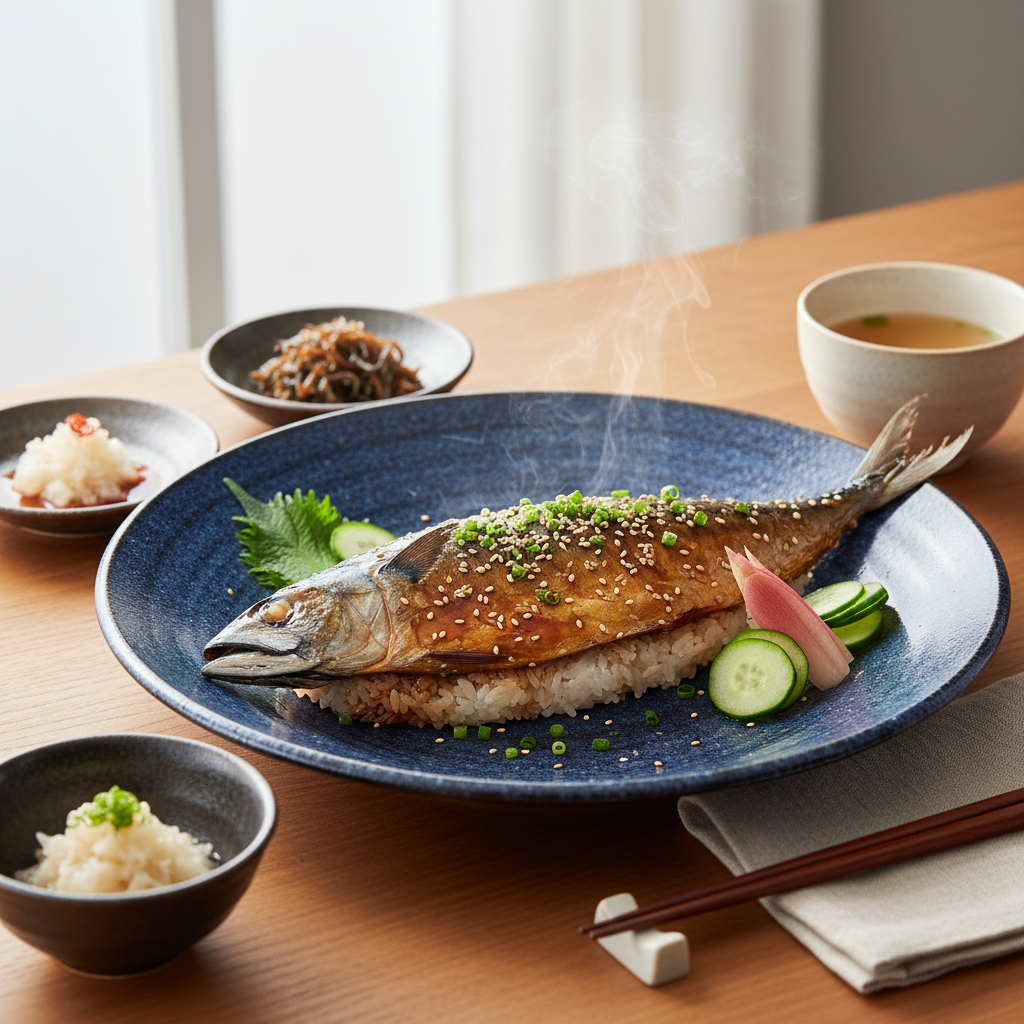
Mackerel whole-fish sushi (saba no sugata zushi) is one of the representative regional dishes of Kochi Prefecture. Made with fresh mackerel split down the back and cured with salt and vinegar, it is a bold whole-fish sushi packed with vinegared rice from head to tail, occupying a special place in Kochi’s food culture.
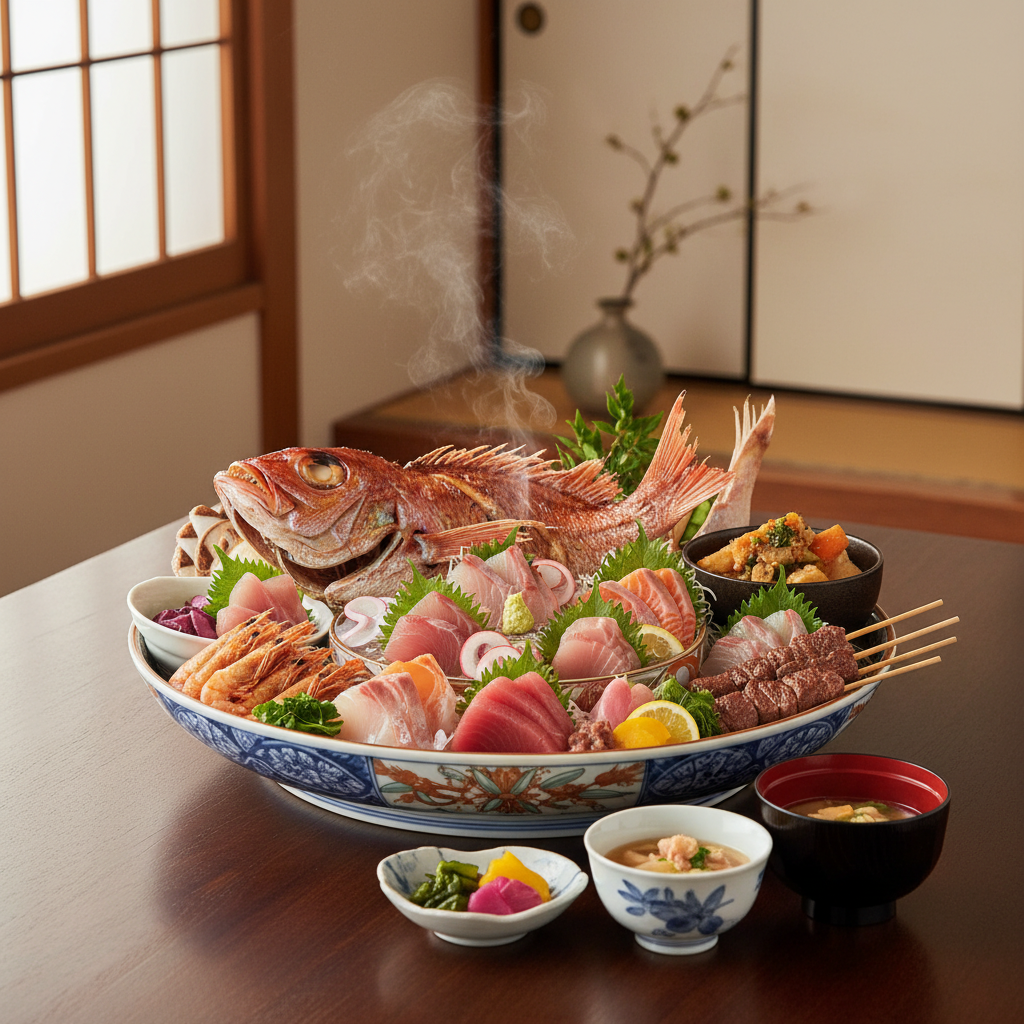
In Kochi Prefecture, banquets called “okkyaku” are held on special occasions such as celebrations, funerals, and religious ceremonies. The mackerel whole-fish sushi serves as an indispensable standard of “sarashi” cuisine (dishes served on large platters) at these gatherings. Presented impressively on a large plate measuring 36 to 39 centimeters with the head and tail standing upright, it is truly emblematic of Tosa’s bold food culture.
Kochi’s Food Culture and Sarashi Cuisine
The “Okkyaku” Culture
In Kochi Prefecture, banquets are called “okkyaku” in the local Tosa dialect. This “okkyaku” is not merely a drinking party, but a unique Kochi cultural practice held whenever people gather for any occasion—celebrations, funerals, religious ceremonies, and community events. It is rooted in the spirit of hospitality toward guests and the importance of human connections, with this eating tradition maintained throughout the prefecture.
Characteristics of Sarashi Cuisine
Sarashi cuisine is known as a representative food culture of Kochi Prefecture. It features lavishly arranged seafood and mountain vegetables on a large platter, with many variations. The contents vary depending on purpose and season—there are sashimi platters, sushi platters, simmered platters, and combination platters.
Facing the Pacific Ocean, Kochi Prefecture benefits from the Kuroshio Current and enjoys abundant fish varieties. Bonito tataki, steamed sea bream, capelin with skin on, and mackerel whole-fish sushi—dishes using fresh seafood grace the center of sarashi platters. These dishes, arranged without gaps on the large plate, truly symbolize Kochi’s blessed natural abundance.
Primary Traditional Areas
Mackerel whole-fish sushi is enjoyed throughout Kochi Prefecture as a regional dish. It is particularly actively prepared in the central to eastern regions of the prefecture and appears almost invariably at celebrations and funerals.
In areas centered around Kochi City, it is offered at restaurants and catering shops, while traditional preparation methods are passed down in households. In the Nakamura district (present-day Shimanto City), there was a custom of putting “konbu sushi,” “egg sushi,” “rolled sushi,” and “mackerel whole-fish sushi” in boxes as gifts to take home after celebrations.
From the western to eastern parts of the prefecture, while there are slight differences in preparation methods from region to region, the basic technique of opening the mackerel down the back and filling it with vinegared rice is common, and it has become established as a familiar regional taste for Kochi residents.
Primary Ingredients Used
Mackerel
The star of mackerel whole-fish sushi is fresh mackerel. In Kochi Prefecture, fatty mackerel caught in the Pacific Ocean is used. Generally, Pacific mackerel is employed, though depending on season and region, Atlantic mackerel may be used. Since this is a dish where freshness is paramount, selecting the freshest possible fish is crucial.
Vinegared Rice
Vinegared rice is made by combining rice with vinegar, sugar, and salt. In Kochi Prefecture, relatively sweet vinegared rice is commonly used, creating an exquisite balance between the mackerel’s umami, the vinegar’s acidity, and the sugar’s sweetness. Rice typically used is locally produced varieties such as Koshihikari.
Seasonings
Salt and vinegar are necessary to cure the mackerel. Coarse salt is used, and rice vinegar is standard, though families and regions have their own unique blends. The amount of sugar used in making the vinegared rice also varies from household to household, with each family’s signature flavor being passed down.
Other Ingredients
When arranging, large shiso leaves, pickled ginger, and yuzu peel may be added. These garnishes further enhance the flavor of the mackerel whole-fish sushi.
History, Origins, and Related Events
The Origins of Mackerel Whole-Fish Sushi
There are various theories about the origins of mackerel whole-fish sushi, but it is believed to have developed against the background of Kochi’s rich fishing grounds and advanced preservation techniques. Before refrigeration technology developed, techniques for curing fish with salt and vinegar were developed to help preserve them longer.
Kochi Prefecture has long had a culture of “narezushi” (fermented sushi). With time, techniques for making quick sushi using vinegar became widespread, and the style of boldly preparing fish whole was established.
Relationship to Sarashi Cuisine
From the Edo to Meiji periods, the culture of sarashi cuisine—arranging dishes on large platters—developed in Kochi Prefecture. The bold spirit influenced by samurai society, combined with abundant food materials from the Pacific, formed a unique banquet culture.
Mackerel whole-fish sushi became central to sarashi cuisine due to its eye-catching appearance and boldness of using the entire fish. The presentation with head and tail standing upright came to be seen as “auspicious” and became indispensable at celebrations such as weddings and religious ceremonies.
Related Events
Throughout the year in Kochi Prefecture, various events feature “okkyaku” banquets where mackerel whole-fish sushi appears. From New Year’s to seasonal festivals, Shinto shrine ceremonies, weddings, and milestone birthday celebrations—sarashi cuisine is prepared for almost every significant occasion, with mackerel whole-fish sushi included.
The connection to religious ceremonies is particularly strong, and the custom remains of preparing sarashi cuisine at autumn festivals honoring local Shinto deities, inviting relatives and neighbors for grand celebrations.
Dining Occasions and Seasons
Cuisine for Special Occasions
Mackerel whole-fish sushi is not an everyday food but positioned as a special delicacy for important events. It is made when people gather for celebrations, funerals, religious ceremonies, house-raising ceremonies, milestone birthday parties, and similar occasions.
Relationship to Seasons
Mackerel becomes fatty and flavorful from autumn through winter, so it is most often prepared during this period. However, with modern refrigeration and freezing technology, it is now possible to prepare it year-round.
During autumn festival season (October to November), “okkyaku” banquets are held throughout the prefecture, increasing demand for mackerel whole-fish sushi. During this season, restaurants and catering shops are inundated with orders, while households can be seen maintaining traditional preparations.
Modern Eating Practices
In recent years, it has become less common for households to prepare it from scratch, with more people ordering from restaurants and catering shops. However, it remains an indispensable dish for celebrations and religious ceremonies, continuing to hold a central place in Kochi’s food culture.
Preparation Method
Basic Cooking Steps
While mackerel whole-fish sushi requires skilled technique in some areas, the basic procedure is as follows.
Ingredients (for 1 fish)
- Mackerel: 1 fish (medium size, approximately 500g)
- Rice: 2 cups
- Salt: as needed (approximately 3% of the mackerel’s weight)
- Vinegar: as needed
- Combined vinegar mixture (vinegar: 4 tablespoons, sugar: 3 tablespoons, salt: 1 teaspoon)
- Large shiso leaves, pickled ginger (as desired)
Preparation
- Use fresh mackerel and remove the internal organs without removing the head
- Split down the back. Make an incision along the backbone, leaving the belly closed and opening from the back
- Carefully remove the central bone. Use tweezers to remove any fine bones
- Sprinkle salt on both sides of the opened mackerel and let sit for 30 minutes to 1 hour
- Rinse away the salt and pat dry thoroughly
- Soak in vinegar for 10 to 15 minutes to cure the mackerel
- Remove from vinegar and pat dry
Vinegared Rice Preparation
- Cook the rice and, while hot, pour the combined vinegar mixture over it
- Mix with a shamoji in a cutting motion and fan with a uchiwa to cool
- Use once it has cooled to body temperature
Shaping
- Place the mackerel skin-side down on a cutting board
- Place vinegared rice on the mackerel’s flesh, filling evenly from head to tail
- Mound the vinegared rice generously in a peaked shape
- Close the mackerel’s flesh around the vinegared rice
- Wrap in cloth or plastic wrap and shape
- Let sit with a weight for 30 minutes to 1 hour to set
Plating
- Remove the cloth and plate with head and tail standing upright
- Cut into serving-size pieces (typically about 1.5 centimeters thick)
- When plating on a sarashi platter, arrange the cut pieces in a circle with the head and tail standing in the center
- Garnish with shiso leaves or pickled ginger to finish
Preparation Pointers
- The mackerel’s freshness is most important. Select fish with clear eyes and firm flesh
- Adjust the salt-curing time depending on the mackerel’s size and thickness
- The sweetness of the vinegared rice can be adjusted to preference, though a relatively sweet version is traditional in Kochi
- When filling with vinegared rice, pack it firmly without gaps
- Be careful when applying weight, as too much pressure will damage the flesh
Recipe Variations
In addition to traditional methods, modern versions feature various adaptations. Some incorporate yuzu peel into the vinegared rice, others add sesame or myoga. Individual households and restaurants apply their own innovations.
There is also a method of lightly searing the mackerel before use, called grilled mackerel sushi, which adds a smoky aroma and different flavor profile.
How to Eat
Basic Eating Method
Mackerel whole-fish sushi is typically served cut into pieces about 1.5 centimeters thick. It can be eaten by hand or with chopsticks.
At “okkyaku” gatherings, each person takes pieces from the large platter. In Kochi’s banquet culture, there is a custom called “henhai” of exchanging cups of alcohol while enjoying the food. Mackerel whole-fish sushi pairs particularly well with sake, with the vinegar’s acidity and mackerel’s umami enhancing the taste of the drink.
Pairing with Garnishes
Eating with pickled ginger or shiso leaves enhances the flavor further. Some people dip it in a small amount of soy sauce, though traditionally it is eaten plain. Since it is well-cured with vinegar, it is delicious even without garnishes.
Storage and Shelf Life
Freshly made is best, but it can be stored in a refrigerator for the next day. The vinegared rice will harden, so eating it soon after making is recommended.
There is also a custom in Kochi of eating leftover mackerel whole-fish sushi the morning or afternoon after an “okkyaku” gathering, which has become part of the prefecture’s food culture.
Differences from Kyoto Mackerel Sushi
Mackerel whole-fish sushi is sometimes compared to Kyoto mackerel sushi (stick sushi). While both use mackerel, there are several significant differences.
Differences in Form
Kyoto mackerel sushi uses one side of a mackerel fillet and forms it into a long stick shape. Kochi’s mackerel whole-fish sushi, by contrast, is split down the back and finished with the head and tail intact, maintaining the fish’s whole form. Preserving this “whole” aspect symbolizes Kochi’s bold food culture.
Differences in Cooking Method
Kyoto mackerel sushi is often wrapped in kelp and aged, aiming for a refined taste. Kochi’s mackerel whole-fish sushi is thoroughly cured with salt and vinegar, and boldly packed with vinegared rice, characterized by a robust flavor.
Differences in Cultural Background
Kyoto mackerel sushi is rooted in the history of the “mackerel road” along which fish was transported from Wakasa to Kyoto and eaten at festivals and events. Kochi’s mackerel whole-fish sushi developed within the “okkyaku” banquet culture as part of sarashi cuisine.
Both are excellent regional dishes reflecting local history and culture, but their origins and characteristics are distinctly different.
Other Kochi Regional Sushi
Kochi Prefecture has other distinctive regional sushi varieties besides mackerel whole-fish sushi.
Country Sushi
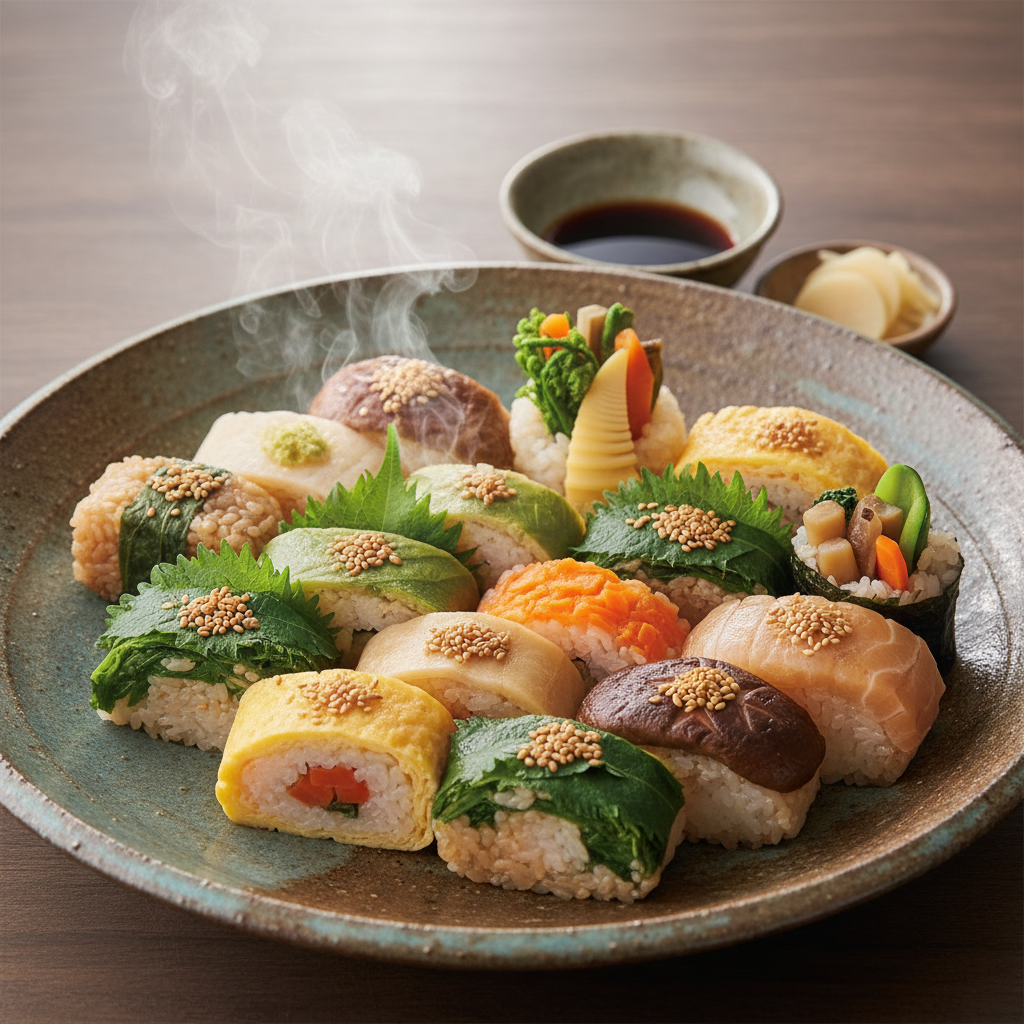
Country sushi (inaka zushi) is made with mountain vegetables including myoga, riukyu (stem of taro), four-direction bamboo, shiitake mushrooms, and konjac combined with vinegared rice. If mackerel whole-fish sushi represents seafood delicacies, country sushi represents mountain delicacies of the region.
On sarashi platters, mackerel whole-fish sushi and country sushi are often served together, allowing simultaneous enjoyment of both sea and mountain bounty.
Kelp Sushi
Sushi wrapped in kelp, made by wrapping vinegared rice in kelp. The umami of the kelp and the sweet-tart flavor of the vinegared rice combine harmoniously in this elegant-tasting sushi.
Egg Sushi
Sushi wrapped in thin omelet with a gentle flavor. The yellow color adds visual interest to sarashi platters.
These regional sushi varieties are sometimes collectively referred to as “Tosa sushi,” forming Kochi’s unique sushi culture.
Preservation and Succession Efforts
The Tosa Sushi Promotion Association
In 2018, Kochi Prefecture established the “Tosa Sushi Promotion Association” through public-private partnership. This organization promotes Kochi’s distinctive sushi culture, including mackerel whole-fish sushi and country sushi, disseminating its appeal both within and outside the prefecture and working toward its popularization and preservation.
Specific efforts include demonstration sales at events, cooking classes, and information sharing through social media, with emphasis on transmission to younger generations.
Ministry of Agriculture, Forestry and Fisheries Initiatives
The Ministry of Agriculture, Forestry and Fisheries’ “Our Regional Cuisine” project features mackerel whole-fish sushi as a representative regional dish of Kochi Prefecture. Recipes, history, and cultural background are detailed in materials distributed nationwide, promoting Kochi’s food culture.
Local Succession Activities
Throughout Kochi Prefecture, traditional cooking classes and food education activities transmit the methods of preparing mackerel whole-fish sushi to future generations. Efforts include incorporating it into school lunches and demonstrations at local festivals.
Commercialization Efforts
In recent years, commercialization using vacuum-packing and freezing technology is progressing. Shipment outside the prefecture has become possible, allowing people from Kochi and tourists to enjoy the authentic taste at home.
Kochi’s food culture is spreading through modern methods such as online shop sales and use as gifts for local tax contributions.
Restaurant Provision
Some regional cuisine restaurants and izakayas in Kochi City provide mackerel whole-fish sushi year-round. An environment where tourists can easily experience the authentic taste has been established, making it one of the dining pleasures when visiting Kochi Prefecture.
The Appeal of Mackerel Whole-Fish Sushi
Coexistence of Boldness and Delicacy
The greatest appeal of mackerel whole-fish sushi lies in the coexistence of its bold appearance with head and tail intact and its delicately refined flavor. Though seemingly a daring dish at first glance, it requires careful technique and experience regarding the mackerel’s curing, the vinegared rice’s sweetness, and overall balance.
The Bounty of Kochi’s Nature
Fresh mackerel brought by the Pacific’s Kuroshio Current and rice grown in clear streams—this dish concentrates nature’s bounty. It is truly a flavor born from Kochi’s abundant natural environment.
Community Bonds
Gathering around sarashi cuisine at “okkyaku” banquets and sharing mackerel whole-fish sushi symbolizes the connections among Kochi’s people. Through food, people bond—such a warm culture thrives here.
Transmission of Tradition
Flavors and techniques passed down through generations. A family’s taste transmitted from grandmother to mother to daughter. Each household has subtle differences, and these differences tell each family’s history.
Conclusion
Mackerel whole-fish sushi has been nurtured through a long history as a regional dish representative of Kochi’s food culture and is deeply rooted in residents’ lives as a standard of sarashi cuisine at celebrations and religious ceremonies.
Its presentation—mackerel split down the back, packed with vinegared rice from head to tail, and boldly plated with head and tail standing—expresses the very spirit of Tosa. The bounty of the Pacific, technique passed down through generations, and the heart that cherishes human connection—all are concentrated in mackerel whole-fish sushi.
Through preservation and succession efforts including the “Tosa Sushi Promotion Association,” this wonderful food culture is surely being passed to the next generation. When visiting Kochi Prefecture, by all means taste authentic mackerel whole-fish sushi and feel its boldness, delicacy, and the rich culture it represents.
Regional cuisine is a cultural heritage that concentrates a region’s history, nature, and people’s lives. Through mackerel whole-fish sushi, one can rediscover Kochi’s charm and the wonder of Japan’s diverse food cultures.