Kozuyu – A Complete Guide to the Traditional Local Cuisine Proud of the Aizu Region of Fukushima Prefecture
“Kozuyu,” a local dish passed down since ancient times in the Aizu region of Fukushima Prefecture, is an indispensable dish for important occasions such as ceremonial events and New Year’s. The history and culture of Aizu are condensed in this dish, in which the bounty of mountains and sea simmered in the refined broth of scallop adductor muscle is savored in a vermillion-lacquered bowl of Aizu ware. This article provides a comprehensive introduction to this traditional dish, from its origins and how to prepare it to modern efforts in its preservation.
Kozuyu – A Local Dish Representing Aizu
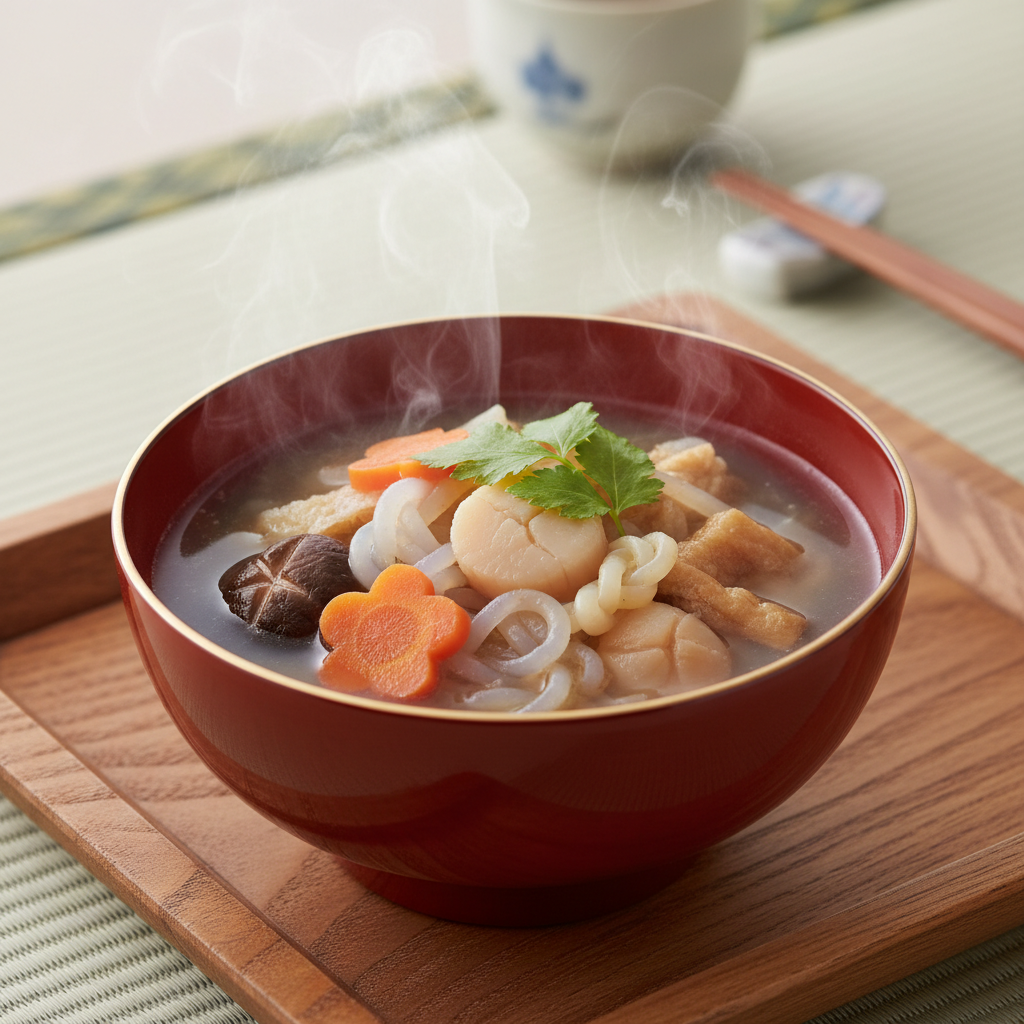
Kozuyu is a traditional soup dish that has been passed down since the Edo period in the Aizu region of Fukushima Prefecture. Because Aizu is an inland region where marine products were difficult to obtain, cooking using preserved dried foods developed. A prime example is kozuyu, a light and refined clear broth made with scallop adductor broth to which soybean fu (wheat gluten), taro, carrot, shiitake mushroom, wood ear fungus, and vermicelli konnyaku are added.
There are various theories about the origin of the name “kozuyu,” but the most plausible is that it was placed in a small vermillion-lacquered bowl of Aizu ware made shallowly called “teshio-sara” (salt plate), and “kojuu no tsuyu” (small tiered soup) became “kozuyu” over time. This dish is eaten in most areas of Aizu, and while there are slight differences in ingredients and seasoning depending on the region, the basic preparation method is common.
History, Origins, and Related Events
The Lineage of Cuisine Beginning with the Aizu Domain Feudal Lord
Kozuyu is said to have its roots in a dish called “kasane” that the eighth feudal lord of the Aizu domain, Matsudaira Katataka, ate during his sankin-kotai (attendance at court). It is believed that the feudal lord who traveled to Edo for sankin-kotai was exposed to the refined culinary culture of Kyoto and Edo, and brought it back to Aizu, which became the prototype of kozuyu.
During the Edo period, Aizu, despite being an inland region, was incorporated into the trade routes of the kitamae-bune (early Japanese cargo ships), and dried marine products were transported overland from ports on the Japan Sea side. Scallop adductor muscle in particular was treasured as a luxury item and was used in special occasion dishes. This historical background gave rise to the unique dish of kozuyu, which combines the bounty of the sea with the bounty of the mountains.
Traditional Cuisine to Brighten “Hare” Days
Kozuyu is positioned as a dish for “hare” days (special occasions), and has always been served at special gatherings such as New Year’s, weddings, memorial services, and festivals. In traditional Aizu celebratory menus, kozuyu is regarded as a symbol of “hospitality spirit,” allowing unlimited servings, and is an indispensable dish when entertaining guests.
Especially during New Year’s, there is a custom of eating kozuyu every day from New Year’s Day through the third day, and it is cherished as an important dish for the family to celebrate the new year together. At weddings, it serves as an auspicious dish celebrating the newlyweds’ new beginnings; at memorial services, it serves as a dish to mourn the deceased and entertain attendees, each playing an important role in their respective occasions.
Major Areas of Transmission
Kozuyu is a local dish transmitted throughout the Aizu region of Fukushima Prefecture, but it is particularly actively prepared in the area centered on Aizuwakamatsu City. The Aizu region consists of municipalities including Aizuwakamatsu City, Kitakata City, Bandai Town, Inawashiro Town, Aizusaka Town, Yukawa Village, Yanaizu Town, Mishima Town, Kaneyama Town, Showa Village, and Aizumiisri Town, with slightly different tastes of kozuyu inherited in each region.
Aizuwakamatsu City has a history of flourishing as the castle town of the Aizu domain, and the tradition of samurai cuisine remains strong in the region. Here, kozuyu is made particularly according to formal methods, with detailed rules for how to cut ingredients and arrange them. On the other hand, in rural areas, there is a tendency to make more homestyle and voluminous kozuyu, with unique arrangements such as adding local specialties.
Main Ingredients Used
Scallop Adductor – The Key to the Broth
The key ingredient that determines the taste of kozuyu is the broth made from scallop adductor muscle. Dried scallop adductor muscle is distributed as “dried scallop adductor,” and is used after being rehydrated with water. The refined and deep umami that emerges from these adductors supports the overall taste of kozuyu. Using high-quality dried scallop adductor is the first step to making delicious kozuyu.
Mame Fu (Bean Wheat Gluten) – An Iconic Ingredient of Kozuyu
Mame fu is a small round wheat gluten unique to the Aizu region and an essential ingredient in kozuyu. About one centimeter in diameter, it has an adorable shape, absorbs plenty of broth, and becomes fluffy in texture. This mame fu is a traditional food ingredient of Aizu and is used in various dishes besides kozuyu. It can be purchased at local supermarkets and souvenir shops, but if unavailable, komachi fu or similar can be substituted.
The Bounty of Mountains – Taro, Shiitake Mushroom, Wood Ear Fungus
The bounty of the mountains brought from Aizu’s rich mountains is also an important component of kozuyu. Taro is cut into bite-sized pieces and adds a moist texture and gentle sweetness. Dried shiitake mushroom is often used, rehydrated with water, and sliced thinly. Wood ear fungus is also made from dried products, and its crispy texture serves as an accent. These ingredients absorb the umami of the broth while each expressing its own character.
Other Ingredients – Carrot, Vermicelli Konnyaku, Bracken
Carrot is an important ingredient that adds color, cut into julienne or flower shapes. Vermicelli konnyaku is cut into convenient lengths, briefly boiled, then added. Bracken is a wild vegetable harvested in Aizu mountains, and the canned version is used. Depending on the region, other wild vegetables such as bamboo shoots, butterbur, and ostrich fern may be added, with ingredient variations depending on the season and household.
Ingredients (Serves 4)
Basic Ingredients
- Dried scallop adductor: 4-5 pieces (about 30g)
- Water: 1200ml
- Mame fu: 20-30 pieces
- Taro: 4-5 pieces (medium size)
- Carrot: 1/2 piece
- Dried shiitake mushroom: 4-5 pieces
- Wood ear fungus: 5-6 pieces (dried)
- Vermicelli konnyaku: 100g
- Canned bracken: 50g
Seasonings
- Light soy sauce: 2-3 tablespoons
- Sake: 2 tablespoons
- Salt: 1/2-1 teaspoon
- Mirin: 1 tablespoon (optional)
Preparation Method
Prep Work
- Rehydrate dried scallop adductor: Soak the dried scallop adductor in water (from the measured amount) from the day before. If in a hurry, it can be rehydrated in lukewarm water for 2-3 hours, but slowly rehydrating over time brings out more umami. Save the rehydration liquid to use as broth.
- Rehydrate dried shiitake mushroom and wood ear fungus: Rehydrate the dried shiitake mushroom in water, remove the hard base, and slice thinly. Rehydrate the wood ear fungus in water and cut into bite-sized pieces if large. The rehydration liquid can be added to the broth to increase flavor.
- Prepare vegetables: Peel the taro, cut into bite-sized pieces, and lightly boil to remove sliminess. Cut carrot into julienne or flower shapes. Cut vermicelli konnyaku into convenient lengths, briefly boil to remove bitterness. Cut bracken into convenient lengths and drain well.
Cooking Steps
- Make the broth: Place the rehydrated scallop adductor and rehydration liquid, and shiitake rehydration liquid into a pot and bring to heat. Once boiling, reduce to low heat and simmer for 15-20 minutes to draw out the umami from the adductors. Remove the adductors and shred them.
- Simmer the ingredients: Add taro to the broth and simmer over medium heat. When the taro is tender, add carrot, shiitake mushroom, wood ear fungus, vermicelli konnyaku, and bracken, and simmer for another 10 minutes.
- Season: Adjust the taste with light soy sauce, sake, and salt. Kozuyu is based on light seasoning, so season conservatively. Adjust gradually while tasting.
- Add mame fu and scallop: Finally, add the mame fu and shredded scallop adductor and simmer for 2-3 minutes. It is complete when the mame fu has absorbed the broth and becomes fluffy.
- Plate: Arrange the ingredients beautifully in an Aizu-lacquered vermillion bowl or shallow bowl. Traditional plating considers color balance so each ingredient is visible in a balanced way.
Occasions and Seasons for Eating
Kozuyu at New Year’s
Kozuyu is an essential dish at New Year’s in the Aizu region. From the morning of New Year’s Day, kozuyu appears on the table alongside soup with mochi, and is eaten almost daily for the first three days of the year. New Year’s kozuyu is made particularly carefully, and often becomes a luxurious version with extra ingredients. Preparation begins in late December, with large quantities made on New Year’s Eve and reheated throughout the three-day New Year’s period.
Kozuyu at Ceremonial Events
Kozuyu is served as one of the dishes at wedding receptions, where it plays an important role as an auspicious dish celebrating the newlyweds’ new beginnings and as a dish that conveys Aizu’s tradition. At memorial services, kozuyu is prepared to entertain attendees and has become a standard menu item when dining together while mourning the deceased.
Local Festivals and Gatherings
Kozuyu is frequently prepared at festivals and community gatherings held throughout the Aizu region. Whether at shrine festivals, village gatherings, or meals following communal farm work, kozuyu is often provided when people gather, and also serves the role of deepening community communication.
How to Eat
Enjoying in Aizu Lacquerware
Kozuyu is traditionally served in lacquerware called Aizu ware. In particular, a shallow vermillion-lacquered bowl called “teshio-sara” (salt plate) is often used, and the colorful ingredients arranged in this bowl make it visually beautiful. The red Aizu lacquerware not only enhances the dish but also serves as an important element in creating the elegance of special occasions.
A Dish That Allows Unlimited Servings
One characteristic of kozuyu is the custom of “allowing unlimited servings.” In Aizu, encouraging guests to “please help yourself to seconds” without hesitation is how the spirit of hospitality is expressed. Because of its light seasoning and refined taste, one never tires of eating multiple servings, and its lightness means it doesn’t burden the stomach.
Dining Etiquette
At formal occasions, there are certain manners to observe when eating kozuyu. First, hold the bowl with both hands and lift it, then eat the ingredients one by one carefully with chopsticks. Drink the broth quietly without making noise, and after finishing, gently place the bowl back in its original position. When requesting seconds, it is considered proper etiquette to empty the bowl first and wait to be offered more.
Preservation and Transmission Efforts
Transmission Activities in the Community
Various efforts are being made in the Aizu region to transmit the tradition of kozuyu to the next generation. Aizuwakamatsu City and surrounding municipalities regularly hold local cuisine classes where local elders serve as instructors to teach younger generations how to prepare kozuyu. Additionally, an increasing number of elementary and junior high schools have incorporated kozuyu preparation into home economics classes and integrated learning periods.
Utilization as a Tourism Resource
An increasing number of restaurants and accommodations in the Aizu region serve kozuyu to tourists. Restaurants in Aizuwakamatsu City offer a range of options, from traditional kozuyu to modern interpretations. Tourism associations and local food culture promotion organizations actively promote kozuyu as a representative local dish of Aizu, featuring it in tourism pamphlets and websites.
Commercialization Efforts
In recent years, product development to enjoy kozuyu more easily has progressed. Retort-packed and freeze-dried kozuyu are sold, purchased as souvenirs by tourists visiting Aizu or by Aizu natives living far away who wish to taste their homeland. Additionally, ingredient sets and seasoning kits for kozuyu are also sold, making it possible to prepare authentic kozuyu at home.
Information Sharing Through Social Media
Active information sharing about kozuyu through social media, particularly among younger generations, is increasing. On Instagram and Twitter, photos of homemade kozuyu and reviews of kozuyu eaten at restaurants are posted, with information shared using hashtags such as “#kozuyu” and “#aizu local cuisine.” YouTube has published videos explaining how to prepare kozuyu, creating an environment for visual learning.
Activities of Preservation Societies and Research Organizations
There are several organizations in the Aizu region dedicated to the preservation and transmission of local cuisine. These organizations record recipes for kozuyu and other Aizu local dishes and conduct activities to preserve cooking techniques. Additionally, they hold lectures and symposiums on local cuisine to widely advocate the importance of food culture. Universities and research institutions are also advancing research on the nutritional value, health effects, and historical background of kozuyu, and its value is recognized from an academic perspective.
Nutritional Value and Health Benefits of Kozuyu
Kozuyu is also drawing attention as a nutritionally balanced and healthy dish. Scallop adductor is high in protein and low in fat, rich in taurine and B vitamins. Taro is abundant in dietary fiber and has the effect of improving intestinal health. Wood ear fungus contains vitamin D and calcium, contributing to bone health. Shiitake mushroom contains β-glucan, which is said to have immune-boosting effects.
Additionally, light seasoning with reduced salt content aligns with modern health-conscious eating. Because it contains many ingredients and allows one to consume various nutrients in a single bowl, it is evaluated as a nutritionally balanced meal. Being a warm soup, it also has the effect of warming the body, making it particularly valued during Aizu’s cold winters.
Modern Interpretations of Kozuyu
While preserving tradition, modern interpretations of kozuyu adapted to contemporary lifestyles have also emerged. Quick recipes using commercially available white dashi or scallop-flavored dashi packets, or methods using a pressure cooker to shorten cooking time, have been introduced. Additionally, vegetarian versions using kombu and dried shiitake for broth instead of adductor muscle, or Western-style interpretations made as soup, have also been devised.
Among younger generations, attempts to repurpose kozuyu into other dishes can be seen. Rice cooked with kozuyu ingredients and broth, or noodle broths made with kozuyu as a base, are creative dishes enjoyed in homes. This flexible approach plays an important role in transmitting traditional cuisine to the next generation.
Kozuyu as an Expression of Aizu’s Food Culture
Kozuyu is not merely a dish but a “food cultural heritage” in which the history, geography, society, and culture of the Aizu region are condensed. The ingenuity of utilizing marine products despite being inland, the wisdom of incorporating abundant mountain bounty, the custom of people gathering and dining together on special occasions, and the spirit of treasuring hospitality—all are expressed in this single bowl of cuisine.
In the Aizu region, the belief that “a meal should be prepared with care and served with care” is deeply rooted, and kozuyu is its symbolic embodiment. The custom of allowing unlimited servings expresses the warm hearts of Aizu people: “We treasure our guests and entertain them until they are satisfied.”
Conclusion – A Taste to Pass to Future Generations
Kozuyu, a traditional local dish of which Fukushima Prefecture’s Aizu region is proud, has been passed down for over 400 years. The refined taste of scallop adductor broth and the bounty of mountains and sea have been woven together, existing alongside the lives of Aizu people, and continue to be loved as a special dish to brighten special occasions.
Even today, the culture of kozuyu is protected and developed in various ways through community transmission activities, utilization as a tourism resource, commercialization efforts, and information sharing through social media. While respecting tradition, incorporating flexible arrangements suited to the era has made it a dish familiar to younger generations.
Kozuyu is a dish symbolizing the richness of Aizu’s food culture and an important cultural heritage expressing the region’s identity. Ensuring that this traditional taste is reliably passed on to the next generation not only preserves the food culture of the Aizu region but also contributes to maintaining the diversity of cuisine throughout Japan. When visiting Aizu, by all means taste authentic kozuyu and experience its history and culture.