Karashi Renkon: Everything About Kumamoto Prefecture’s Traditional Local Dish with 400 Years of History
Karashi renkon (mustard lotus root), a representative local dish of Kumamoto Prefecture, is a unique dish made by filling the holes of lotus root with spicy mustard miso, coating it with a golden batter, and deep-frying it. The crisp texture of the lotus root and the sharp stimulation of the mustard miso harmonize exquisitely, and it has been loved by the people of Kumamoto for approximately 400 years. This article provides a detailed explanation from every angle, including the history of this traditional dish, its preparation method, how to eat it, and efforts to preserve and pass it on.
What is Karashi Renkon?
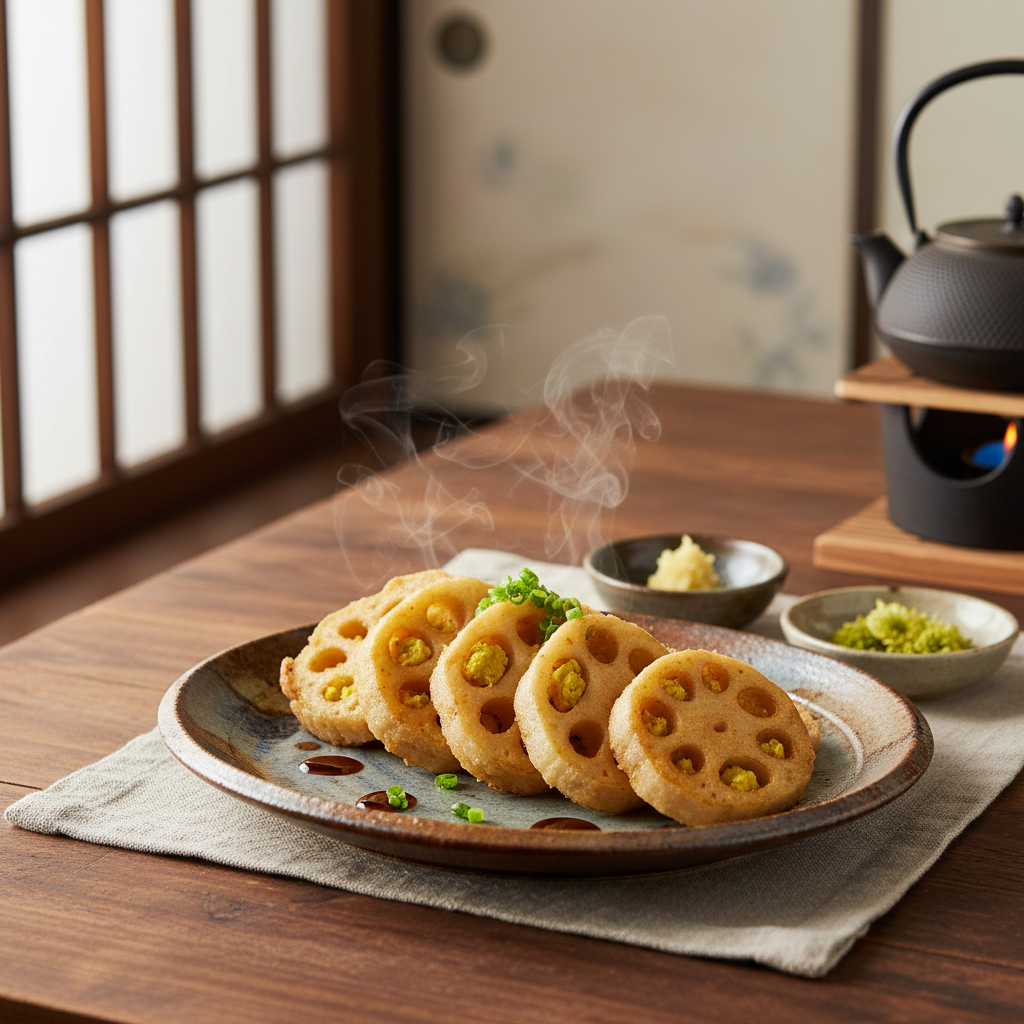
Karashi renkon is a traditional local dish eaten throughout Kumamoto Prefecture, centered in Yatsushiro City and Kumamoto City. It is characterized by an original cooking method that takes advantage of the natural shape of the holes in lotus root, fills them with miso mixed with mustard, and then coats the whole thing with a batter made of wheat flour mixed with egg yolk before deep-frying.
In appearance, it is a beautiful fried dish that gleams golden, and the cross-section reveals the mustard miso stuffed in the lotus root holes. This beauty of the cross-section is also considered one of the attractions of karashi renkon. Locally, it is enjoyed as an ingredient in New Year’s feast dishes and as an accompaniment to alcohol, and has become a must-try specialty for tourists visiting Kumamoto.
Characteristics of Karashi Renkon
- Texture: Crispy on the outside, with the characteristic crunch of lotus root on the inside
- Flavor: A harmony of the sharp stimulation of mustard, the umami of miso, and the natural sweetness of lotus root
- Appearance: Golden-colored batter with mustard miso visible in the lotus root holes on the cross-section
- Nutritional value: Lotus root’s vitamin C, dietary fiber, and the metabolism-promoting effects of mustard
History, Origins, and Related Events
Born as a Nourishing Dish for the Hosokawa Clan Daimyo
The history of karashi renkon dates back to Kan’ei 9 (1632). In this year, Hosokawa Tadatoshi, the first daimyo of the Higo Hosokawa clan, entered Kumamoto, but Tadatoshi was frail from birth and had concerns about his health.
Concerned about this situation, the Buddhist priest Gensaku of Suizenji (or Rakan Temple) ordered the clan’s cooks to devise a nutritious dish to promote the daimyo’s recovery. At the time, lotus root was known as an auspicious item that “provides a clear view,” while also being considered nutritious. Additionally, mustard was believed to warm the body and stimulate appetite.
A cook named Heigoro (said to be an ancestor of the Mori karashi renkon family) came up with the original cooking method of stuffing mustard miso into the holes of lotus root and presented it to Daimyo Tadatoshi. It is said that the holes in the lotus root resembled the Hosokawa family crest, the “kuyo mon” (nine-star pattern), which was also one of the reasons it was welcomed as an auspicious dish.
From Forbidden Secret to Common People’s Food
Throughout the Edo period, karashi renkon was designated as a “forbidden dish” of the Hosokawa clan, kept as a closely guarded secret. Only the daimyo and high-ranking samurai could eat this special dish, and its preparation method was strictly protected.
This situation changed dramatically after the Meiji Restoration. With the collapse of the feudal system, the preparation method of this previously secret luxury dish was gradually revealed to the common people. The dish rapidly became popular among the people of Kumamoto.
Current Status
Today, karashi renkon has become a well-known local dish representative of Kumamoto Prefecture nationwide. It has been selected by the Ministry of Agriculture, Forestry and Fisheries as part of “Our Local Dishes,” and is recognized as a dish symbolizing Kumamoto’s food culture.
Main Transmission Areas and Lotus Root Producing Regions
Production and Consumption in Kumamoto Prefecture
While karashi renkon is eaten throughout Kumamoto Prefecture, Yatsushiro City and Kumamoto City are particularly central areas. This is deeply related to these regions being known as traditional lotus root production areas.
Kumamoto Prefecture is a lotus root producing area with a high output nationally. Especially in the southwestern part of Kumamoto City, there is a long history of lotus root cultivation, and the stable supply of high-quality lotus root has supported the development of karashi renkon culture.
Distribution of Specialty Shops
Kumamoto City has numerous specialty shops dedicated to karashi renkon. Established shops such as “Ganso Mori Karashi Renkon,” “Ueda Karashi Renkon Shop,” and “Murakami Karashi Renkon Shop” line the streets, each preserving their own unique preparation method and flavor. Most of these specialty shops use fresh lotus root purchased from contract farmers and insist on traditional handmade preparation methods.
Main Ingredients Used and How to Select Them
Basic Ingredients
The main ingredients needed to make karashi renkon are as follows (for 7-9 pieces):
Lotus Root
- Fresh lotus root 7-9 pieces (thick with well-defined holes)
- Kumamoto Prefecture-grown lotus root is optimal
Spicy Mustard Miso
- Japanese mustard powder as needed
- White miso or barley miso as needed
- Sugar as needed
- Mirin as needed
- A small amount of sake
Batter
- Wheat flour as needed
- 2-3 egg yolks
- A small amount of turmeric (for coloring)
Frying Oil
- Rapeseed oil or soybean oil
How to Select Lotus Root
In making karashi renkon, the selection of lotus root is extremely important. Pay attention to the following points when selecting:
- Thickness: Choose thick pieces with uniform thickness
- Hole condition: Choose pieces with clearly defined holes that are not clogged
- Color: Choose white pieces with no discoloration
- Firmness: Choose pieces with appropriate hardness, not too soft
- Damage: Choose pieces with few scratches or dark spots on the surface
Specialty shops often use special lotus root purchased from contract farmers, selecting varieties with larger holes that are easier to fill with mustard miso compared to common varieties.
Types of Mustard and Blending
It is traditional to use Japanese mustard. Since the flavor differs from Western mustard, use Japanese mustard powder if seeking authentic taste. Adjust the spiciness by adjusting the amount of mustard.
Some shops use white miso and others use barley miso, each becoming a characteristic of that shop. Using white miso produces a mellow sweetness, while using barley miso creates a rich flavor.
Preparation Method (Traditional Technique)
The preparation method of karashi renkon is guarded as a secret by each specialty shop, but the basic approach is as follows.
1. Preparing the Lotus Root
- Wash the lotus root well and peel the skin (though some shops use it unpeeled)
- Cut off both ends and align the length
- Soak in vinegared water to prevent discoloration
- Wipe away moisture thoroughly
2. Preparing the Spicy Mustard Miso
- Mix Japanese mustard powder with a small amount of lukewarm water to bring out the pungency
- Mix together miso, sugar, mirin, and sake
- Add the prepared mustard and mix well
- Adjust to appropriate consistency (firm enough to fill the lotus root holes)
3. Filling the Holes with Mustard Miso
- Using a piping bag or specialized tool, fill each hole in the lotus root with mustard miso
- Push firmly to the back of each hole, avoiding air pockets
- Wipe away any excess miso from the surface
- Let sit in the refrigerator overnight to allow flavors to blend
4. Coating with Batter and Frying
- Mix wheat flour, egg yolk, turmeric, and water to make the batter
- Coat the entire lotus root evenly with the batter
- Deep-fry in oil at 160-170 degrees until golden brown
- Drain oil well and let cool
5. Finishing
- Slice into rings approximately 5-7mm thick
- Verify the beauty of the cross-section
- Arrange on a serving plate
At specialty shops, all of these steps are done by hand, with each piece carefully finished. The step of filling the mustard miso into the holes is particularly demanding of skilled technique, and filling firmly all the way to the back of each hole is said to be the secret to deliciousness.
Occasions for Consumption and Seasons
Year-Round Consumption
Karashi renkon is generally eaten throughout the year, though there are specific seasons when demand increases.
New Year and New Year’s Feast Dishes
The season with the greatest increase in consumption is year-end and New Year. In Kumamoto Prefecture, many households include karashi renkon as a dish in their New Year’s feast, making it an indispensable part of New Year celebrations. The auspiciousness of the lotus root’s “providing a clear view” and the resemblance of its holes to the Hosokawa family crest make it a dish befitting New Year celebrations.
As year-end approaches, specialty shops are flooded with orders, with production unable to keep pace with demand. Large quantities are also sold at local supermarkets and department stores as New Year products.
As an Everyday Side Dish
Recently, popularity as an everyday side dish has grown beyond just New Year. It is consumed year-round as an accompaniment to alcohol, as a rice dish topping, and as an item in lunch boxes.
As a Tourist Souvenir
For tourists visiting Kumamoto, karashi renkon is one of the must-purchase souvenirs. Vacuum-packed products have good shelf life, making them popular as gifts to take outside the prefecture. Demand as a souvenir also increases during tourist seasons when visiting Kumamoto Castle or Mount Aso.
How to Eat and Ways to Enjoy
Basic Way of Eating
The most common way to eat karashi renkon is to eat it as is. It is usually provided in thin rings, with each slice taken by hand and eaten.
Recommended Ways to Eat:
- Eat it plain (the most basic way, allowing you to enjoy the flavor of the ingredients)
- Eat it warmed (gently warming in a toaster oven restores the fried texture)
- Eat it with a little soy sauce (recommended for those who find it too spicy)
As an Accompaniment to Alcohol
Karashi renkon pairs excellently with Japanese sake and shochu. Especially with Kuma shochu, a local spirit of Kumamoto, you can enjoy a perfect pairing of local products. The sharp stimulation of the mustard enhances the flavor of the alcohol.
As a Rice Dish Topping
It also serves well as a rice dish topping. The saltiness and umami of the mustard miso pair well with white rice. When included in lunch boxes, its characteristic of remaining delicious even when cold is a major advantage.
Arranged Dishes
In recent years, various arrangements beyond traditional ways of eating have emerged:
- Karashi Renkon Croquettes: Finely chop and mix into croquette filling
- Karashi Renkon Salad: Slice thinly and use as a vegetable salad topping
- Karashi Renkon Fried Rice: Finely chop and use as fried rice filling
- Karashi Renkon Pizza: Use as pizza topping
More specialty shops are developing such creative menu items, continuing efforts to arrange the traditional flavor in contemporary ways.
Storage Methods and Shelf Life
Storage After Purchase
The storage method for karashi renkon differs depending on the purchase form.
Fresh Type (purchased warm from a specialty shop):
- Refrigeration: Consume within 2-3 days
- Freezing: Can be stored for approximately one month (warm in a toaster oven after thawing)
Vacuum-Packed Products:
- Unopened: Approximately 1-2 weeks in the refrigerator
- After opening: Consume within 2-3 days
Tips for Delicious Storage
- Wrap in plastic wrap: Wrap securely in plastic wrap to avoid exposure to air
- Proper refrigerator placement: The refrigerator section is better than the vegetable drawer
- For freezing: Wrap each slice individually in plastic wrap and place in a ziplock bag
- Thawing method: Thaw naturally, then warm in a toaster oven for 3-5 minutes
How to Reheat
Properly reheating refrigerated karashi renkon is important for eating it deliciously:
- Toaster oven: 3-5 minutes at 160-180 degrees (most recommended)
- Frying pan: Lightly pan-fry both sides with a small amount of oil
- Microwave: Not recommended (the batter may become soggy)
Nutritional Value and Health Benefits
Nutritional Value of Lotus Root
Lotus root, the main ingredient of karashi renkon, is known as a highly nutritious vegetable:
- Vitamin C: Contains an amount comparable to lemon, effective for improving immunity
- Dietary Fiber: Improves intestinal environment and helps relieve constipation
- Potassium: Effective for regulating blood pressure
- Tannin: Has antioxidant properties and helps prevent aging
- Mucin: Protects the mucous membrane of the stomach and intestines
Health Benefits of Mustard
Japanese mustard also has various health benefits:
- Metabolism Promotion: Warms the body and improves blood circulation
- Appetite Stimulation: Promotes gastric juice secretion and aids digestion
- Antibacterial Properties: Effective for preventing food poisoning
Tonic and Strength-Building Effects
True to its origin of being devised to wish for the recovery of Daimyo Hosokawa Tadatoshi, karashi renkon has been considered beneficial for building strength and tonicity. The combination of lotus root and mustard is believed to warm the body, provide nutritional supplementation, and stimulate appetite.
Precautions
On the other hand, since karashi renkon is a fried dish, its calories and oil content are relatively high. Additionally, because the stimulation of the mustard is strong, those with weak stomachs or young children should be careful about portion size. It is important to enjoy it in moderation.
Preservation and Transmission Efforts
Preservation of Tradition by Specialty Shops
What continues to preserve the tradition of karashi renkon are specialty shops scattered throughout Kumamoto City. These shops continue to guard the preparation methods handed down through generations, insisting on handmade production.
Major Established Specialty Shops:
- Ganso Mori Karashi Renkon: One of the oldest continuing shops from the Edo period, with lineage to its ancestor Heigoro who is said to have presented it to Daimyo Tadatoshi
- Ueda Karashi Renkon Shop: Offers authentic local flavors prepared using traditional methods
- Murakami Karashi Renkon Shop: Develops creative menu items while preserving the traditional umami
At these specialty shops, skilled craftspeople continue to hand-produce each piece, with efforts to pass on the techniques to the next generation.
Commercialization and Expanded Distribution
While preserving tradition, modern initiatives are also progressing. The introduction of vacuum-pack technology has enabled the development of longer-lasting products and nationwide shipping. Many specialty shops have opened their own online shopping sites to deliver their authentic flavors to people unable to visit Kumamoto.
Additionally, sales at department store regional product exhibitions and airport souvenir shops are actively promoted, contributing to increased recognition of karashi renkon outside Kumamoto Prefecture.
Regional Preservation Activities
Kumamoto City, Kumamoto Prefecture tourism associations, and local product promotion associations are also putting effort into the preservation and promotion of karashi renkon. In the “Kumamoto Hometown Food Masters” system, craftspeople with karashi renkon manufacturing skills are certified, and their technical transmission is supported.
With inclusion in the Ministry of Agriculture, Forestry and Fisheries’ “Our Local Dishes” and “Japanese Traditional Food Encyclopedia,” nationwide recognition has also increased.
Use of SNS and Media
In recent years, information dissemination using SNS has become active. Many specialty shops share manufacturing processes and product information on Instagram and Facebook, seeking to appeal to younger generations.
It is frequently featured on television travel programs and food shows, establishing its status as a representative local dish of Kumamoto.
Challenges in Training Successors
On the other hand, challenges exist such as the aging of skilled craftspeople and a shortage of successors. Karashi renkon production requires skilled techniques, and the step of filling mustard miso into lotus root holes particularly demands many years of experience.
Each specialty shop is putting effort into transmitting techniques to younger generations, establishing apprenticeship and training systems to pass on traditional skills to the next generation.
Places to Purchase and Mail Order
Purchasing in Kumamoto Prefecture
Specialty Shops:
- Purchasing from specialty shops in Kumamoto City is most recommended
- Fresh, freshly-fried products are available
- Some shops allow viewing of the manufacturing process
Department Stores and Supermarkets:
- Department stores in Kumamoto City (such as Tsuruyahyakkaten)
- Local supermarkets
- Souvenir shops at Kumamoto Station and Kumamoto Airport
Mail Order
Those unable to visit Kumamoto can still enjoy the authentic flavor through internet shopping. Many specialty shops operate their own online shopping sites, shipping vacuum-packed products nationwide.
Benefits of Mail Order:
- Can enjoy authentic flavors at home
- Can be used as gifts
- Can compare flavors from multiple shops
Precautions When Ordering:
- Check the expiration date
- Confirm if shipping date and time can be specified
- Refrigerated shipping is standard
4 Famous Shops Where You Can Enjoy Karashi Renkon
When visiting Kumamoto, be sure to experience the authentic flavors at specialty shops. Each shop has its own characteristics, and the flavors differ subtly.
1. Ganso Mori Karashi Renkon
An old-established shop of the highest caliber that has passed down the Edo period flavor unchanged through traditional handmade production. With lineage to its ancestor Heigoro who is said to have presented karashi renkon to Daimyo Tadatoshi, it boasts approximately 400 years of history. The proportions of the mustard miso and the preparation method are guarded as carefully kept secrets.
2. Ueda Karashi Renkon Shop
Offers authentic Kumamoto karashi renkon prepared using time-honored methods. Fresh lotus root purchased from contract farmers is used, with each piece carefully finished. You can also consult about adjusting the spiciness, making it recommended even for those who find spicy food challenging.
3. Murakami Karashi Renkon Shop
A shop that preserves traditional flavors while actively developing creative menu items. Modern arrangements such as karashi renkon croquettes are offered, making it popular with younger generations as well.
4. Local Side Dish Shops
Beyond specialty shops, you can also purchase karashi renkon at side dish shops and food stores in Kumamoto City. While not as authentic as specialty shops, they offer more affordable pricing for enjoying it regularly.
Conclusion: The Appeal of Karashi Renkon and Its Future
Karashi renkon is a representative local dish of Kumamoto Prefecture with a history of approximately 400 years. Its origin story of being devised to wish for a daimyo’s health, its history of being guarded as a closely kept secret, and its evolution into common people’s food after the Meiji period symbolize the transition of Japan’s food culture.
The crispy crunch of the lotus root and the sharp stimulation of the mustard miso, combined with the beautiful golden appearance, create an impression that lingers long after tasting. It is also a nutritious health food considered beneficial for building strength.
In modern times, various initiatives are underway, including preservation of tradition by specialty shops, expanded distribution through commercialization, and information dissemination using SNS and media. Efforts continue to preserve tradition while adapting to a new era.
When visiting Kumamoto, be sure to taste authentic karashi renkon. The experience of eating freshly-fried pieces at a specialty shop will surely become an unforgettable memory. Additionally, using mail-order services allows you to enjoy the authentic flavor at home.
Karashi renkon is truly a local dish of which Kumamoto Prefecture can be proud, containing the history, culture, and wisdom of Kumamoto people.