Handa Somen: Complete Guide to Tokushima’s Local Specialty | History, Characteristics, and How to Enjoy It
“Handa somen,” a local dish of Tokushima Prefecture with a history of over 200 years in the Handa region of Tsurugimachi, Mima County, is renowned for its distinctive thickness and strong firmness that sets it apart from ordinary somen. The traditional flavor nurtured by the clear waters of the Yoshii River and the cool mountain breezes from Mount Tsurugi is cherished by local residents and highly regarded by noodle enthusiasts across the country.
This article provides a thorough explanation of Handa somen, from its history and manufacturing methods to its characteristics, delicious ways to enjoy it, and where to purchase it—all about this signature local dish of Tokushima Prefecture.
What is Handa Somen? Tokushima’s Traditional Local Dish
Handa somen is hand-stretched somen noodles manufactured in Tsurugimachi (formerly Handa Town), Mima County, Tokushima Prefecture. While the noodle diameter of ordinary somen is approximately 0.7mm to 1.2mm, Handa somen is approximately 1.3mm to 1.7mm in diameter—thicker, and classified as “hiyamug” according to Japanese Agricultural Standards (JAS)—yet it employs the traditional hand-stretching technique of somen noodle production.
The strong firmness produced by this unique thickness and the texture that allows one to fully experience the flavor of wheat are its greatest characteristics. As a local dish of Tokushima Prefecture, it is enjoyed locally both chilled and warm, particularly cherished as a summer tradition.
The Production Area: Handa Region of Tsurugimachi
The Handa region of Tsurugimachi is located at the foot of Mount Tsurugi in the Shikoku Mountains, with the Handa River, a tributary of the Yoshii River, flowing through this nature-rich area. During winter, the temperature drops and the climate becomes dry, creating an ideal environment for somen production.
With its high altitude and large temperature fluctuations between day and night, this region’s climate conditions allow for ideal progress through the “drying” and “aging” processes necessary for somen production. This somen-making tradition continuing since the Edo period is a traditional industry closely intertwined with the region’s climate and geography.
History of Handa Somen | A Tradition Spanning Over 200 Years
History from the Late Edo Period
The history of Handa somen dates back to the Bunka era (1804-1818) of the late Edo period. At that time, the production method is said to have been transmitted from the Miwa region of Nara Prefecture, and it underwent unique development suited to the Handa region’s climate and geography.
Under the protection of the Awa clan, somen production spread in the Handa region as a winter sideline for farmers, and it was shipped to Tokushima City and the Osaka region using the water transportation of the Yoshii River. Production increased during the Meiji era, and from the Taisho period through the early Showa era, Handa somen established itself as a signature specialty of Tokushima Prefecture.
The Reason Thick Noodles Were Created
While there are various theories about why Handa somen became thicker than ordinary somen, the most plausible explanation is “to increase production efficiency as a farmers’ sideline business.” During the winter off-season when somen was produced, there was a need to produce efficiently in a limited time frame.
The ingenuity of increasing production efficiency by making the noodles thicker while maintaining the unique firmness and texture through hand-stretching techniques ultimately became the individuality of Handa somen. It is also suggested that there was a practical reason: thicker noodles were less likely to break during transport via the Yoshii River shipping routes.
Handa Somen in Modern Times
From the late Showa period through the Heisei era, as mechanized noodle production became widespread, the number of hand-stretched somen producers declined, but in the Handa region, several noodle factories continue to preserve traditional production methods.
In recent years, its unique texture and high quality have been re-evaluated, and its national recognition has increased. As an important local dish and specialty of Tokushima Prefecture, efforts are being made to establish regional branding and foster successors.
Handa Somen Production Methods | Traditional Hand-Stretching Techniques
Basic Procedures of Hand-Stretched Somen
Handa somen is made using traditional hand-stretching methods. The process is complex and requires the skills of a master craftsperson and spans two days.
Main Manufacturing Steps:
- Kone (Kneading): Mixing wheat flour, salt, and water to create dough
- Nekashi (Resting): Allowing the dough to rest and mature
- Aburakaeshi (Oil Turning): Cutting dough into strips, applying vegetable oil, and adding twist
- Koyori (Twisting): Combining dough into thick rope-like shapes
- Hosome (Thinning): Gradually stretching and thinning the dough
- Kakeba (Hanging Bar): Hanging the dough on two sticks in a figure-eight pattern and stretching
- Monbiki (Gate Pulling): Further stretching to achieve the desired thickness
- Kansou (Drying): Drying in sunlight or indoors
Manufacturing Technique Specific to Handa Somen
What is distinctive about Handa somen’s production method is the “technique of hand-stretching while maintaining thickness.” Since the noodles are finished thicker than ordinary somen, the force applied during the stretching process and the timing of aging become extremely important.
Manufacturing Characteristics:
- Strong twist: To produce firmness in thick noodles, a strong twist is applied to the dough
- Low-temperature aging: Taking advantage of winter’s cool climate, the noodles are aged slowly
- Sun-drying: On days with favorable weather, sun-drying is performed to enhance flavor
- Carefully selected wheat flour: High-quality wheat flour, centered on Tokushima Prefecture varieties, is used
The slightly different techniques and mixing ratios used by different noodle factories become their individual characteristics.
The Importance of Kanzukuri (Cold-Season Production)
The production of Handa somen is mainly carried out during the cold season, roughly from November through March of the following year. This is called “kanzukuri” (cold-season production).
The low-temperature, low-humidity winter environment allows dough aging to proceed slowly, imparting unique firmness and flavor to the noodles. Additionally, it suppresses the proliferation of harmful bacteria, which improves shelf life. Somen produced during this kanzukuri period is considered particularly high quality.
Characteristics of Handa Somen | Differences from Other Somen
Thickness and Strong Firmness
The greatest characteristic of Handa somen is its thickness and resilient firmness. With a diameter of approximately 1.3mm to 1.7mm, it is about 1.5 times thicker than ordinary somen (0.7mm to 1.2mm) and visually resembles “hiyamug.”
However, unlike machine-made hiyamug, the hand-stretching method creates a twist in the dough, making it resistant to becoming overcooked when boiled and maintaining strong firmness throughout. This texture is described as either “chewy” or “springy,” and as you chew, the wheat flavor spreads throughout your mouth.
Distinctive Wheat Flavor
The thick noodle strands allow you to directly perceive the original flavor of wheat. The sweetness and aroma of wheat, which are difficult to sense in thin somen, are clearly detectable in Handa somen.
Even when eaten with simple broth, the deliciousness of the noodles themselves stands out, allowing you to fully enjoy the quality of the ingredients. Additionally, because of their strong presence, they can hold their own against thick broths and bold flavorings, making them easy to adapt for various dishes.
Balance of Boiling Time and Texture
The standard boiling time for Handa somen is approximately 4-6 minutes, longer than ordinary somen (1-2 minutes). Because of their thickness, the heat must reach the center of the noodles completely.
Adjusting boiling time is also a charm of Handa somen, allowing you to control texture. Shorter boiling times yield firmer texture, while longer times produce a chewier feel. This flexibility in boiling time is another characteristic of these noodles.
How to Enjoy Handa Somen Deliciously
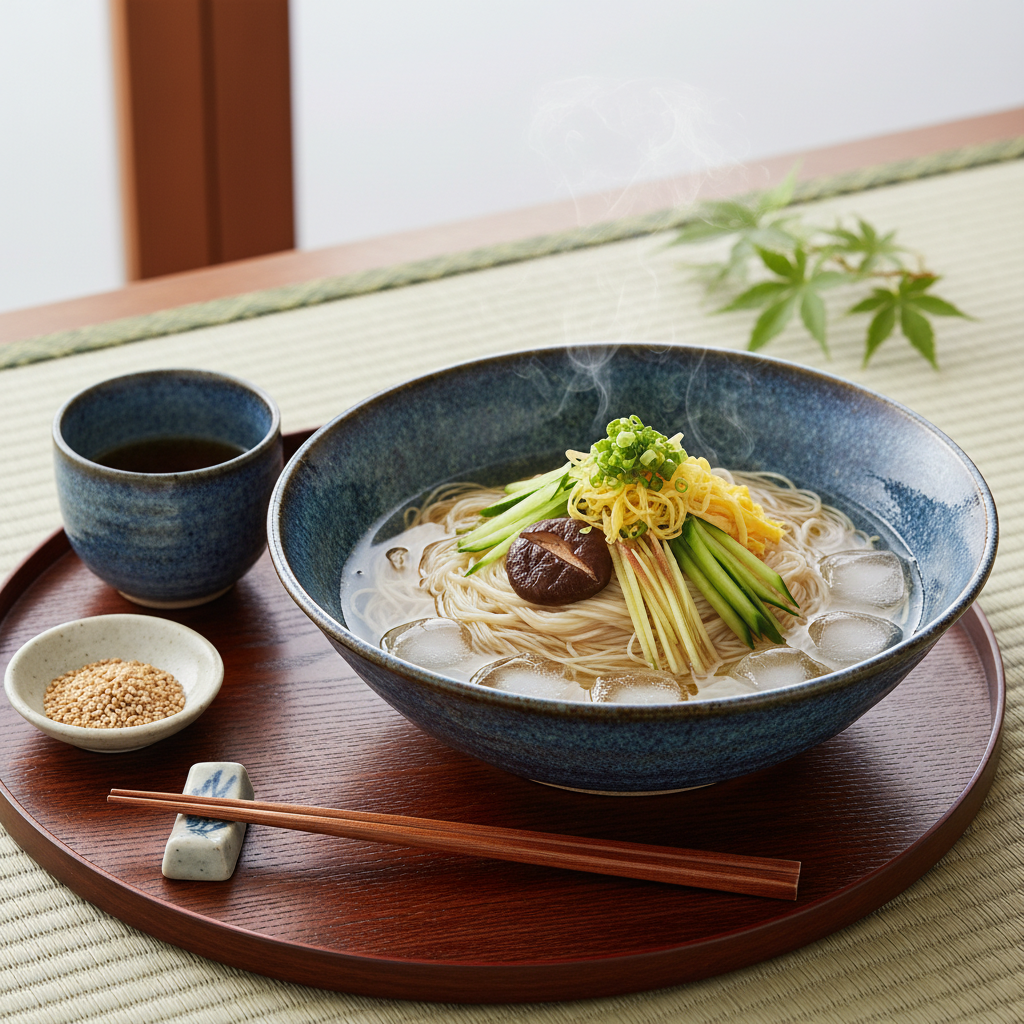
Chilled Somen (Basic Way of Eating)
The most standard way to enjoy Handa somen is as chilled somen.
Basic Cooking Procedure:
- Bring plenty of water to a boil (at least 1 liter per 100g of noodles)
- Add the somen and boil for 4-6 minutes (refer to cooking time on product)
- Once cooked, rinse thoroughly under cold water to remove starch
- Plunge into ice water to firm up, then drain
- Dip into broth and enjoy
Recommended Toppings:
- Sudachi (a Tokushima specialty)
- Green onion, ginger, myoga
- Shiso leaves, wasabi
- Vegetable tempura (kakiage, vegetable tempura, etc.)
- Egg ribbons
- Cucumber, tomato, and other summer vegetables
The strong firmness of Handa somen is maintained even when chilled, so it remains delicious even after some time has passed.
Hot Somen / Nyumen
During winter or on cold days, eating with warm broth as “nyumen” (somen in hot broth) is also recommended. Because of their thickness, Handa somen does not become overcooked in warm broth and offers a texture similar to udon noodles.
Tips for Hot Somen:
- Boil slightly shorter than usual and finish with warm broth
- Add ingredients like chicken, shiitake mushrooms, and kamaboko for a more nutritious dish
- Add ginger to warm the body
- Adapt to the Tokushima local dish style of “tarai udon”
Adapted Recipes
By taking advantage of the strong firmness and thickness of Handa somen, you can enjoy various adapted dishes.
Popular Adaptations:
- Aglio e Olio Style: Sauté boiled Handa somen with olive oil, garlic, and red chili pepper
- Somen Salad: Serve Handa somen over a vegetable-rich salad
- Yakisomen: Stir-fry with vegetables and meat for a fried-noodle style
- Chanpuru: Stir-fry in the Okinawan somen champuru style
- Cold Pasta Style: Pair with tomatoes, basil, and mozzarella cheese for an Italian twist
- Pot Finale: Enjoy at the end of hot pot dishes
With characteristics somewhere between udon and ordinary somen, Handa somen has a versatility that works with Japanese, Western, and Chinese flavorings alike.
Nutrition and Health Benefits of Handa Somen
Basic Nutritional Composition
Handa somen is a carbohydrate-based food with wheat flour as its main ingredient. The standard nutritional composition per 100g is as follows:
Per 100g of Dried Noodles (approximate):
- Energy: Approximately 340-360 kcal
- Protein: Approximately 9-11g
- Fat: Approximately 1-2g
- Carbohydrates: Approximately 70-75g
- Sodium: Approximately 3-5g
※Nutritional values vary by product
Easy Digestibility and Gentleness on the Body
Somen is known as an easily digestible food and can be eaten even during summer fatigue or illness. Handa somen, made through hand-stretching methods, develops wheat gluten appropriately, allowing for smooth digestion and absorption.
Additionally, eating it chilled has the effect of lowering body temperature, making it suitable for energy replenishment during hot summer months.
For Balanced Diet
Since somen is primarily carbohydrate-based, the following adjustments are recommended for balanced nutrition:
- Protein: Add eggs, chicken, pork, fish, etc.
- Vitamins and Minerals: Top generously with vegetables and seaweed
- Fat: Add appropriate fat through tempura or sesame oil
Handa somen pairs well with ingredients, making it easier to balance nutrition.
How to Purchase Handa Somen | Where to Buy
Purchasing in Tokushima Prefecture
In Tokushima, Handa somen can be purchased at the following locations:
Main Sales Locations:
- Direct sales shops of noodle factories in Tsurugimachi
- Michi no Eki (Roadside Station) “Saiko Yuyukan”
- Supermarkets throughout Tokushima Prefecture
- Tokushima Awaodori Airport shops
- Souvenir shops around JR Tokushima Station
- Tokushima Prefecture Product Center
Locally, various manufacturers’ Handa somen products are available, and you can enjoy comparing different brands.
Purchasing Through Online Shops
Online shops that allow nationwide purchases are also well-developed.
Main Online Purchase Options:
- Official online shops of individual noodle factories
- Major e-commerce sites such as Rakuten, Amazon, and Yahoo! Shopping
- Tokushima Prefecture antenna shop online stores
- As return gifts for hometown tax donations
Online, gift sets and comparison sets from multiple noodle factories are also available.
Major Noodle Factories and Brands
Several noodle factories exist in the Handa region, each with unique characteristics.
Representative Noodle Factories:
- Okada Seimen
- Morita Seimen Factory
- Miyoshi Seimen Factory
- Member factories of the Handa Hand-Stretched Somen Cooperative
Each factory preserves tradition while implementing its own innovations, allowing you to enjoy subtly different textures and flavors.
Price Range and Selection
The price range for Handa somen varies depending on quality, production methods, and packaging.
Typical Price Range (Tax Included):
- Household use (200g-300g): Approximately 300-600 yen
- Gift items (500g-1kg): Approximately 1,000-3,000 yen
- Premium/Aged products: 3,000 yen and above
Selection Tips:
- First-time buyers: Start with a small package to try
- As gifts: Choose products in wooden or decorative boxes
- For connoisseurs: Check manufacturing dates and select “aged products” with longer maturation periods
- Daily use: Choose large-capacity packages with good value
Storage Method and Shelf Life of Handa Somen
Proper Storage Method
Because Handa somen is dried noodles, it can be stored long-term if kept properly.
Storage Tips:
- Avoid direct sunlight: Sunlight degrades flavor
- Avoid moisture: Moisture causes mold and deterioration
- Store in sealed container: After opening, store in an airtight container
- Cool location: Keep in a cool, dark place at room temperature
- Away from strong odors: Somen easily absorbs odors, so be careful
Shelf Life and Aging
The shelf life for Handa somen is typically set at about 2 years from manufacture, but properly stored somen can often be eaten even after the expiration date.
Flavor Changes Through Aging:
Somen matures over time after production, becoming “hinemono” (aged product).
- New product: Within 1 year of manufacture. Fresh flavor
- Aged (1-year-old): 1-2 years after manufacture. Firmness increases, flavor deepens
- Very aged (2+ years old): 2 or more years after manufacture. Strongest firmness, deepest flavor
As aging progresses, value increases, with aged products particularly prized as gifts.
After Opening
After opening, be careful about moisture and insect infestation.
- Transfer to ziplock bags or similar sealed containers
- Include a drying agent
- Consume as soon as possible (within 1-2 months is the guideline)
- Regularly check for insects or mold
Handa Somen and Tokushima’s Food Culture
Position as a Tokushima Local Dish
Handa somen, with its history of over 200 years, is one of Tokushima’s representative local dishes and an important element of the region’s identity. While Tokushima has diverse food culture including “tarai udon,” “Naruto sea bream,” “Awa-odori chicken,” and “sudachi,” Handa somen stands out for its particularly long history and preserved traditional manufacturing methods.
Locally, it is enjoyed as a summer staple in households and is an indispensable part of events like Bon Festival and summer festivals. It is also popular as a gift and has become a standard item for year-end gifts and mid-year gifts.
Contribution to Regional Economy and Tourism
Handa somen production is an important regional industry in Tsurugimachi. Beyond noodle factories, many people are involved in Handa somen—from suppliers of wheat flour to the factories, to those providing packaging materials, to those engaged in distribution and sales.
In recent years, the number of tourists visiting specifically for Handa somen has increased, and tourism content such as noodle factory tours and hand-stretching experiences has become more abundant. As “somen tourism,” it has become a core element of regional revitalization.
Collaboration of Handa Somen with Other Tokushima Specialties
Handa somen pairs excellently with other Tokushima specialties.
Recommended Combinations:
- Sudachi: The refreshing acidity complements Handa somen’s flavor
- Awa-odori Chicken: Top with chicken for improved nutritional balance
- Naruto Wakame: Mineral-rich seaweed pairing
- Tokushima Ramen Broth: A new style pairing thick ramen broth with Handa somen
- Awa Wasanbon Sugar: For dessert-style adaptations
These combinations between regional ingredients symbolize the richness of Tokushima’s food culture.
The Future of Handa Somen | Preserving Tradition and Innovation
Successor Development Efforts
The manufacturing technique of Handa somen requires the craftsmanship of experienced artisans developed over many years. However, aging and a shortage of successors present challenges for preserving traditional techniques.
In response to this issue, the region is undertaking the following initiatives:
- Holding semen-making technique workshops and training sessions
- Young craftsperson development programs
- Technical exchange between noodle factories
- Traditional industry education in local schools
- Employment support for UIJ-turn individuals in semen production
Through these efforts, gradually more young people are entering the semen production field.
Enhancement of Brand Value and Quality Management
To preserve and further enhance Handa somen’s brand value, quality management and certification system improvements are being advanced.
Main Initiatives:
- Considering registration of “Handa Hand-Stretched Somen” under geographic indication (GI) protection system
- Clarification of manufacturing standards and quality assurance system development
- Establishment of traceability
- Thorough hygiene management (HACCP compliance, etc.)
Through these efforts, an environment is being created where consumers can confidently select genuine Handa somen.
Challenges in New Markets
While preserving tradition, ventures into new markets are also beginning.
New Developments:
- Export to overseas markets: As health consciousness grows globally, international interest in Japanese somen is increasing
- Gluten-free options: Product development of somen-like products using rice flour
- Premium products: Combination with high-end ingredients and special aged products
- Instant products: Products with shortened boiling times and retort broth sets
- Restaurant collaborations: Developing Handa somen menu items at renowned restaurants
Product development that preserves traditional methods while adapting to modern needs continues.
Building a Sustainable Production System
With growing environmental awareness, the Handa somen production sites are beginning initiatives toward sustainability.
- Expanding use of locally produced wheat for local consumption promotion
- Introduction of energy-efficient drying equipment
- Environmentally conscious packaging
- Effective use of water resources in manufacturing processes
- Food waste reduction
These initiatives are essential for ensuring a sustainable future for Handa somen.
Conclusion | Handa Somen: A Local Flavor Tokushima is Proud Of
Handa somen is a traditional local dish of Tsurugimachi, Tokushima Prefecture, with a history of over 200 years. This hand-stretched somen, thicker than ordinary somen with strong firmness and wheat flavor as its characteristics, is a masterpiece created by the region’s climate, geography, and artisan craftsmanship.
Delicious whether chilled or hot, and enjoyable in various adaptations, Handa somen can be appreciated not just as a summer tradition but year-round as a versatile noodle dish. If you visit Tokushima Prefecture, by all means try authentic Handa somen. It is also available through online shops, so you can enjoy this local Tokushima flavor at home.
Handa somen, continuing to preserve tradition while pursuing new challenges, will surely continue to be beloved by many people. Please try this local specialty that Tokushima is proud of.