Hotaru Ika no Su-Miso Ae: The Charm and Preparation of Toyama Prefecture’s Representative Spring Local Dish
Hotaru Ika no Su-Miso Ae (Firefly Squid in Vinegar-Miso Sauce) Explained
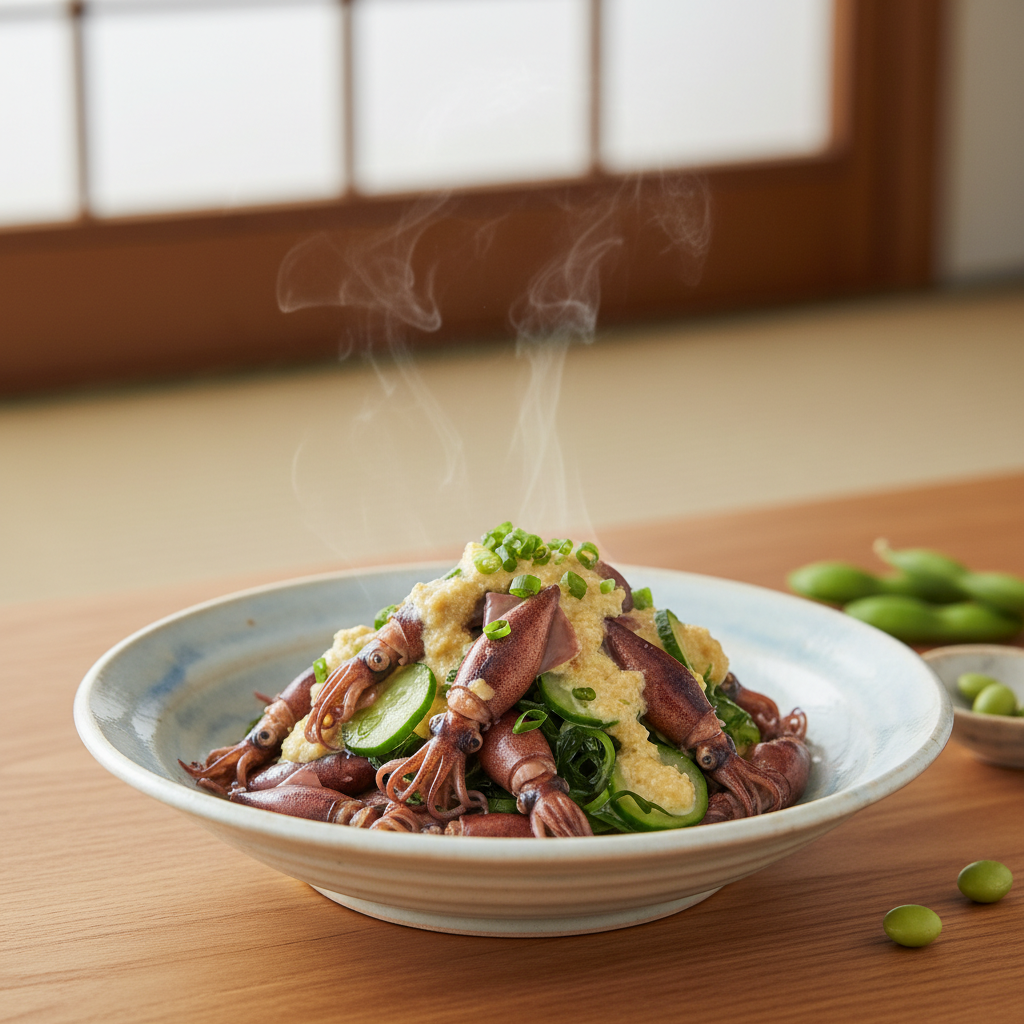
Hotaru ika no su-miso ae is a spring local dish representative of Toyama Prefecture. It is a simple yet deeply flavored dish made by boiling fresh firefly squid and tossing it with vinegar-miso sauce. For Toyama residents, it has long been cherished as a home-style flavor that announces the arrival of spring.
Hotaru ika (firefly squid) are small squid measuring 5-7 centimeters in length, mysterious creatures whose entire bodies glow with a pale blue light. They normally inhabit the deep sea at depths of 200-600 meters, but during their spawning season from March to May, they gather in large numbers along the coastal areas of Toyama Bay. The vinegar-miso dressed firefly squid, made from these seasonal squid caught only during this period, is known throughout the country as a dish symbolizing Toyama’s food culture, not just locally but nationally.
Main Traditional Areas
Hotaru ika no su-miso ae is enjoyed throughout Toyama Prefecture as a local dish, but it is particularly popular in areas along Toyama Bay’s coast.
Namerikawa City (なめりかわし)
Namerikawa City is one of Toyama Prefecture’s leading areas for firefly squid catches. At Namerikawa Fishing Port, firefly squid fishing by fixed net fishing is conducted from March to May every year. Historical records from the Edo period document that firefly squid fishing was already being conducted in this area, establishing a deep-rooted fishing culture with a long history.
Namerikawa City has the “Hotaru Ika Museum,” the world’s only museum themed on firefly squid, where visitors can learn about firefly squid ecology, fishing methods, and food culture. Additionally, every spring, “Hotaru Ika Sea Sightseeing Tours” are conducted, offering the rare experience of observing schools of glowing firefly squid from the sea.
Uozu City and Toyama City
Firefly squid fishing is also actively conducted in Uozu City, Toyama City, and other areas along Toyama Bay’s coast. In these regions too, when spring arrives, hotaru ika no su-miso ae appears on home dining tables, and is served at izakayas and restaurants as a seasonal specialty.
Toyama Bay is called “nature’s fish farm” due to its abundance of seafood. The sea bottom topography that drops steeply deep, combined with snowmelt water rich in nutrients flowing from the Tateyama Mountain Range, creates abundant plankton that serve as food for firefly squid, making it an ideal spawning environment for hotaru ika.
History, Origins, and Related Events
History of Firefly Squid Fishing
Firefly squid fishing has a long history, with documents showing it was already being conducted in Toyama Bay during the Edo period. At that time, they were called “torch squid” or “small squid,” and were cherished by local people as a spring phenomenon.
During the Meiji period, the light-emitting phenomenon of firefly squid began to receive academic attention, and the name “Hotaru Ika” (firefly squid) became established. During the Taisho period, fixed net fishing became formalized, and catch volumes increased. From the Showa period onward, processing techniques also advanced, leading to the creation of preserved foods such as tsukudani (small fish boiled down in soy sauce) and oki-zuke (fish marinated in sauce).
Origins of Vinegar-Miso Dressing
The vinegar-miso dressing method is one of Japan’s traditional mixed vegetable dishes. In Toyama Prefecture, when large quantities of fresh firefly squid are caught in spring, the simple cooking method of boiling them and dressing with vinegar-miso became established.
Firefly squid have a unique sweetness and umami in their internal organs (wata), and by combining this with the acidity of vinegar-miso and the depth of miso flavor, an exquisite balance of taste is created. In times when food preservation technology was underdeveloped, the sterilizing effect of vinegar was also likely valued.
Related Events
Various events and activities are held in Toyama Prefecture timed with the firefly squid season.
Hotaru Ika Sea Sightseeing Tours (Namerikawa City): From late March to late May, visitors board fishing boats early in the morning to observe firefly squid fixed net fishing. With luck, one can witness the fantastic phenomenon called “Hotaru Ika no mi-nageshi” (firefly squid self-sacrifice), where the sea surface glows pale blue.
Hotaru Ika Festivals: Centered on Namerikawa City, local events themed on firefly squid are held, with tastings and sales of firefly squid dishes.
Main Ingredients Used
Firefly Squid
The star ingredient of hotaru ika no su-miso ae. Firefly squid caught in Toyama Bay are characterized by plump, tender flesh with natural sweetness, and particularly concentrated umami in the internal organs (wata).
Firefly squid are called “the mystery of Toyama Bay,” with approximately 1,000 light-emitting organs across their bodies. These are believed to serve purposes such as protection from predators, communication with companions, and attracting small fish that serve as food.
Their peak season is March to May during their spawning period, and firefly squid during this time carry eggs and milt, making them considered most delicious. Particularly, April marks the peak fishing season.
Vinegar-Miso
Vinegar-miso is a seasoning made by combining miso, vinegar, and sugar (or mirin). In Toyama Prefecture, the proportions differ slightly in each household, with each family having its own distinctive flavor.
Miso: Some households use white miso, while others use red miso or blended miso. Using white miso brings out sweetness and smoothness, while red miso adds depth and richness.
Vinegar: Rice vinegar is standard, though grain vinegar is sometimes used. The acidity of vinegar brings out the umami of firefly squid and provides a crisp aftertaste.
Sugar/Mirin: These moderate the acidity of the vinegar and help bring the overall flavors together.
Other Ingredients
Wakegi (Negi/Green Onion Segments): Often added as a garnish, providing a crisp texture and aroma that adds accent to the vinegar-miso dressing.
Karashi (Japanese Mustard): A small amount mixed into the vinegar-miso adds depth and sharpness to the flavor.
Ginger: Sometimes used to remove any unwanted odors.
Ingredients (Serves 4)
Basic Ingredients
- Hotaru Ika (boiled): 300g (approximately 30-40)
- Wakegi: 2-3 stalks
Vinegar-Miso Ingredients
- White miso: 3 tablespoons
- Rice vinegar: 2 tablespoons
- Sugar: 1.5-2 tablespoons
- Mirin: 1 tablespoon
- Japanese mustard paste: 1/2 teaspoon (optional)
※Amounts of vinegar and sugar can be adjusted according to the type of miso and personal preference. If using red miso, slightly increase the sugar amount.
Preparation Methods
Preliminary Preparation
- Processing Firefly Squid: If using raw firefly squid, remove the eyes, mouth (beak), and cartilage. If using pre-boiled squid, this step is unnecessary.
- Preparing Wakegi: Slice wakegi into small rounds, soak in water, then drain well.
Boiling Firefly Squid (If Using Raw)
- Bring plenty of water to a boil in a pot and add a pinch of salt.
- Place firefly squid into the boiling water and cook for approximately 2-3 minutes. Be careful not to overcook, as the flesh will become tough.
- Place in a colander to cool slightly. At this point, avoid washing with water as it will leach the umami; allow it to cool naturally.
- Once cooled, remove the eyes, mouth, and cartilage. The eyes come off easily with light pressure from a finger. The mouth is located in the center of the body, and the cartilage is on the back.
Preparing Vinegar-Miso
- Place white miso in a bowl, gradually add rice vinegar while stirring with a whisk or spoon until smooth.
- Add sugar and mirin and mix well. Taste and check the balance of acidity and sweetness, adjusting to preference.
- If desired, add mustard paste and mix. Adding mustard adds depth and adult sophistication to the flavor.
Dressing
- Place the prepared firefly squid in a separate bowl.
- Add the prepared vinegar-miso and gently toss until the squid is evenly coated. Handle carefully to avoid breaking the squid.
- Transfer to a serving dish and scatter the sliced wakegi on top.
- It is delicious eaten immediately, but chilling in the refrigerator for about 30 minutes allows the flavors to meld and become even more delicious.
Cooking Tips
- Do not overcook firefly squid: Prolonged boiling makes the flesh tough and causes umami to escape. Aim for 2-3 minutes; once the flesh appears fluffy, remove from heat.
- Preserve the internal organs (wata): The organs of firefly squid are packed with unique sweetness and umami. If not averse, it is recommended to preserve the organs during cooking.
- Taste and adjust vinegar-miso as you go: Adjust the amounts of vinegar and sugar according to the type of miso and its salt concentration. Begin with smaller amounts and taste as you adjust to your preferred flavor.
- Freshly dressed may seem watery: Immediately after dressing, the vinegar-miso may seem thin, but as time passes, it blends with moisture released from the squid, reaching an ideal consistency.
Dining Occasions and Seasons
Peak Season
Hotaru ika no su-miso ae is a spring-only dish served during the firefly squid fishing season from March to May. Particularly in April, when fishing peaks, it appears most frequently on dining tables.
Firefly squid gather in Toyama Bay for spawning, and during this period they carry eggs and milt, with their flesh at its most plump and delicious. In Toyama Prefecture, many people eagerly anticipate this season as it brings the spring’s signature taste.
Dining Occasions
As a home dish: In Toyama homes, when spring arrives, boiled firefly squid appear in supermarkets and fish shops, and families prepare vinegar-miso dressed squid to enjoy. It is an indispensable dish as an evening drink accompaniment and as a side dish with rice.
Cherry blossom viewing and outings: During spring outing season, it is popular as a boxed lunch side dish. It remains delicious when cooled and is easy to transport, making it ideal for cherry blossom viewing and outings.
Celebratory occasions: At spring weddings and celebratory gatherings, it is sometimes served as a representative spring dish of Toyama.
Hospitality for tourists: For visitors to Toyama, it is offered as a local spring delicacy. At inns and restaurants, it is often served as an appetizer or small side dish.
Dining Methods
How to Eat
Hotaru ika no su-miso ae is served in a small bowl or dish and eaten as-is. Take a bite-sized piece of firefly squid with chopsticks and bring it to your mouth along with the vinegar-miso sauce.
It is Toyama style to eat the internal organs (wata) along with the squid. The wata contains concentrated umami and sweetness that intertwines exquisitely with the vinegar-miso, creating unique deliciousness.
Compatible Food Pairings
Japanese sake: It pairs perfectly with Toyama’s local sake. Pairing with Toyama’s famous sake brands such as “Katsuuma,” “Masuzumi,” and “Tateyama” further brings out the umami of firefly squid. The crisp flavor of vinegar-miso cleanses the aftertaste of sake.
Beer: It pairs well with cold beer and is a standard combination at izakayas.
Rice: The mild acidity and sweetness of vinegar-miso, along with the umami of firefly squid, pairs well with plain white rice. When eating as a rice side dish, slightly stronger seasoning works well.
Grated radish: Adding refreshing grated daikon radish provides flavor variation and allows enjoyment without tiring until the end.
Storage Method
When stored in the refrigerator, it remains delicious for 2-3 days. However, over time, firefly squid release moisture and the vinegar-miso may become diluted. In such cases, adding a bit more vinegar-miso and adjusting the flavor works well.
When preparing ahead, storing the firefly squid and vinegar-miso separately and dressing just before eating yields the most delicious results.
Conservation and Transmission Efforts (Overview of Transmitters, Preservation Organizations, SNS Utilization, Commercialization, and Other Contemporary Initiatives)
Community Transmission Activities
Toyama Prefecture is making efforts to transmit local dishes including hotaru ika no su-miso ae.
Food Education Activities: In home economics classes at elementary and junior high schools, and at community food education events, efforts are made to teach the preparation of hotaru ika no su-miso ae. By transmitting local food culture to children, transmission to the next generation is promoted.
Cooking Classes: Food culture lectures are held at community centers and cooking schools throughout the region, where traditional cooking methods for hotaru ika no su-miso ae are taught. Experienced housewives and professional chefs serve as instructors.
Selection for the Ministry of Agriculture, Forestry and Fisheries “Our Local Dishes” Database
Hotaru ika no su-miso ae is registered in the “Our Local Dishes” database operated by the Ministry of Agriculture, Forestry and Fisheries as a representative local dish of Toyama Prefecture. This has led to nationwide recognition of it as part of Toyama’s food culture and its utilization as a tourism resource.
Commercialization Efforts
Retort and vacuum-packed products: Food manufacturers and seafood processors in Toyama Prefecture have commercialized hotaru ika no su-miso ae. By using retort pouches and vacuum packaging, shelf life is extended and nationwide shipping is made possible.
Frozen foods: Using rapid freezing technology, products that maintain fresh-made taste while frozen are also sold. They can be thawed at home to enjoy the authentic flavor.
Souvenir products: At Toyama Station, the airport, and tourist shops, hotaru ika no su-miso ae is sold as a souvenir. Packaging is carefully designed, making it popular with tourists as a symbol of Toyama’s spring phenomena.
Sharing on SNS and Media
SNS Utilization: Toyama Prefecture, local tourism associations, and restaurants share photos of firefly squid fishing scenes and hotaru ika no su-miso ae on Instagram, Twitter, Facebook, and other platforms. Many posts can be found using hashtags such as “#hotaruika” and “#toyamagourmet.”
Recipe Videos on YouTube: Food researchers and local chefs introduce preparation methods for hotaru ika no su-miso ae through videos. Watching videos makes the cooking procedures and techniques easy to understand.
Television Program Features: It is frequently featured on national broadcast gourmet and travel programs as Toyama’s spring delicacy, increasing nationwide recognition.
Utilization as a Tourism Resource
Hotaru Ika Museum: The “Hotaru Ika Museum” in Namerikawa not only displays firefly squid ecology but also offers tastings and sales of firefly squid dishes. It is popular as a facility where tourists can learn about firefly squid and actually taste them.
Service at Restaurants: From spring onward, izakayas, kaiseki restaurants, conveyor-belt sushi restaurants, and other establishments throughout Toyama Prefecture hold “Hotaru Ika Fairs,” serving various firefly squid dishes. Vinegar-miso dressed squid always appears as a signature menu item.
Food Events: At events such as the “Etchu Toyama Shoku no Oukoku Festa” (Etchu Toyama Kingdom of Food Festival) hosted by Toyama Prefecture, hotaru ika no su-miso ae and other local dishes are introduced, with tastings and sales.
Nutritional Value and Health Benefits of Hotaru Ika no Su-Miso Ae
Hotaru ika no su-miso ae is not only delicious but also highly nutritious.
Nutrition in Firefly Squid
Taurine: Firefly squid contain abundant taurine. Taurine is said to have effects including improved liver function, fatigue recovery, and blood pressure normalization.
Vitamin A: Firefly squid have exceptionally high vitamin A content, helping maintain vision and the health of skin and mucous membranes.
Vitamin E: Has antioxidant properties and is said to be effective in preventing aging and lifestyle-related diseases.
Vitamin B12: Aids in red blood cell production and is effective in preventing anemia.
Copper: Firefly squid contain abundant copper, which aids iron absorption and is involved in bone formation and immune function maintenance.
DHA/EPA: Omega-3 fatty acids commonly found in oily fish are also contained, with expected benefits for brain health and blood-thinning effects.
Health Benefits of Vinegar
Vinegar has fatigue recovery effects, appetite stimulation effects, and effects that moderate blood glucose rise. Additionally, it helps with calcium absorption.
Nutrition in Miso
Miso is a fermented food that improves intestinal environment. Additionally, it contains soybean-derived protein and isoflavone.
Thus, hotaru ika no su-miso ae is a well-reasoned local dish combining deliciousness with nutrition.
Other Ways to Eat Firefly Squid
In Toyama Prefecture, various firefly squid dishes beyond vinegar-miso dressed squid are enjoyed.
Firefly Squid Sashimi: Fresh firefly squid eaten raw—a luxurious delicacy found only in Toyama, representing spring’s finest flavor.
Firefly Squid Oki-zuke: Marinated in soy sauce-based sauce and popular as a rice accompaniment and drinking snack.
Firefly Squid Tempura: Crispy batter combined with firefly squid’s umami.
Firefly Squid Tsukudani: Sweet-savory preserves ideal for boxed lunch sides.
Firefly Squid Sun-dried: Drying concentrates the umami, popular as a snack.
Firefly Squid Pasta: A fusion with Italian cuisine gaining popularity in recent years.
Firefly Squid Mixed Rice: Spring rice cooked with firefly squid flavor permeating throughout.
Conclusion
Hotaru ika no su-miso ae is a spring local dish of which Toyama Prefecture is proud, representing the culmination of the bounty of the rich natural environment of Toyama Bay and food culture cultivated over many years.
It is a precious dish that can only be tasted during the brief season from March to May, and for Toyama residents, it is a home-style flavor announcing spring’s arrival, cherished across generations.
Despite its simple cooking method, the exquisite balance between fresh firefly squid’s umami and vinegar-miso creates an unforgettable taste. It is an exceptional dish whether as a rice side or as a drinking snack.
If you have the opportunity to visit Toyama Prefecture, by all means try hotaru ika no su-miso ae during spring. Additionally, boiled firefly squid can be purchased online, allowing you to enjoy Toyama’s spring delicacy at home.
Local dishes represent the essence of a region’s climate, geography, history, and culture. Through hotaru ika no su-miso ae, we hope you experience Toyama Prefecture’s rich food culture and encounter the diversity of Japanese cuisine.