Niboutou: A Traditional Local Dish that Fukaya City, Saitama Prefecture is Proud of
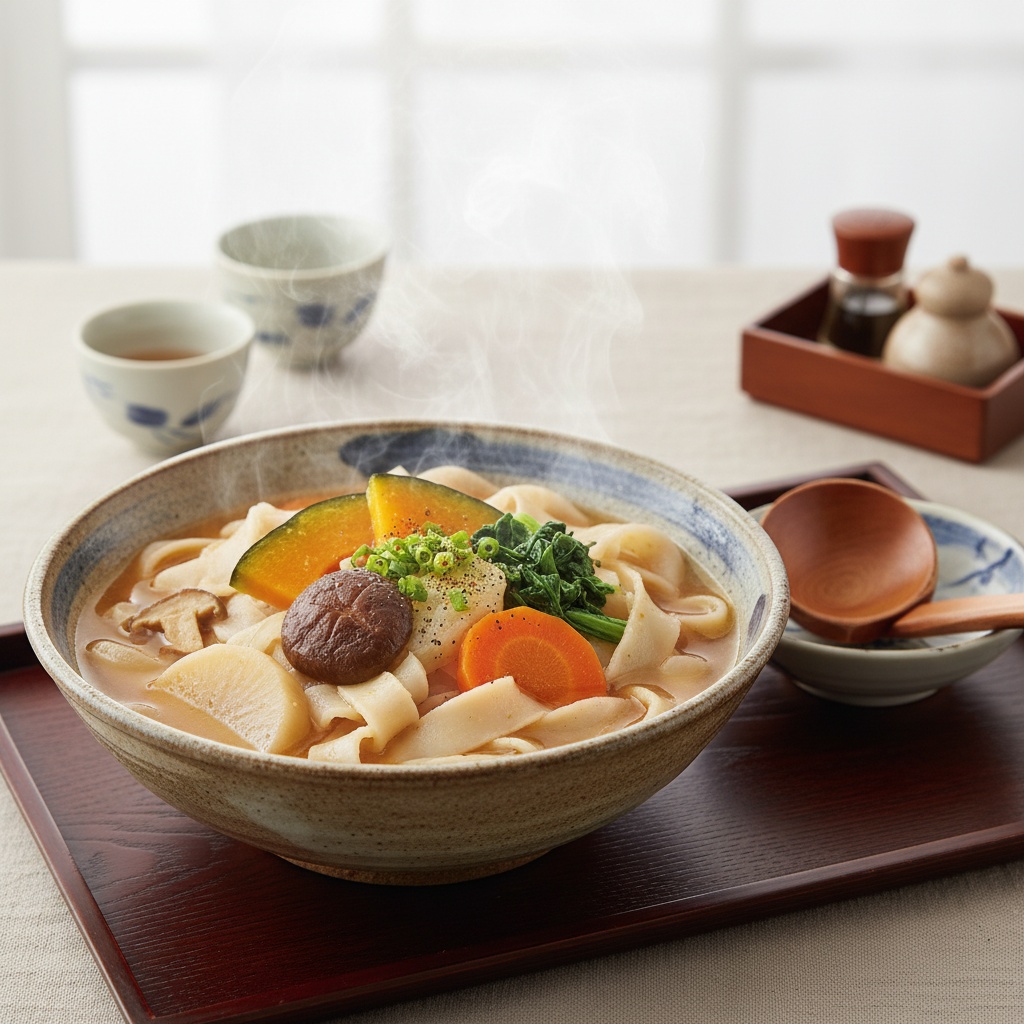
Niboutou (煮ぼうとう) is a traditional local dish that has been loved for a long time in the Fukaya City area of Saitama Prefecture and its surrounding regions. This dish, made by simmering wide fresh noodles and plenty of locally-sourced vegetables and seasoning them with soy sauce, is a masterpiece filled with the wisdom and ingenuity unique to a wheat-producing region, and continues to be cherished in many households and restaurants today.
This article provides detailed explanations of the history and origins of niboutou, its characteristics, how to prepare it, regional differences in naming, and efforts to preserve and pass down this representative local dish of Saitama Prefecture in modern times.
Niboutou: A Representative Local Dish of Fukaya City, Saitama Prefecture
Basic Characteristics of Niboutou
Niboutou is a type of simmered udon and is a local dish eaten mainly in Fukaya City, Saitama Prefecture. Also called “nibout” or “Bushu niboutou,” its greatest features are as follows:
Noodle Characteristics: Wide, thin fresh noodles approximately 2.5 centimeters in width and about 1.5 millimeters thick are used. These wide noodles are similar to “houto” from Yamanashi Prefecture, but niboutou noodles are often finished more thinly.
Cooking Method Characteristics: The greatest characteristic is simmering the noodles with vegetables from their raw state without boiling them first. This cooking method allows the starch that dissolves from the noodles to thicken the soup, creating a unique texture and flavor.
Seasoning Characteristics: Soy sauce-based seasoning is the foundation. In contrast to Yamanashi’s “houto,” which uses wide noodles but is flavored with miso, niboutou’s soy sauce flavor is a major difference.
Ingredient Characteristics: Beginning with Fukaya negi (a specialty of Fukaya City), root vegetables such as daikon radish, Chinese cabbage, taro, and carrots are used generously, along with seasonal vegetables harvested locally.
Regional Differences in Naming
Even within Saitama Prefecture, the names differ by region, and each region has developed its own unique versions.
- Fukaya City and Surrounding Areas: “Niboutou,” “Nibout”
- Iruma and Hiki Counties: “Himokawa,” “Uchi-ire”
- Chichibu Region: “Okkiri-komi”
These are essentially dishes of the same tradition, but each region has subtle differences in noodle width and thickness, ingredients, and seasoning.
History, Origins, and Related Events of Niboutou
A Local Flavor Nurtured by Wheat Culture
Saitama Prefecture, particularly the Bushu region including Fukaya City, is an area where wheat cultivation has been actively practiced as a supplementary crop to rice farming since ancient times. Due to this wheat cultivation tradition that has continued since the Edo period, an environment existed where wheat flour was relatively easy to obtain.
Because of this regional characteristic, various types of diverse udon dishes were born and developed throughout Saitama Prefecture. Niboutou is one of them, created in each household as a dish to warm the body during breaks in farm work and in the cold winter season, as well as on occasions when families gathered and on special days.
Connection to Shigeki Shibusawa
Shigeki Shibusawa, known as the father of Japanese capitalism and also a founder of Tokyo Gas, was born in Fukaya City. Historical records remain showing that Shibusawa Eiichi enjoyed eating niboutou, and this local dish is passed down as a source of local pride.
When he was adopted as the portrait on the 10,000 yen bill in the new banknotes in 2024, attention on Shibusawa Eiichi increased, and at the same time, interest in Fukaya City and niboutou expanded nationwide.
Occasions and Seasons for Eating
Niboutou is particularly enjoyed during the winter season. It has the effect of warming the body, and this is the time when the deliciousness of winter vegetables stands out, making it a frequent appearance as a home-cooked dish.
Additionally, it is often served when relatives gather for memorial services and death anniversaries, playing a role in connecting the regional community. Particularly during the agricultural off-season in winter, there was a custom in each household of making noodles and simmering them together with vegetables harvested that day.
How to Make Niboutou: Authentic Recipe and Ingredients
Ingredients (Serves 4)
Noodles:
- All-purpose flour: 300g
- Water: approximately 150ml
- Salt: 1/2 teaspoon
Ingredients:
- Fukaya negi: 2 stalks
- Daikon radish: 200g
- Chinese cabbage: 1/4 head
- Carrot: 1
- Taro: 4 pieces
- Shiitake mushrooms: 4
- Fried tofu (aburage): 1 sheet
- Chicken: 150g (optional)
Broth:
- Dashi stock: 1200ml
- Soy sauce: 3-4 tablespoons
- Mirin: 2 tablespoons
- Sake: 2 tablespoons
Instructions
Noodle Preparation:
- Add flour and salt to a bowl, gradually adding water while kneading. Knead thoroughly until the dough reaches the consistency of an earlobe.
- Gather the dough, wrap it in plastic wrap, and let it rest for about 30 minutes.
- On a surface dusted with flour, stretch the dough thinly (approximately 1.5mm) using a rolling pin.
- Fold the stretched dough and cut it into pieces approximately 2-2.5cm wide. Dust the cut noodles with flour to prevent them from sticking together.
Vegetable Preparation:
- Cut the daikon radish and carrot into matchsticks or half-moon slices.
- Chop the Chinese cabbage roughly and slice the Fukaya negi diagonally.
- Peel the taro and cut into bite-sized pieces.
- Remove the stems from the shiitake mushrooms and slice thinly.
- Blanch the fried tofu and cut into matchsticks.
- If using chicken, cut into bite-sized pieces.
Simmering:
- Pour dashi stock into a large pot, bring to a boil, and add chicken (if using).
- Add vegetables in order, starting with those that take longer to cook (daikon radish, carrot, taro).
- When the vegetables have softened, season with soy sauce, mirin, and sake.
- Once it returns to a boil, add the fresh noodles one by one to the pot, stirring gently with chopsticks to prevent them from sticking together.
- Add Chinese cabbage, shiitake mushrooms, and fried tofu, and simmer over medium heat for 5-7 minutes.
- Finally, add the Fukaya negi and simmer for another 2-3 minutes to finish.
How to Eat and Enjoy
Niboutou is served piping hot in a large bowl. The starch that dissolves from the noodles thickens the broth, making it slow to cool.
Adding shichimi togarashi (seven-spice chili pepper) or yuzu kosho (yuzu-pepper paste) allows you to enjoy variations in flavor. In some regions, a few drops of sesame oil are drizzled on top as a finishing touch.
Any leftover broth can be enjoyed the next day as zosui (rice soup) by adding rice.
Primary Transmission Areas and Ingredients Used
Primary Transmission Areas
Niboutou has been passed down primarily in the following areas.
Fukaya City: The center of niboutou, it is the most widely known area. Niboutou is served in many restaurants throughout the city and is well-established as a home-cooked dish.
Iruma and Hiki Counties: Known as “himokawa” or “uchi-ire.”
Chichibu Region: Known as “okkiri-komi,” with regional characteristics in ingredients and seasoning.
Honjo City and Kumagaya City Surroundings: Similar dishes are eaten in areas adjacent to Fukaya City.
What these areas have in common is that wheat cultivation was historically thriving and they experience harsh winter conditions.
Primary Ingredients Used
The characteristic of niboutou is the generous use of seasonal vegetables grown locally.
Essential Ingredients:
- Fukaya Negi: A specialty of Fukaya City, characterized by its thickness and strong sweetness. An indispensable ingredient in niboutou.
- All-purpose Flour: Using locally-grown flour is traditional.
Standard Vegetables:
- Daikon radish, carrot, Chinese cabbage, taro, burdock, shiitake mushrooms, fried tofu, etc.
Seasonal Variations:
- Spring: Spring cabbage, new onions
- Summer: Eggplant, zucchini
- Autumn: Sweet potato, mushrooms
- Winter: Chinese cabbage, daikon radish, negi (the most traditional combination)
Protein:
- Chicken, pork, and fried tofu are used, though many households make it with vegetables only.
Famous Restaurants Serving Niboutou in Fukaya City
There are many restaurants in Fukaya City that serve niboutou. Here we introduce some representative establishments.
Historic Restaurants Preserving Traditional Flavors
There are multiple long-established restaurants in Fukaya City that continue to preserve the niboutou flavors passed down through generations. These restaurants are dedicated to hand-made noodles and local vegetables, serving niboutou using traditional methods.
Each restaurant has its own character in noodle thickness, soup seasoning, and ingredient combinations, allowing for a comparison of flavors.
Popular Restaurants with Tourists
As the number of tourists visiting Fukaya City has increased in recent years, more people come specifically for niboutou. Authentic niboutou can be enjoyed at restaurants in roadside stations and tourism facilities.
Particularly during the winter season, this warm local dish is enjoyed by many tourists.
Local Eateries Offering Home-Cooked Flavors
Many neighborhood restaurants and diners in Fukaya City also serve niboutou as daily specials or regular menu items. These establishments allow you to enjoy diverse versions of niboutou reflecting family tastes.
Preservation and Transmission Efforts: Traditional Practices Passed Down to Modern Times
Activities of the Fukaya Niboutou Research Association
In Fukaya City, the “Fukaya Niboutou Research Association” conducts activities aimed at preservation and promotion of niboutou. This association, composed of local restaurant owners, chefs, and traditionalists of local cuisine, conducts the following activities:
- Recording and preserving traditional niboutou recipes
- Teaching cooking techniques to new generations
- Providing niboutou and conducting PR activities at events
- Developing new menu items using niboutou
Serving in School Lunches
In elementary and junior high schools in Fukaya City, niboutou regularly appears on lunch menus. By providing opportunities for children to become familiar with regional local cuisine, the city aims to pass it down to the next generation.
Additionally, schools hold classes where students learn about local cuisine, including lessons on the history and cultural background of niboutou.
Commercialization and Modern Initiatives
Frozen and Retort Products:
Frozen niboutou and retort-packaged versions have been developed for home enjoyment and are sold at roadside stations and online shops.
Souvenir Sets:
Souvenir products containing niboutou noodles, broth, and recipes are also popular.
SNS Information Sharing:
Fukaya City and local restaurants actively share the appeal of niboutou through SNS such as Instagram and Facebook. Beautiful plating and cooking process videos are posted, expanding awareness among younger generations.
Promotion Through Events
Various events are held throughout the year in Fukaya City, where niboutou is served.
Fukaya Negi Festival: An event promoting Fukaya City’s specialty, Fukaya negi, where niboutou is also served on a large scale.
Shibusawa Eiichi-Related Events: Niboutou, which he is said to have enjoyed, is served at events honoring Shibusawa Eiichi.
Local Cuisine Fair: Niboutou is exhibited as Fukaya City’s representative dish at local cuisine events held throughout Saitama and beyond.
Differences Between Niboutou and Other Noodle Dishes
Comparison with Yamanashi’s Houto
Niboutou is often compared with “houto,” a local dish from Yamanashi Prefecture. The two have the following differences:
Seasoning:
- Niboutou: Soy sauce base
- Houto: Miso base
Noodle Characteristics:
- Niboutou: Often finished more thinly
- Houto: Slightly thicker noodles are standard
Ingredients:
- Niboutou: Fukaya negi is characteristic
- Houto: Pumpkin is standard
Relationship with Gunma’s Okkiri-komi
Gunma Prefecture’s local dish “okkiri-komi” is also a dish of wide noodles simmered with vegetables. The same name is also used in the Chichibu region of Saitama Prefecture, suggesting cultural exchange between geographically close areas.
Differences from Regular Udon
While regular udon is boiled before cooking, niboutou’s greatest difference is that it is simmered from its raw noodle state. This cooking method allows starch that dissolves from the noodles to thicken the broth, creating a unique texture and flavor.
Nutritional Value and Health Benefits of Niboutou
A Well-Balanced One-Dish Meal
Niboutou is a one-dish meal that allows for balanced intake of carbohydrates, protein, vitamins, minerals, and dietary fiber.
Carbohydrates: Carbohydrates from flour noodles provide an energy source.
Vitamins and Minerals: Due to the use of multiple types of vegetables, it contains various nutrients such as vitamins A, C, E, potassium, and calcium.
Dietary Fiber: Root vegetables mainly provide abundant dietary fiber, which aids in improving intestinal health.
Protein: Protein is obtained from chicken and fried tofu.
Body-Warming Effects
The combination of warm broth and vegetables has the effect of warming the body from the core. Particularly during the cold winter season, it helps promote blood circulation and improve cold sensitivity.
Allicin, contained in Fukaya negi, is said to promote blood circulation and warm the body.
Low-Calorie and Healthy
Because the dish centers on vegetables, it has good volume while remaining relatively low in calories. When using chicken, choosing lean cuts makes it even healthier.
Tips for Making at Home and Variations
Points for Delicious Preparation
Make Noodle Thickness Uniform: When stretching the noodles, be careful to maintain uniform thickness. Uneven thickness results in uneven cooking.
Cut Vegetables Large: Since vegetables shrink when simmered, cutting them slightly larger provides a more satisfying finish.
Watch the Heat: Strong heat causes noodles to break apart easily. After bringing to a boil, slow-simmering over medium heat is the key.
Add Fukaya Negi Last: To bring out the aroma and texture of Fukaya negi, it is best added at the end.
Modern Variations
While preserving traditional recipes, modern adaptations suited to contemporary eating habits can also be enjoyed.
Western-Style Arrangement:
- Use bacon and cabbage, finishing with a consommé-based broth
- Top with cheese as a finishing touch
Chinese-Style Arrangement:
- Chicken broth base with sesame oil for aroma
- Add doubanjiang (spicy bean paste) for a spicy kick
Curry Flavor:
- Add curry powder for a Japanese curry simmer
Tomato Flavor:
- Add tomato for a Western taste
Time-Saving Techniques
Use Store-Bought Fresh Udon: If you don’t have time to make noodles from scratch, commercial flat or wide udon can be substituted.
Use Frozen Vegetables: Pre-cut frozen vegetables reduce prep time.
Pressure Cooker: Root vegetables can be cooked tender in a short time.
The Future of Fukaya City and Niboutou
Potential as a Tourism Resource
With the adoption of Shibusawa Eiichi’s portrait on the new banknote, tourist numbers to Fukaya City are expected to increase further. Niboutou, as a representative local dish of Fukaya City, is gaining further value as a tourism resource.
Maps for eating niboutou while walking and increases in specialty niboutou restaurants are being prepared in the city to accommodate tourists.
Passing Traditions to the Next Generation
Various initiatives are underway to pass niboutou traditions to the next generation.
- Cooking class offerings
- Parent-child local cuisine experience events
- Recipe video creation and distribution
- Enhanced local cuisine education in schools
Through these activities, the appeal of niboutou is communicated to younger generations and is expected to be passed down as a home-cooked dish.
Addressing Globalization
In recent years, Japanese local dishes have gained attention overseas. Niboutou, with its healthfulness and abundance of vegetables, has potential to be accepted by people worldwide.
Research is progressing on diverse serving methods adapted to different food cultures, including English recipe creation and halal and vegetarian options.
Summary: The Appeal of Niboutou, a Pride of Fukaya City, Saitama Prefecture
Niboutou is a traditional local dish that has been loved for a long time in the Fukaya City area and its surrounding regions in Saitama Prefecture. Nurtured by the climate of the Bushu region where wheat cultivation was thriving, this dish, made by simmering wide fresh noodles and plenty of local vegetables seasoned with soy sauce, possesses a simple yet profound flavor.
Drawing on local ingredients including Fukaya negi and allowing enjoyment of different vegetables by season, niboutou is truly a dish packed with the region’s bounty. It is cherished by many people today as a home-cooked dish, as a menu item in restaurants, and as a local dish that attracts tourists.
This traditional flavor, loved by Shibusawa Eiichi himself, is surely being passed to the next generation through various preservation and transmission activities including the Fukaya Niboutou Research Association. Modern efforts such as serving in school lunches, commercialization, and SNS information sharing are actively pursued, creating new value while preserving tradition.
When visiting Saitama Prefecture, be sure to try this niboutou. A bowl of this dish, containing the region’s history, culture, and the lives of its people, will surely become an unforgettable memory. Furthermore, it can be made relatively easily at home, so please try using the recipe in this article.
Niboutou transcends being merely a dish—it is the very identity of Fukaya City, Saitama Prefecture. Through this local dish, we rediscover the appeal of the region and play an important role in passing on to the next generation Japan’s rich food culture.