Detchi Yōkan – Fukui Prefecture’s Winter Local Cuisine|Complete Explanation from History and Origins to How to Make It
Detchi yōkan, beloved by local people as a winter icon of Fukui Prefecture, continues to be cherished by the region’s residents. While mizu yōkan (water-based sweet red bean jelly) is known nationwide as a summer refreshment, in Fukui Prefecture it has a unique food culture of being eaten in kotatsu during snowy, cold winters. This article provides a thorough explanation of the charm of detchi yōkan, covering everything from its history and origins to its preparation methods and ways of eating.
What is Detchi Yōkan (でっちようかん)?
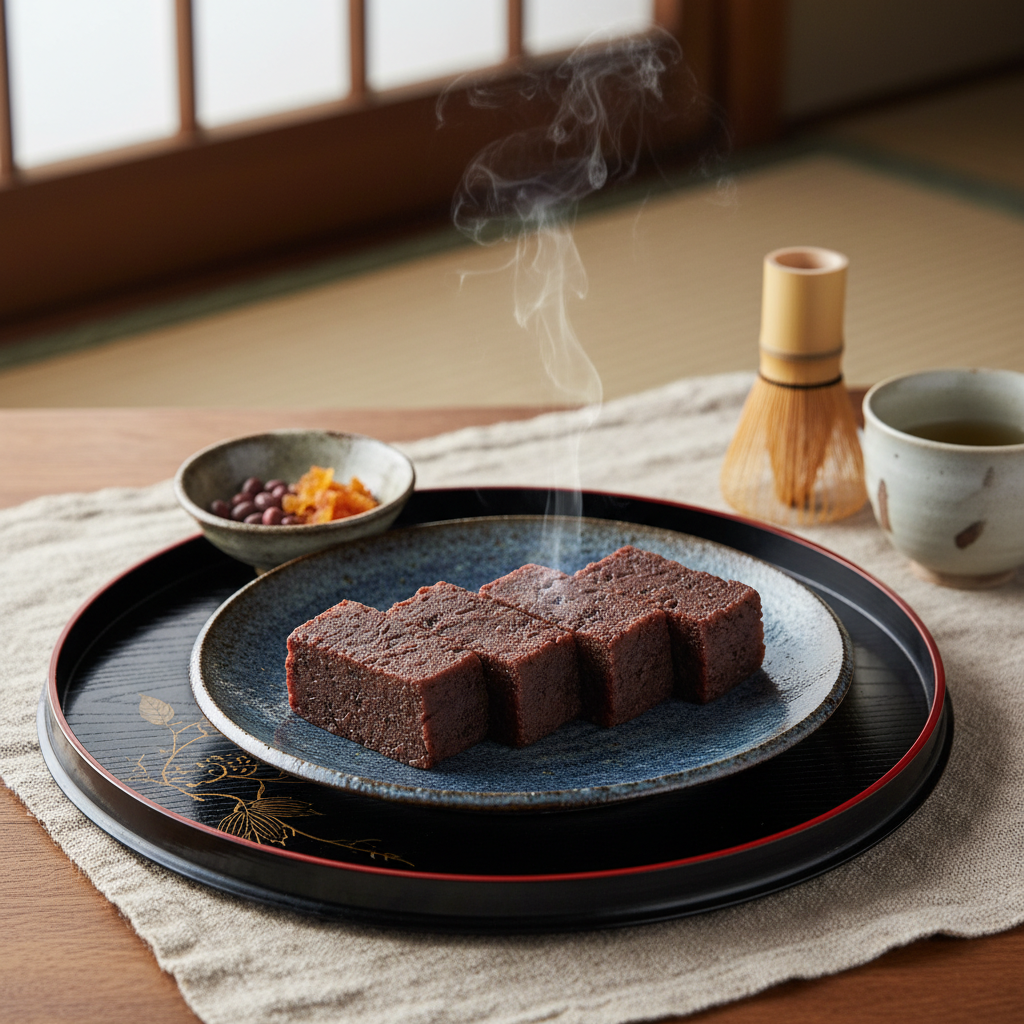
Detchi yōkan is a type of mizu yōkan that is familiar as an everyday taste for common people in Fukui Prefecture. Compared to ordinary kneaded yōkan, it contains approximately 2.5 times more moisture and is characterized by a smooth, slippery texture.
In Fukui Prefecture, there is a custom of eating mizu yōkan while sitting in a kotatsu during winter, and particularly in Ono City it is called “detchi yōkan.” The traditional style is to cut and eat the thick, juicy mizu yōkan that is packed into a box using an included scraper.
Because it contains less red beans and sugar than ordinary yōkan and can be manufactured inexpensively, it has been widely embraced as a taste for common people. It can be said to be a local cuisine representing the food culture unique to the region, making use of Fukui Prefecture’s abundant water resources.
History, Origins, and Related Events
The Name’s Origin and the Apprenticeship Era
The name detchi yōkan traces back to the era of detchi (apprenticeship) during the Taisho and Showa periods. In the detchi apprenticeship system, which is said to have continued for about 200 years from the Edo period, young people from Fukui Prefecture who apprenticed in Kyoto brought back Kyoto’s mizu yōkan when they returned to their hometown of Fukui during New Year’s. This is said to be the origin of the dish.
Detchi refers to young apprentices who worked live-in at merchants’ shops. The yōkan that these young people brought back during their New Year’s homecoming eventually developed uniquely in Fukui and took root in the region as “detchi yōkan.”
Relationship with Fukui Prefecture’s Water Culture
Fukui Prefecture is also known for its abundant water, with tributaries from the sacred mountain “Hakusan” and abundant water sources such as the Kuzuryū and Asuwagawa Rivers. The prefecture also has many springs and groundwater, and the water quality is extremely soft, which has been utilized not only for rice cultivation but also for buckwheat production and brewing high-quality ginjo sake.
Particularly, Ono City is known as the land of famous waters, with “Oshōzu” selected in the list of Japan’s 100 Famous Waters being one such example. Detchi yōkan is a Japanese confection that uses a lot of water, so it is a local cuisine that can only exist with this high-quality water. Even in Ono City, the land of famous waters, many shops manufacture detchi yōkan.
The Establishment of Winter Eating Culture
While mizu yōkan is enjoyed nationwide as a summer refreshment, in Fukui Prefecture it is typically eaten in winter. There are various theories about why this unique eating custom became established, but it is thought that in the era before refrigerators, the cold of winter served as a natural refrigerator, making it easier to preserve mizu yōkan with its high water content.
Additionally, because it was an inexpensive taste for common people, it became established as an everyday snack that families ate together in a warm kotatsu during cold winters. The historical background that yōkan brought back from Kyoto during New Year’s was imprinted on Fukui Prefecture residents’ hearts as a winter taste is also thought to have influenced the formation of this food culture.
Major Transmission Regions
Detchi yōkan is enjoyed throughout Fukui Prefecture, but is particularly vigorously manufactured and consumed in the following regions.
Ono City
Ono City is the region where the name “detchi yōkan” is most established. Blessed with abundant groundwater including Oshōzu selected in Japan’s 100 Famous Waters, the city actively makes detchi yōkan utilizing this high-quality water. The city has several long-established Japanese confectionery shops, each continuing to preserve the traditional taste with their own methods.
Fukui City
In Fukui City, the prefectural capital, many Japanese confectionery shops and food stores sell mizu yōkan when winter arrives. In Fukui City, the term “mizu yōkan” is more commonly used than “detchi yōkan,” but the culture of eating it in a kotatsu during winter is similarly established.
Sakai City, Katsuyama City, and Other Areas
In various regions of Fukui Prefecture including Sakai City and Katsuyama City, winter mizu yōkan is cherished as a local taste. Mizu yōkan made using different methods at each region’s confectionery shops has subtly different flavors and textures, allowing one to enjoy the individuality of each region.
Main Ingredients Used
The main materials for detchi yōkan are as follows.
Red Beans (Azuki)
Red beans, which are the primary raw material of detchi yōkan, are an important ingredient that determines the flavor of the yōkan. Although the amount used is less than in ordinary kneaded yōkan, using high-quality red beans creates a refined taste.
Sugar
Sugar used to add sweetness is also used more sparingly than in ordinary yōkan. This results in a refreshing taste with reduced sweetness, contributing to its appeal as an everyday snack for common people.
Agar
The agar that creates the texture of detchi yōkan is a gelling agent made from seaweed. The texture and firmness of the yōkan change depending on the amount of agar used.
Water
The most important ingredient is water. Because detchi yōkan contains approximately 2.5 times the water content of kneaded yōkan, the quality of water greatly influences the taste. High-quality water from Fukui Prefecture’s abundant water sources supports the deliciousness of detchi yōkan. Detchi yōkan made using famous water from Ono City particularly reflects the goodness of the water in its taste.
Other Ingredients
Depending on the manufacturing shop, a small amount of salt may be added to enhance flavor, or food coloring may be used to adjust the color.
Ingredients (for 10 servings)
The ingredients for making detchi yōkan at home are as follows:
- Red beans: 200g
- Sugar: 150g~200g (adjust to taste)
- Powdered agar: 8g
- Water: 800ml~1000ml
- Salt: a pinch
Compared to ordinary kneaded yōkan, the amount of water is large and the amount of sugar is small. Because of the high water content, a smooth texture is created.
How to Make It
Here is the basic method for making detchi yōkan.
1. Boil the red beans
Wash the red beans thoroughly and boil them in plenty of water until soft. Add water as needed during cooking, and simmer until the red beans can be easily crushed between your fingers. Once cooked, drain the water and pass through a fine sieve to make smooth bean paste.
2. Make the agar liquid
Put water and powdered agar in a pot and mix well while heating. Once it boils, reduce to low heat and simmer for 2-3 minutes to completely dissolve the agar.
3. Mix the ingredients together
Add the bean paste and sugar to the agar liquid and mix well while heating. Once the sugar is completely dissolved, add a pinch of salt to enhance the flavor. Continue mixing until everything is uniform, being careful not to burn it.
4. Pour into molds
Pour the smooth yōkan liquid into molds or containers that have been wet with water. Traditionally it is poured into wooden boxes or shallow containers, but in the home setting, baking pans or plastic containers can also be used.
5. Chill and set
Once it has cooled slightly, refrigerate for 3-4 hours to set. During winter, it will also set if left in a cold place. Once completely set, cut it into pieces using a scraper or knife and eat.
Manufacturing Tips
- By using more water, the smooth texture characteristic of detchi yōkan is created
- The amount of sugar can be adjusted to taste, but using less creates a more common taste
- It is important to thoroughly dissolve the agar
- Using high-quality water significantly improves the flavor
Occasions and Seasons for Eating
Detchi yōkan is a winter icon in Fukui Prefecture and is eaten during specific seasons.
Sales Period
Most Japanese confectionery shops sell detchi yōkan exclusively during the cold months from November to March. This stems from its characteristic of having high water content and not keeping well, as well as the traditional preservation method where winter cold served as a natural refrigerator.
A New Year’s Taste
Given that its origin is said to be yōkan brought back from Kyoto by apprentices during New Year’s, the New Year’s period is when detchi yōkan is consumed in particularly large quantities. The scene of families eating detchi yōkan together in a kotatsu during New Year’s has become established as a winter landscape in Fukui Prefecture.
Everyday Snack
As an inexpensive and common-tasting sweet, detchi yōkan is also enjoyed as an everyday snack during winter. The scene of children returning from school eating detchi yōkan while sitting in a kotatsu is often recounted as a cherished memory by Fukui residents.
As a Gift
During the winter season, detchi yōkan is sometimes used as a gift. There is also a custom of sending it to relatives and acquaintances outside the prefecture as a specialty product of Fukui, serving to transmit the region’s food culture.
Eating Method
Detchi yōkan has a unique way of eating that is characteristic of Fukui Prefecture.
Eating in a Kotatsu
The most traditional way of eating is to sit in a kotatsu on cold winter days. The contrast of eating cold detchi yōkan while warm inside a kotatsu has become a winter pleasure for Fukui residents.
Cutting with a Scraper
Detchi yōkan is typically sold packed into a box and is commonly cut into pieces using an accompanying scraper or wooden scraper. By cutting with a scraper rather than a knife, the casual, common-people atmosphere is maintained.
In Bite-Sized Pieces
For enjoying the smooth texture, it is recommended to cut it into bite-sized pieces. Because of its high water content, it has a characteristic texture of melting smoothly in the mouth.
With Tea
The standard way to eat detchi yōkan is together with warm tea. It pairs well with green tea and roasted tea, and the mildly sweet flavor brings out the taste of the tea.
Modern Ways of Eating
In recent years, more people are enjoying detchi yōkan in creative ways. Attempts to add new elements to the traditional way of eating are seen, such as serving it with ice cream or sprinkling it with roasted soybean powder.
Nutritional Value and Health Characteristics
Detchi yōkan has several nutritional characteristics based on its ingredients and preparation method.
Low Calorie
Because it uses less sugar than ordinary kneaded yōkan and has high water content, the calorie count is modest. It is also suitable for those who want to eat something sweet but are concerned about calories.
Nutrition of Red Beans
The main ingredient, red beans, contains dietary fiber, B vitamins, minerals (iron, potassium, magnesium, etc.), polyphenols, and other nutrients. These nutrients are said to be helpful for maintaining health.
Effects of Agar
Agar is rich in dietary fiber and is expected to help regulate the intestinal environment. Additionally, because it has almost no calories, it has drawn attention as a diet food.
Water Hydration
Detchi yōkan, which contains abundant water, contributes to hydration during the dry winter season. By eating it as a snack in indoor spaces that tend to be dried out by heating, one naturally takes in water.
Preservation and Transmission Efforts
Various efforts are being made to protect the tradition of detchi yōkan and pass it on to future generations.
Transmission by Regional Japanese Confectionery Shops
Long-established Japanese confectionery shops in Fukui Prefecture, particularly in Ono City, continue to manufacture detchi yōkan while preserving the methods passed down through generations. Each shop has its own unique blending and manufacturing methods, offering flavors that reflect each shop’s individuality.
Commercialization and Sales Promotion
Efforts are being made to actively sell detchi yōkan as a winter-only product. Using diverse sales channels including regional merchandise exhibitions, tourism facilities, and online shops, efforts are also being made to increase awareness outside the prefecture.
Food Education Activities
Detchi yōkan is incorporated into school lunches and introduced in classes that teach about local cuisine, transmitting the region’s food culture to children. Some schools even conduct manufacturing experiences, making efforts toward transmission to the next generation.
Media Coverage
There has been an increasing opportunity for detchi yōkan to be featured in television programs, magazines, and web media as a winter icon of Fukui Prefecture. Active information sharing on social media has contributed to increased awareness especially among younger generations.
Ministry of Agriculture, Forestry and Fisheries Initiatives
In the Ministry of Agriculture, Forestry and Fisheries’ “Our Local Cuisine” project, detchi yōkan is introduced as a representative local cuisine of Fukui Prefecture. Through such public initiatives, nationwide awareness has increased and cultural value is being re-evaluated.
Use in Regional Events
At food events and tourism events held in Fukui Prefecture and Ono City, detchi yōkan is sometimes introduced. Through tastings and sales, it provides an opportunity for visitors from outside the region to experience Fukui’s food culture.
Use as a Tourism Resource
In Fukui Prefecture’s tourism promotion, detchi yōkan is introduced as a winter delicacy. Tasting local cuisine when visiting Fukui has been positioned as one motivation for tourists to visit the region, with detchi yōkan playing an important role in this.
Relationship with Other Fukui Prefecture Local Cuisines
Detchi yōkan forms part of Fukui Prefecture’s rich food culture.
Food Culture Utilizing Water
Fukui Prefecture has numerous food cultures that make use of high-quality water. In foods where water quality influences taste, such as buckwheat, sake, and tofu, Fukui Prefecture’s water resources play a major role. Detchi yōkan is one such example, and can be said to be a local cuisine that exists because of famous waters.
Winter Food Culture
In addition to detchi yōkan, Fukui Prefecture has many local cuisines eaten in winter. With abundant food culture to be enjoyed during the cold season, such as Echizen crab, mizu yōkan, and salted mackerel, the region is rich in winter cuisine.
Taste of Common People
Many of Fukui Prefecture’s local cuisines are familiar as the everyday taste of common people. Detchi yōkan, as a luxury confection rather than a high-end sweet, has taken root in the region as a common taste that anyone can easily enjoy.
How to Enjoy Detchi Yōkan
How to Purchase
Detchi yōkan can be purchased at Japanese confectionery shops and food stores throughout Fukui Prefecture. Particularly during the winter months from November to March, many stores carry it. It is also possible to purchase it from anywhere in the country through online shops.
Storage Method
Because it has high water content, it does not keep long. After purchase, store it in a refrigerator and try to eat it as soon as possible. After opening, it spoils especially quickly, so it is ideal to eat it within 2-3 days.
When Visiting Fukui Prefecture
If you have the opportunity to visit Fukui Prefecture during winter, be sure to purchase detchi yōkan from a local confectionery shop and try the experience of eating it in a kotatsu. It will be a valuable opportunity to feel the region’s food culture firsthand.
Conclusion
Detchi yōkan is a local cuisine of Fukui Prefecture with a long history and unique food culture, serving as a winter icon of the region. It has many appeals including its origins continuing from the apprenticeship era, the manufacturing method utilizing Fukui Prefecture’s abundant water resources, and its unique way of being eaten in a kotatsu.
The detchi yōkan, with its high water content compared to ordinary yōkan and its mildly sweet, common taste, is deeply etched in the hearts of Fukui residents. The detchi yōkan eaten in a warm kotatsu together with family on cold winter days carries meaning beyond that of a mere confection, and has become an important element forming the region’s identity.
Even in modern times, the tradition of detchi yōkan is protected and passed on to future generations through the efforts of regional confectionery shops, food education activities, and media coverage. As a local cuisine representing Fukui Prefecture, it will surely continue to be cherished by many people.
Fukui Prefecture’s unique food culture of eating mizu yōkan, which is known nationwide as a summer refreshment, in a kotatsu during winter, is a precious cultural heritage created by the region’s climate, geography, history, and lifestyle. Through detchi yōkan, one can contemplate Fukui Prefecture’s rich food culture and the endeavors of the people who have supported it.
If you have the opportunity to visit Fukui Prefecture, be sure to taste detchi yōkan and experience the region’s food culture. Additionally, because it is available for purchase online, it is also recommended to enjoy Fukui’s winter taste at home while sitting in a kotatsu.