
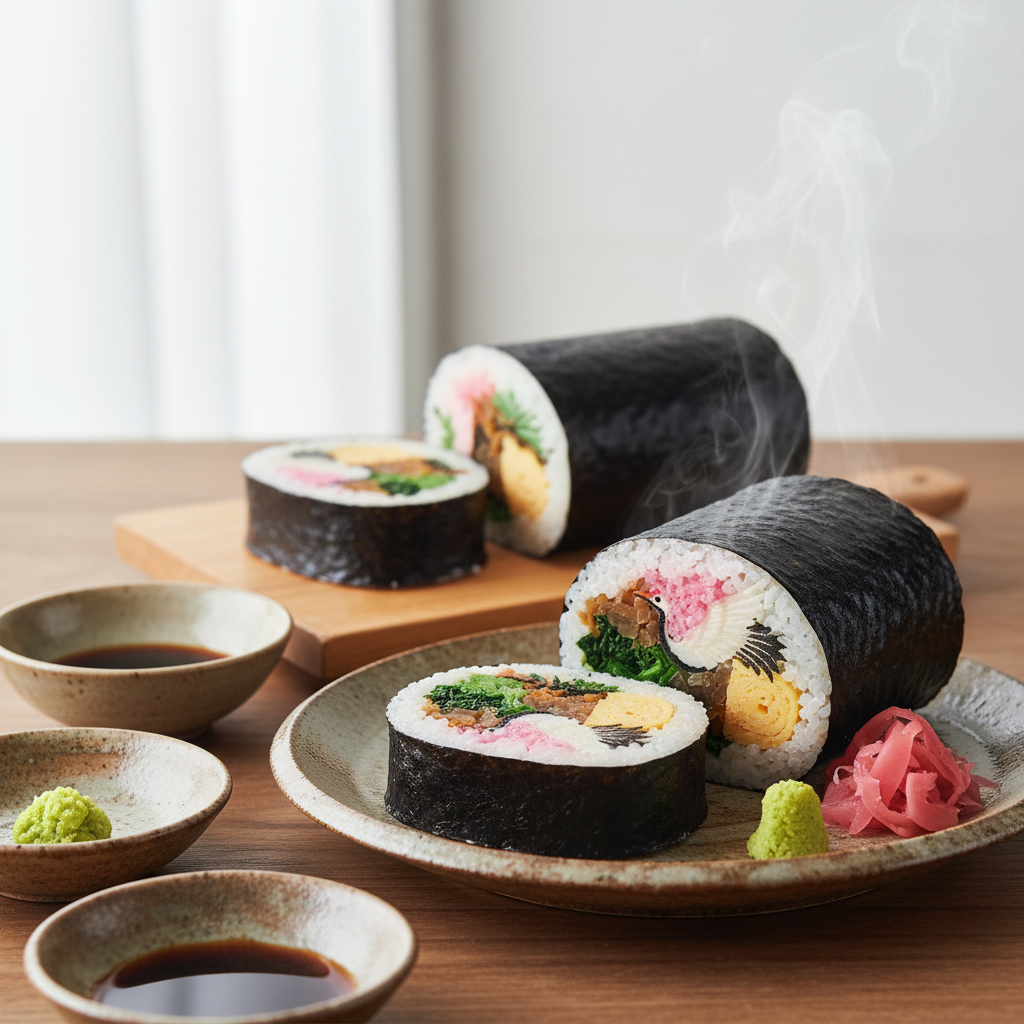
Futomaki Sushi: A Complete Guide to Chiba Prefecture’s Local Cuisine—History, Design Techniques, and Preparation Methods
Futomaki sushi, known nationwide as a local specialty of Chiba Prefecture, is a type of rolled sushi characterized by vibrant patterns visible in cross-section and traditional techniques. Known by various names such as “futomaki matsuri sushi,” “Boso futomaki sushi,” and “e-maki sushi,” it has been selected for the Ministry of Agriculture, Forestry and Fisheries’ “Traditional Local Dishes of Agricultural, Forestry, and Fishing Villages.” This article provides a thorough explanation of the appeal of this local dish, covering the history of Chiba Prefecture’s futomaki sushi, traditional techniques, detailed recipes, and regional characteristics.
Futomaki Sushi: Chiba Prefecture’s Representative Local Cuisine
Futomaki sushi is a type of sushi made by wrapping vinegared rice and various ingredients in seaweed, making it the most representative local dish of Chiba Prefecture. Its greatest feature lies in the intricate patterns—flowers, butterflies, animals, and characters—that appear when sliced. The technique of skillfully arranging colorful tamagoyaki (egg omelet), kanpyo (gourd strips), shiitake mushrooms, carrots, and sakura denbu (pink fish flakes) to create beautiful designs in cross-section has been passed down through generations across various regions of Chiba Prefecture.
Unlike ordinary sushi rolls, futomaki sushi has a diameter exceeding 5 centimeters. A single thick roll is sliced and enjoyed by multiple people. Due to its gorgeous appearance, it is prepared for special occasions such as celebrations and funerals, community gatherings, and festivals, playing an important role as a dish for hospitality.
Alternative Names for Futomaki Sushi
Depending on the region within Chiba Prefecture, it is called by different names: “futomaki matsuri sushi,” “Boso maki,” “kazari maki sushi,” and others. The term “futomaki matsuri sushi” in particular derives from its preparation for festivals and celebrations, expressing the special significance this dish holds.
History and Origins of Futomaki Sushi
Traditions Since the Edo Period
There are various theories about the origins of futomaki sushi, but it is believed to have begun when “nori maki” (seaweed rolls) were introduced from Edo during the Edo period. Chiba Prefecture, particularly the inner bay region, was a source of high-quality seaweed and also produced rice. The theory that futomaki sushi was created by thickening thin nori rolls, which were precious, by placing them inside is widely accepted.
In the Boso region, seaweed farming has been conducted for approximately 200 years, and due to seaweed being made in the Kazusa district, blessed with both sea and countryside bounty, this local cuisine developed. The fusion of fishing culture and agricultural culture created a unique sushi culture that utilized local ingredients.
Development and Dissemination of Design Techniques
The design techniques characteristic of futomaki sushi were passed down through generations in individual households. Particularly from the 1960s onward, Hideko Ryuzaki, who presided over the Chiba Traditional Local Cuisine Research Association, systematically organized rolling techniques and designs scattered throughout the Boso region, actively transmitting them to younger generations.
Through Ryuzaki’s achievements, techniques that had previously developed uniquely in different regions and households became widely shared, and increasingly diverse designs were created. Today, numerous designs exist beyond floral patterns, including shikai maki, rose, plum, cherry blossom, swallowtail butterfly, turtle, and crane—more than dozens of varieties—with creative possibilities expanding.
Selection for the Ministry of Agriculture, Forestry and Fisheries’ Local Dishes of the Hundred Villages
Futomaki sushi has been selected for the Ministry of Agriculture, Forestry and Fisheries’ “Traditional Local Dishes of Agricultural, Forestry, and Fishing Villages” and “Hometown Onigiri Hundred Selection,” officially recognized as a cuisine representing Chiba Prefecture’s food culture. This selection has heightened national recognition and activated efforts to preserve and transmit futomaki sushi as an important food cultural heritage of Chiba Prefecture.
Primary Transmission Regions for Futomaki Sushi
Sanbu Region: Center of Design Research
The Sanbu region (Sanbu City, Tougane City, Kujukuri Town, etc.) within Chiba Prefecture is known as the area where futomaki sushi design research has made the most progress. In this region, futomaki sushi is prepared not only for celebrations and funerals but also in various contexts, serving as an important food culture rooted in the regional community.
JA Sanbu Gunshi actively conducts dissemination activities for futomaki sushi, with technique transmission continuing through women’s groups and cooking classes in the region. Characterized by diverse design variations and sophisticated techniques, the futomaki sushi of the Sanbu region is particularly highly regarded within Chiba Prefecture.
Ichihara City and the Boso Region
Throughout the Boso region, including Ichihara City, futomaki sushi is positioned as an important local cuisine. Organizations such as the “Association to Convey Boso Futomaki Sushi” are active, and it has been selected as one of Ichihara’s 50 Treasures, being cherished as a source of regional pride.
The futomaki sushi of the Boso region is characterized by the abundance of ingredients utilizing sea and countryside bounty, with traditional recipes using fresh vegetables and seafood produced in the region being passed down.
Other Areas Throughout Chiba Prefecture
Throughout Chiba Prefecture—in the inner bay, outer bay, and northern regions—futomaki sushi culture is rooted. There are subtle differences in the ingredients used and design styles in each region, with each developing uniquely reflected characteristics.
Designs and Techniques of Futomaki Sushi
Types of Representative Designs
Futomaki sushi designs are remarkably diverse, ranging from traditional to creative.
Floral Designs
- Shikaï maki (four-direction roll): Design with flower petals spreading in four directions
- Rose: A gorgeous flower arranged in a spiral
- Plum: A Japanese-style flower with five petals
- Cherry blossom: A flower symbolizing spring
- Chrysanthemum: A formal flower used in dignified occasions
Animals and Living Creatures
- Swallowtail butterfly: An elegant butterfly
- Crane: A symbol of longevity and celebration
- Turtle: Popular as an auspicious symbol
- Dragonfly: A summer seasonal element
Characters and Others
- Auspicious characters such as longevity and fortune
- Seasonal motifs (snowmen, Christmas trees, and other contemporary creations)
Key Points in Design Techniques
Creating beautiful designs requires the following skills.
- Ingredient Placement Calculation: The ability to visualize the completed form mentally and place ingredients in reverse order requires spatial awareness.
- Vinegared Rice Amount Adjustment: Precisely adjusting the amount of vinegared rice between each design element determines the beauty of the pattern when sliced.
- Rolling Pressure: If too strong, ingredients are crushed; if too weak, the form collapses. Rolling with uniform pressure is essential.
- Color Balance: Placement considering color contrast—tamagoyaki (yellow), sakura denbu (pink), spinach (green), shiitake mushroom (brown)—is key to beautiful results.
- Cutting Method: Using a sharp knife and wiping it with a damp cloth after each cut ensures a clean cross-section.
Ingredients for Futomaki Sushi (Serves 4)
Basic Vinegared Rice
- Rice: 3 cups (540ml)
- Water: As needed
- Kombu (kelp): One 5cm square piece
- Vinegar: 4 tablespoons
- Sugar: 2 tablespoons
- Salt: 1 teaspoon
Seaweed
- Toasted seaweed sheets: 4-5 full sheets
Ingredients (for Design)
Tamagoyaki (Egg Omelet)
- Eggs: 4
- Sugar: 2 tablespoons
- Salt: A pinch
- Salad oil: As needed
Simmered Kanpyo (Gourd Strips)
- Kanpyo: 30g
- Dashi broth: 200ml
- Soy sauce: 2 tablespoons
- Sugar: 2 tablespoons
- Mirin: 1 tablespoon
Simmered Shiitake Mushrooms
- Dried shiitake mushrooms: 5-6
- Soaking liquid: 150ml
- Soy sauce: 1.5 tablespoons
- Sugar: 1 tablespoon
- Mirin: 1 tablespoon
Other Ingredients
- Carrot: 1 (cut into thin strips and simmered sweetly)
- Sakura denbu: As needed
- Cucumber: 1-2 (cut into thin long strips)
- Spinach: 1 bunch (boiled and squeezed)
- Koya dofu (freeze-dried tofu): 2 pieces (simmered and cut into thin strips)
For Coloring (Pink Vinegared Rice)
- Sakura denbu or juice from pickled red ginger: As needed
How to Make Futomaki Sushi
Preparation
1. Preparing Vinegared Rice
Cook rice slightly firmer than usual. Adding kombu while cooking enhances the flavor. Once cooked, transfer to a sushi oak (or large bowl) and pour the combined vinegar (vinegar, sugar, salt mixed together) over it, mixing with a rice paddle using a cutting motion while cooling.
Some vinegared rice is mixed with sakura denbu to make pink vinegared rice. Depending on the design, green vinegared rice can also be made with squeezed spinach juice.
2. Preparing Tamagoyaki
Add sugar and salt to eggs and mix well, then make a thick omelet in a tamagoyaki pan. Cut into various shapes depending on the design—thin sticks, thin sheets—for use as the center of flowers or butterfly bodies.
3. Simmered Kanpyo
Soak kanpyo in water and rub with salt to wash. Simmer in dashi broth, soy sauce, sugar, and mirin until soft, reducing the broth until almost none remains.
4. Simmered Shiitake Mushrooms
Soak dried shiitake mushrooms in water, remove the stems, and cut into thin strips. Simmer with soaking liquid and seasonings.
5. Other Ingredients
Cut carrots into thin strips and simmer sweetly with sugar and a small amount of water. Boil spinach and squeeze out water thoroughly. Soak freeze-dried tofu, simmer, then cut into thin strips.
Basic Rolling Method (Example: Shikaï Maki)
1. Preparing the Bamboo Mat
Place plastic wrap on the bamboo mat, then place seaweed on top. The seaweed should be positioned with the glossy side facing down.
2. Spreading Vinegared Rice
Spread vinegared rice evenly on the seaweed. Leave about 2cm at the front and 1cm at the back. The rice thickness should be about 5mm.
3. Creating the Center of the Design
For shikaï maki, place a tamagoyaki stick in the center, surrounding it with pink vinegared rice. This becomes the center of the flower.
4. Creating the Petal Section
Around the center, alternately place white vinegared rice and ingredients (kanpyo, shiitake mushrooms, etc.) to form the shape of flower petals. The spacing of each part and the amount of rice determine the beauty of the design.
5. Finishing the Outside
Cover the entire outside of the design with white vinegared rice and adjust the shape.
6. Rolling
Roll from front to back with uniform pressure. Using the bamboo mat, adjust the shape while rolling firmly.
7. Resting
After rolling, wrap in plastic and let rest for 10-15 minutes. This allows the rice and ingredients to blend and makes cutting easier.
8. Slicing
Using a damp cloth, wipe the knife and cut into 2-3cm slices. Wipe the knife after each slice to ensure clean cross-sections.
Design-Specific Rolling Tips
Rose Rolling Method
Arrange pink vinegared rice in a spiral pattern, gradually expanding from center to outside. Placing green vinegared rice (with spinach) on the outside creates a leaf-like appearance.
Swallowtail Butterfly Rolling Method
Create the butterfly body with tamagoyaki and compose the wings using a combination of colored and white vinegared rice arranged symmetrically on both sides. This is one of the most technically challenging designs.
Occasions for Consumption and Seasons
Role in Life Events
Futomaki sushi is indispensable in Chiba Prefecture’s celebrations and funerals. Prepared for weddings, milestone celebrations, and memorial services, it plays an important role as a dish expressing hospitality through food.
For celebrations, vibrant floral designs and auspicious patterns such as cranes and turtles are preferred; for memorial services, more subdued color designs may be selected.
Community Events and Festivals
Futomaki sushi is prepared for various community occasions where people gather—community festivals, sports days, and community meetings. The name “futomaki matsuri sushi” itself derives from its essential role in festive occasions.
During seasonal celebrations—Hinamatsuri (Girl’s Day), Tango no Sekku (Boy’s Day), and New Year—futomaki sushi is prepared with designs matching the season. Spring cherry blossoms, summer dragonflies, autumn chrysanthemums, and winter snowmen are popular seasonal designs.
As an Everyday Lunch
Beyond special occasions, futomaki sushi is also prepared for everyday situations such as sports day or field trip lunches and family gatherings. Its gorgeous appearance doubles the joy of opening a lunchbox, and with balanced nutrition, it is appreciated by children and adults alike.
Consumption Methods and Ways to Enjoy
Appreciating the Cross-Section Beauty
The greatest appeal of futomaki sushi lies in the beauty of the cross-section when sliced. The moment a single thick roll is cut is special for both the maker and those eating it. The emotion felt when a design appears beautifully is a unique joy of this dish.
When plating, arrange pieces so cross-sections are visible, highlighting the color beauty. Arranging on a white plate makes the vibrancy of the design stand out.
Proper Storage Method
Although futomaki sushi is best eaten fresh, note the following when storing:
- Ideal to eat within 2-3 hours at room temperature
- For longer storage, refrigerate (but allow to return to room temperature 30 minutes before eating, as vinegared rice becomes hard)
- Wrap thoroughly in plastic to prevent drying
- Best eaten the same day; flavor diminishes after the next day
Dishes to Enjoy Together
Although sufficient on its own, futomaki sushi pairs well with other Chiba local dishes for a richer table.
- Sanga-yaki (broiled horse mackerel or sardine namero)
- Simmered dishes (such as chikuzenni)
- Clear soup
- Chawanmushi (steamed egg custard)
Combining these completes a menu appropriate for celebrations and ceremonies.
Preservation and Transmission Efforts
Activities of the Chiba Traditional Local Cuisine Research Association
Founded in 1982, the Chiba Traditional Local Cuisine Research Association is an important organization conducting transmission activities for Chiba’s local cuisines, centered on futomaki matsuri sushi. Under the direction of Hideko Ryuzaki, it conducts diverse activities including community exchange, events within and outside the prefecture and internationally, and volunteer work.
Through this research association, techniques previously transmitted uniquely in individual households and regions have been systematized, enabling organized technology transmission to younger generations. Regular workshops and demonstrations transmit the appeal and techniques of futomaki sushi to many people.
Regional Preservation Societies and Transmission Organizations
Various organizations dedicated to futomaki sushi transmission exist throughout Chiba Prefecture:
- Association to Convey Boso Futomaki Sushi (Ichihara City)
- Cooking class groups of JA Sanbu Gunshi
- Women’s associations and living improvement groups in various regions
These organizations conduct diverse transmission activities including demonstrations at regional events, volunteer classes in schools, and cooking classes.
Efforts in Educational Settings
An increasing number of primary and junior high schools in Chiba Prefecture incorporate futomaki sushi making into integrated studies and home economics classes. Local transmission experts serve as instructors, allowing children to deepen understanding and attachment to local cuisine through hands-on futomaki sushi making.
Towns such as Kujukuri introduce futomaki sushi preparation methods on municipal websites, enabling residents to easily attempt it.
Social Media and Digital Utilization
Recently, information dissemination via social media has become active. More transmission experts share futomaki sushi-making videos on Instagram and YouTube, broadening interest among younger generations.
Beautiful cross-section photographs are Instagram-friendly, serving as a catalyst for younger people to attempt futomaki sushi making, providing a good example of traditional local cuisine being transmitted through contemporary means.
Commercialization and Tourism Resource Development
Futomaki sushi is gaining attention as a Chiba tourism resource. Sales at roadside stations and tourism facilities, and the provision of futomaki sushi-making experience tours offer increasing opportunities for tourists to encounter Chiba’s food culture.
Some restaurants offer not only traditional designs but also creative futomaki sushi incorporating characters and contemporary designs, with futomaki sushi culture developing from both traditional and innovative perspectives.
Technical Certification Systems
Some organizations establish certification systems for futomaki sushi technique levels. Grading into beginner, intermediate, and advanced levels aims to boost learner motivation and standardize techniques.
Nutritional Value and Health Aspects of Futomaki Sushi
Futomaki sushi excels in nutritional balance in addition to visual beauty.
Balanced Nutrients
- Carbohydrates: Adequate energy source from vinegared rice
- Protein: High-quality protein from tamagoyaki and freeze-dried tofu
- Vitamins and Minerals: Abundant vitamins and minerals from carrot, spinach, and shiitake mushroom
- Dietary Fiber: Dietary fiber from kanpyo and vegetables
Health Benefits of Vinegar
Vinegar in vinegared rice offers fatigue recovery, appetite stimulation, and calcium absorption promotion effects. Particularly in summer or when tired, the vinegar’s effects make it easy to eat and appropriate for nutritional supplementation.
Good Preservation
Vinegar’s antimicrobial properties make futomaki sushi relatively long-lasting. The development of futomaki sushi as a dish served to many people at celebrations and ceremonies during times without adequate refrigeration is partly due to this good preservation.
New Developments in Futomaki Sushi Today
Expansion of Creative Designs
Beyond traditional floral and animal designs, various contemporary creations now exist. Anime characters, sports team logos, corporate mascots—new designs reflecting the current era are continuously conceived.
These creative activities play an important role in attracting younger generation interest and facilitating traditional technique transmission.
Evaluation Overseas
Within the Japanese food boom, futomaki sushi’s beautiful designs have gained overseas attention. Introduced as “Sushi Art,” it is evaluated as exemplifying the refinement and artistry of Japanese food culture.
The Chiba Traditional Local Cuisine Research Association participates in overseas events, disseminating Japanese food culture through futomaki sushi demonstrations.
Event and Contest Organization
Futomaki sushi contests and exhibitions are periodically held throughout Chiba Prefecture. As occasions to compete techniques and present new designs, these events provide opportunities for technique transmission practitioners to interact and improve their skills.
Conclusion: Chiba Prefecture’s Proud Food Cultural Heritage
Futomaki sushi, a local cuisine of which Chiba Prefecture is proud, has been loved by regional people for more than 200 years. Developing as a dish to entertain guests at celebrations and community gatherings while leveraging Chiba Prefecture’s geographical characteristics as both a seaweed-producing region and rice granary, this food culture transcends mere cuisine to play an important role in connecting regional communities.
The gorgeous designs appearing in cross-sections are the crystallization of maker’s technique and creativity, providing joy and surprise to those who eat them. While protecting traditional techniques, futomaki sushi continues to evolve with the times by incorporating new designs and expression methods.
Through efforts by various organizations including the Chiba Traditional Local Cuisine Research Association, this valuable food culture is certainly being transmitted to future generations. Multiple approaches including educational implementation, social media information dissemination, and tourism resource utilization expand futomaki sushi’s appeal.
When visiting Chiba Prefecture, be sure to enjoy this beautiful local cuisine and appreciate the depth of its history and technique. Attempting it at home deepens understanding of Chiba’s food culture. Futomaki sushi is a wonderful local dish with three winning qualities—beautiful to see, delicious to eat, and fun to make.


