Complete Guide to Saba Soumen (Yaki Saba Soumen) | History, How to Make, and Cultural Background of a Local Dish from the Kita-Ko Region of Shiga Prefecture
Saba soumen (さばそうめん) or yaki saba soumen (やきさばそうめん) is a unique local dish that has been passed down for generations in the Kita-Ko region of Shiga Prefecture, particularly around Nagahama City. Despite being in an inland area, this dish features mackerel, a treasure from the sea. Roasted mackerel is simmered in a sweet and savory broth, and the soumen noodles are served generously soaked in this cooking liquid. This dish has become deeply rooted in the region’s food culture as an indispensable food for special occasions such as rice planting.
This article thoroughly explains everything about this local dish, from its historical background and relationship with the Mackerel Road (Saba Kaido), to the unique custom of “Satsuki Mimai” (May Well-Wishes), detailed recipes, and contemporary efforts to preserve and pass on the tradition.
What is Saba Soumen?
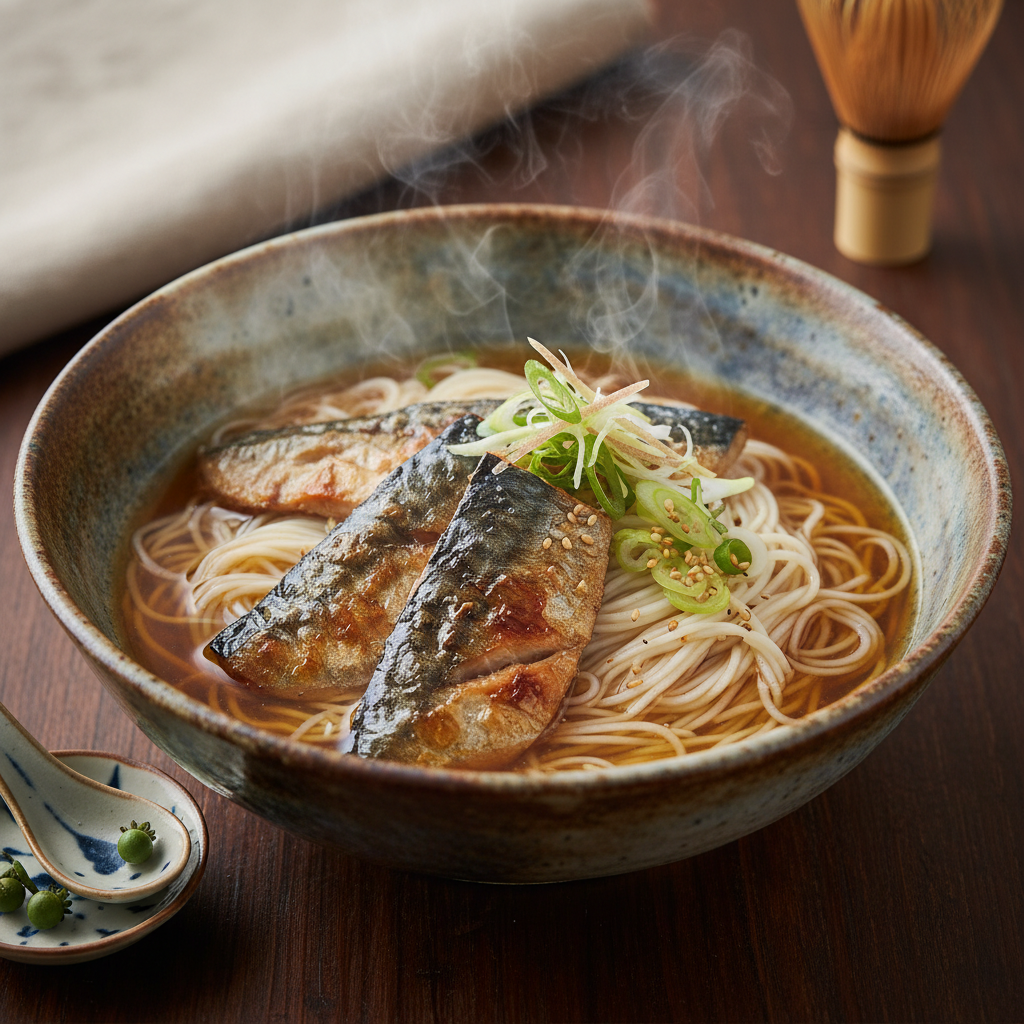
Saba soumen is a local dish of Shiga Prefecture in which roasted mackerel is simmered in a sweet and savory broth made with soy sauce, sugar, mirin, and served over boiled soumen noodles along with the cooking liquid. It is also called “yaki saba soumen” and is enjoyed throughout Shiga Prefecture, centered in the Kita-Ko region.
While common soumen noodles are typically eaten cold in summer, saba soumen is usually served as a hot dish, with soumen positioned as if it were a staple food, treated almost like rice. It is so hearty that one bundle (50g) per person is not enough; two or more bundles are often used.
Main Ingredients Used
The basic ingredients for saba soumen are as follows:
- Yaki saba (roasted mackerel): A whole mackerel roasted (or half fillet)
- Soumen: Dried noodles
- Seasonings: Soy sauce, sugar, mirin, sake
- Broth: Kombu dashi, or utilizing the umami of the mackerel
- Condiments: Green onion, ginger, grated daikon radish, etc.
Depending on the region and household, vegetables (burdock, carrot, shiitake mushroom, etc.) may be added.
Major Areas of Transmission in the Kita-Ko Region of Shiga Prefecture
Saba soumen is a local dish that has been passed down primarily in the Kita-Ko region of Shiga Prefecture, particularly centered on Nagahama City. The areas of the former Asai District, such as Kinomoto Town, Yogo Town, and Takatsuki Town in Nagahama City, are believed to be its birthplace.
Today, it has spread throughout Shiga Prefecture, not just the Kita-Ko region, and is served not only in home cooking but also in local restaurants. In particular, along the Kita-Koku Highway in Nagahama City, there are restaurants that feature yaki saba soumen as their signature menu, and it is popular with tourists.
Geographic Background and the Existence of the Mackerel Road
Shiga Prefecture is an inland prefecture with no sea access, despite having Lake Biwa. Nevertheless, the rooting of a local dish using mackerel is due to the existence of the Mackerel Road (Saba Kaido).
The Mackerel Road is a collective term for trade routes used to transport seafood such as mackerel caught in Wakasa Bay, Fukui Prefecture, to Kyoto. Multiple routes existed, but the route running from Wakasa through the northwestern part of Shiga Prefecture, south along the western shore of Lake Biwa to Kyoto, was particularly important.
Mackerel caught in Wakasa was salted and carried for a night’s journey to Kyoto. By the time it arrived in Kyoto, the salt had done its work, making it perfectly ripe for eating—exquisite timing. In the Kita-Ko region, a waypoint on this Mackerel Road, fresh mackerel was readily available, and this gave birth to the unique food culture of saba soumen.
History and Origin of Saba Soumen and the Custom of “Satsuki Mimai”
When discussing the history of saba soumen, one cannot omit the unique custom of “Satsuki Mimai” (May Well-Wishes).
What is Satsuki Mimai?
Satsuki Mimai is a custom in which parents send roasted mackerel to their daughters who have married into farming families during rice planting season (around the 5th lunar month, or currently around June). Rice planting was the busiest and most physically demanding time of year for farming families. Out of concern for their daughters, parents would send highly nutritious mackerel to thank them and their families for their hard work.
The delivered roasted mackerel was not only eaten as is but was also cooked together with soumen to make “yaki saba soumen.” It was served as a hospitality dish for those who helped with rice planting, or as a celebratory dish (a hare no shoku, or special occasion food) that the entire family would enjoy at gatherings held after the planting was finished.
Positioning as a Hare (Special Occasion) Food
Saba soumen was not everyday food but rather “hare no shoku,” food for special occasions. It was prepared for other events as well, including festivals and ceremonial occasions such as weddings and funerals, and was served to many people at gatherings.
At that time, seafood was a valuable commodity, and soumen was also a luxury item. Saba soumen, which combined these, was truly an appropriate treat for special occasions. Additionally, it had the practical advantage of being easy to make in large quantities and suitable for serving many people.
Women’s Labor and Saba Soumen
The custom of Satsuki Mimai speaks to the harsh working conditions of women in farming families. Rice planting was work primarily carried out by women, involving long hours of stooped work in a physically demanding posture. The act of parents sending roasted mackerel was an expression of love for their married daughter and, at the same time, a consideration for the labor of women in agricultural society.
How to Make Saba Soumen (Recipe)
Here is a basic way to make saba soumen that can be prepared at home.
Ingredients (Serves 5)
- Yaki saba (roasted mackerel): 1 whole fish (or 2 half fillets)
- Soumen: 10 bundles (500g) ※Approximately 2 bundles per person
- Soy sauce: 6 tablespoons
- Sugar: 4 tablespoons
- Mirin: 4 tablespoons
- Sake: 2 tablespoons
- Water: 600ml
- Kombu: 1 piece (10cm square)
- Ginger: 1 piece (thinly sliced)
- Green onion: As needed (thinly sliced)
- Grated daikon radish: As desired
Instructions
- Preparing the roasted mackerel: If you cannot obtain pre-roasted mackerel, salt-grill fresh mackerel. Brown both sides well in a grill or frying pan.
- Preparing the cooking liquid: In a pot, add water, kombu, and ginger, and heat. Remove the kombu just before boiling. Add soy sauce, sugar, mirin, and sake and bring to a boil.
- Simmering the mackerel: Add the roasted mackerel to the cooking liquid, place a drop lid on top, and simmer over medium heat for 15 to 20 minutes. Spoon the cooking liquid over the mackerel occasionally as it simmers so the flavor permeates. The key is to simmer until the flavor is thoroughly absorbed into the mackerel.
- Boiling the soumen: In a separate pot, bring plenty of water to a boil and cook the soumen. Follow the cooking time indicated on the package. When done, drain in a colander and rinse thoroughly under running water to remove sliminess.
- Plating: Place soumen in a bowl, top with mackerel, and pour plenty of cooking liquid over it. Garnish with green onion and grated daikon radish and serve.
Cooking Tips
- Amount of cooking liquid: Since soumen absorbs the cooking liquid well, make plenty of it.
- Choosing the mackerel: Select fatty mackerel for a more delicious result.
- Handling the soumen: Since it is eaten as hot soumen, after rinsing with water, you may want to warm it again lightly.
- Variations: Adding vegetables (burdock, carrot, shiitake mushroom) makes it a more nutritionally balanced dish.
Occasions and Seasons for Eating Saba Soumen
The main occasions and seasons for eating saba soumen are as follows:
Rice Planting Season (May to June)
This is the most traditional way to eat it. During rice planting season around the 5th lunar month (currently around June), it was prepared using mackerel from Satsuki Mimai. It was served as hospitality for those who helped with rice planting and was enjoyed at celebrations after planting was complete.
Festivals and Events
It was also prepared for local festivals, memorial services, and ceremonial occasions such as weddings and funerals. As a dish that could be prepared in large quantities and served to many people, it was treasured.
Modern Ways of Eating
Today, regardless of season, it can be enjoyed year-round as home cooking or as a menu item in restaurants. Especially for tourists, it is offered year-round as a local dish of Shiga Prefecture.
Eating Methods and Regional Differences
Basic Eating Method
Saba soumen is typically eaten in a hot state. It is served in a bowl with soumen noodles, topped with simmered mackerel, and plenty of cooking liquid poured over.
Using chopsticks, you flake the mackerel meat while eating it together with the soumen. The cooking liquid clings to the soumen, and you can enjoy the unique flavor where the umami of the mackerel and the sweet-savory seasoning blend together.
Use of Condiments
- Green onion: Thinly sliced and scattered on top
- Ginger: May be added grated
- Grated daikon radish: For a refreshing taste
- Shichimi togarashi (seven-spice chili powder): To add a spicy kick
Regional and Household Variations
Even within the Kita-Ko region, there are subtle differences among households and areas:
- Flavor of cooking liquid: Some households prefer it sweeter, others prefer a stronger soy sauce flavor
- Presence or absence of vegetables: Some households add burdock, carrot, shiitake mushroom, etc.
- Amount of soumen: Two bundles per person is standard, but some households use three
- Cutting the mackerel: Some serve it in large pieces, while others cut it into easier-to-eat portions
Restaurants Serving Saba Soumen
There are several dining establishments in the Kita-Ko region of Shiga Prefecture that serve yaki saba soumen.
Michikusa (Kinomoto, Nagahama City)
A casual dining restaurant utilizing an old private house along the Kita-Koku Highway, designated as a tangible cultural property. A popular restaurant where you can enjoy traditional yaki saba soumen. You can also enjoy local dishes and local sake.
Other Restaurants
Various dining halls, set meal restaurants, and roadside stations within Nagahama City also serve yaki saba soumen. You can obtain information at tourist information centers.
Efforts to Preserve and Pass On the Tradition
Various efforts are being made to pass on the local dish of saba soumen to the next generation.
Community Cooking Classes and Events
Nagahama City and Shiga Prefecture regularly hold cooking classes and events where residents can learn about local cooking. Local women’s groups and food life improvement promoters take the lead in passing on the recipes to younger generations and new residents.
School Lunch Programs
As part of food education to learn about local dishes, yaki saba soumen is sometimes served in school lunches at elementary and junior high schools throughout Shiga Prefecture. This provides a valuable opportunity for children to experience the region’s food culture.
Use as a Tourism Resource
In tourism promotion efforts by Shiga Prefecture and Nagahama City, yaki saba soumen is positioned as an important local dish. It is featured in tourist brochures and websites, and is positioned as a dish that “should be eaten when visiting Shiga.”
Product Development Efforts
Some food manufacturers and regional companies are working to commercialize saba soumen. By selling it as ready-to-eat or frozen food products, it has become possible for households to easily enjoy the local flavor.
Information Sharing on Social Media
In recent years, local restaurants and individuals have been promoting the appeal of saba soumen through social media. Searching for hashtags such as “#yaki saba soumen” and “#Shiga gourmet” on Instagram and Twitter reveals many posts.
Listing in MAFF’s “Our Local Dishes” Database
Saba soumen is also listed in the “Our Local Dishes” database operated by the Ministry of Agriculture, Forestry and Fisheries as a local dish of Shiga Prefecture, contributing to increased national recognition.
Nutritional Value and Health Aspects of Saba Soumen
Saba soumen is not only delicious but also nutritionally excellent.
Nutrition of Mackerel
Mackerel is rich in omega-3 fatty acids such as DHA (docosahexaenoic acid) and EPA (eicosapentaenoic acid), which have effects such as making blood flow more smoothly and maintaining brain health. It also contains high-quality protein, B vitamins, vitamin D, and calcium.
Energy from Soumen
Soumen is primarily composed of carbohydrates, which quickly convert to energy. It was an ideal food to eat after heavy labor such as rice planting.
A Nutritionally Balanced Dish
You obtain protein and fat from the mackerel and carbohydrates from the soumen, and if you add vegetables, you can also supplement vitamins and minerals. It is a dish with well-balanced nutrition in one serving.
Saba Soumen and Mackerel Dishes from Other Regions
There are several local mackerel dishes along the Mackerel Road.
Mackerel Dishes of Fukui Prefecture
In the Wakasa region of Fukui Prefecture, the starting point of the Mackerel Road, there are local dishes such as saba no heshiko (mackerel preserved in bran) and yaki saba sushi (roasted mackerel sushi).
Mackerel Sushi of Kyoto
At the end of the Mackerel Road in Kyoto, there is a specialty called saba sushi (mackerel sushi). It is a pressed sushi made with salt-cured mackerel placed on vinegar rice, an essential dish at Kyoto festivals.
Uniqueness of Shiga Prefecture
Saba soumen is a dish that underwent unique development specific to Shiga Prefecture, a waypoint on the Mackerel Road. The combination of mackerel and soumen is rarely seen in other regions, indicating the uniqueness of the food culture of the Kita-Ko region.
Conclusion: The Regional Story Told by Saba Soumen
The local dish of Shiga Prefecture’s Kita-Ko region, “saba soumen” (yaki saba soumen), holds meaning beyond that of a mere recipe.
The existence of the Mackerel Road as a trade route, the custom of Satsuki Mimai demonstrating family bonds, rice planting as a crucial agricultural event, and the positioning as a special occasion dish—all of these are condensed into a single dish.
The wisdom of utilizing marine resources despite being inland, the culture of carefully eating precious food on special occasions, parental love expressed in concern for a married daughter, and the spirit of honoring those who have completed hard labor—saba soumen contains the history and daily life of the region.
In modern times, the custom of Satsuki Mimai is fading, but saba soumen as a dish continues to be beloved in the region. It is passed down in households, served in restaurants, and enjoyed by tourists.
If you have the opportunity to visit Shiga Prefecture, please do try authentic yaki saba soumen. And why not reflect on the regional story embedded in this dish? You should be able to sense the rich food culture and history of the Kita-Ko region of Shiga Prefecture from a single bowl of saba soumen.