
Yaseuuma | A Thorough Explanation of the History, How to Make, and Cultural Background of Oita Prefecture’s Representative Local Dish
What is Yaseuuma
Yaseuuma is a traditional local dish from Oita Prefecture made by kneading wheat flour, flattening and stretching it, then boiling the dough and coating it with kinako (roasted soybean powder) and sugar. Known for its chewy texture and simple sweetness, it has long been cherished as a traditional snack in homes throughout Oita Prefecture.
The characteristic cooking method is simple yet unique: dough made by kneading wheat flour with salt and water is stretched like noodles and boiled. “Dango-jiru,” another representative local dish of Oita Prefecture, is made by placing the same dough into a soup with vegetables and a barley miso base, and yaseuuma and dango-jiru can be said to have a sibling-like relationship.
The name yaseuuma has an interesting legend dating back to the Heian period, and it has become an indispensable part of Oita Prefecture’s food culture.
History, Origin, and Related Events of Yaseuuma
A Legend Continuing from the Heian Period
The origin of the name yaseuuma traces back to a legend from approximately 1,200 years ago during the Heian period. A nobleman’s child named Tsurukiyomaru, who had fled from the capital, was living hidden in Myorenji Temple in Furuya, Hasamacho, Oita Prefecture. Tsurukiyomaru had a wet nurse named Yase, and Yase would knead wheat flour, stretch it long, boil it, and coat it with kinako to make a snack for the young lord.
Tsurukiyomaru loved this snack so much that he would call out “Yase, uma! Yase, uma!” asking for it, and according to the legend, the name “yaseuuma” was born from this. This legend is widely known among the people of Oita Prefecture, giving the dish historical romance.
Connection to Nehan-e (Buddha’s Parinirvana Commemoration)
Yaseuuma also has a deep connection to Buddhist practices. During Nehan-e, a Buddhist service commemorating Buddha’s entry into Parinirvana, there was a custom of offering dumplings made from new wheat flour or wheat flour, and the current yaseuuma is thought to have developed from this original form.
From this religious background, yaseuuma has a history of being made not only as a snack but also during community annual events and Buddhist ceremonies.
Main Transmission Areas
While yaseuuma is a local dish enjoyed widely throughout Oita Prefecture, traditional methods of preparation remain particularly strong in the Hasamacho area (currently Yufu City Hasamacho), which is said to be its birthplace.
It is made daily in homes throughout the prefecture, including Oita City, Beppu City, and Yufu City, and is sometimes included on school lunch menus. It is also served at roadside stations and local cuisine restaurants throughout the prefecture and is popular with tourists.
There are subtle differences between regions in the thickness and size of the dough and the ratio of kinako, and the existence of “grandmother’s taste” passed down in each household is one of the charms of yaseuuma.
Main Ingredients Used
Basic Ingredients
The ingredients for yaseuuma are extremely simple. The main ingredients are as follows:
For the dough:
- Wheat flour (medium-strength flour is optimal): 300-400g
- Salt: approximately 1/2 teaspoon
- Water: as needed (adjust while observing the dough’s state)
For finishing:
- Kinako: 6-8 tablespoons
- Sugar: 4-6 tablespoons (ratio of kinako to sugar from 1:1 to 2:1)
- Salt: a pinch (to enhance kinako flavor)
Choosing Wheat Flour
Medium-strength flour is typically used, though some households mix soft flour and bread flour. Using medium-strength flour creates the chewy texture and appropriate chewiness characteristic of yaseuuma.
Since wheat is also produced in Oita Prefecture, using locally-sourced wheat flour allows for creating yaseuuma with stronger regional character.
The Role of Kinako
Kinako is made by roasting soybeans and grinding them into powder, offering a fragrant flavor and high nutritional value rich in protein. When mixed with sugar, it achieves a balance of sweetness and aroma, transforming simple dough into a delicious snack.
How to Make It (for 8-10 servings)
Ingredient Preparation
Dough:
- Medium-strength wheat flour: 400g
- Salt: 1/2 teaspoon
- Water: approximately 200ml (adjust while observing dough state)
Kinako mixture:
- Kinako: 8 tablespoons
- Sugar: 6 tablespoons
- Salt: a pinch
Detailed Cooking Steps
1. Making the dough (Time required: approximately 15 minutes)
Place medium-strength flour and salt in a bowl, gradually adding water while mixing. Initially mix with chopsticks or similar, and once it starts to come together, knead by hand. It is important to knead thoroughly for about 10 minutes until the dough reaches the softness of an earlobe.
Once the dough becomes smooth, cover the bowl with a damp cloth and let it rest for 30 minutes or more. During this resting time, gluten relaxes and the dough becomes easier to stretch.
2. Stretching the dough (Time required: approximately 20 minutes)
Divide the rested dough into 8-10 equal portions. On a surface dusted with flour (not included in the ingredient list), use a rolling pin to stretch the dough thinly. The thickness should be about 2-3mm.
Cut the stretched dough into stick-like pieces about 3-4cm wide. Traditionally, there is also a method of stretching by hand, where you hold the dough in both hands and gradually stretch it to make it thin and long. This hand-stretching technique requires skill and is a traditional method.
3. Boiling (Time required: approximately 10 minutes)
Boil plenty of water in a large pot. Once boiling, add the stretched dough and boil. After the dough floats, boil for an additional 2-3 minutes for a chewy texture.
Place the boiled dough on a strainer and rinse in cold water. This process tightens the dough’s surface and improves its texture. It is important to drain off all water well.
4. Finishing (Time required: approximately 5 minutes)
Mix kinako, sugar, and salt together in a bowl. Add the boiled and drained dough and mix so that kinako is evenly coated throughout.
Transfer to a serving dish and it is complete. It can be enjoyed warm or after cooling.
Occasions and Seasons for Consumption
Yaseuuma is a local dish enjoyed year-round, without regard to season. It is particularly often made in the following situations:
As Everyday Snacks
The most common use is as an afterschool or weekend snack for children in homes. With simple ingredients and relatively quick preparation time, it has become established as home cooking.
Supplementary Food During Agricultural Work
In agricultural Oita Prefecture, yaseuuma was eaten as a “kobiru” (light meal) supplement during agricultural work. The combination of wheat flour and kinako provides sustained energy and is suitable for energy replenishment.
Annual Events and Buddhist Ceremonies
It is sometimes made during Buddhist events such as Nehan-e, community festivals, and memorial services. Its advantage is that large quantities can be easily made at once, making it useful when many people gather.
Provision in School Lunches
School lunches in Oita Prefecture sometimes provide yaseuuma as an opportunity for children to learn local cuisine. It also serves an educational role in passing on regional food culture to children.
Eating Methods and Variations
Basic Way of Eating
The most common way to eat is to coat the boiled dough with a mixture of kinako and sugar. Eating it while warm enhances the chewy texture of the dough and the fragrant aroma of kinako.
It is also delicious when cooled and can be carried as a snack or in a lunch box.
Modern Arrangements
While based on traditional methods, various arrangements are now enjoyed:
With black sugar syrup: Adding black sugar syrup to kinako and sugar creates a richer sweetness.
Matcha kinako: Mixing matcha powder with kinako creates visually vibrant yaseuuma with rich flavor.
With red bean paste: Coating boiled dough with kinako and adding red bean paste creates a Japanese confectionery-like dish.
Paired with fruit: Adding seasonal fruit to kinako-coated yaseuuma creates a nutritionally balanced snack.
Relationship with Dango-jiru
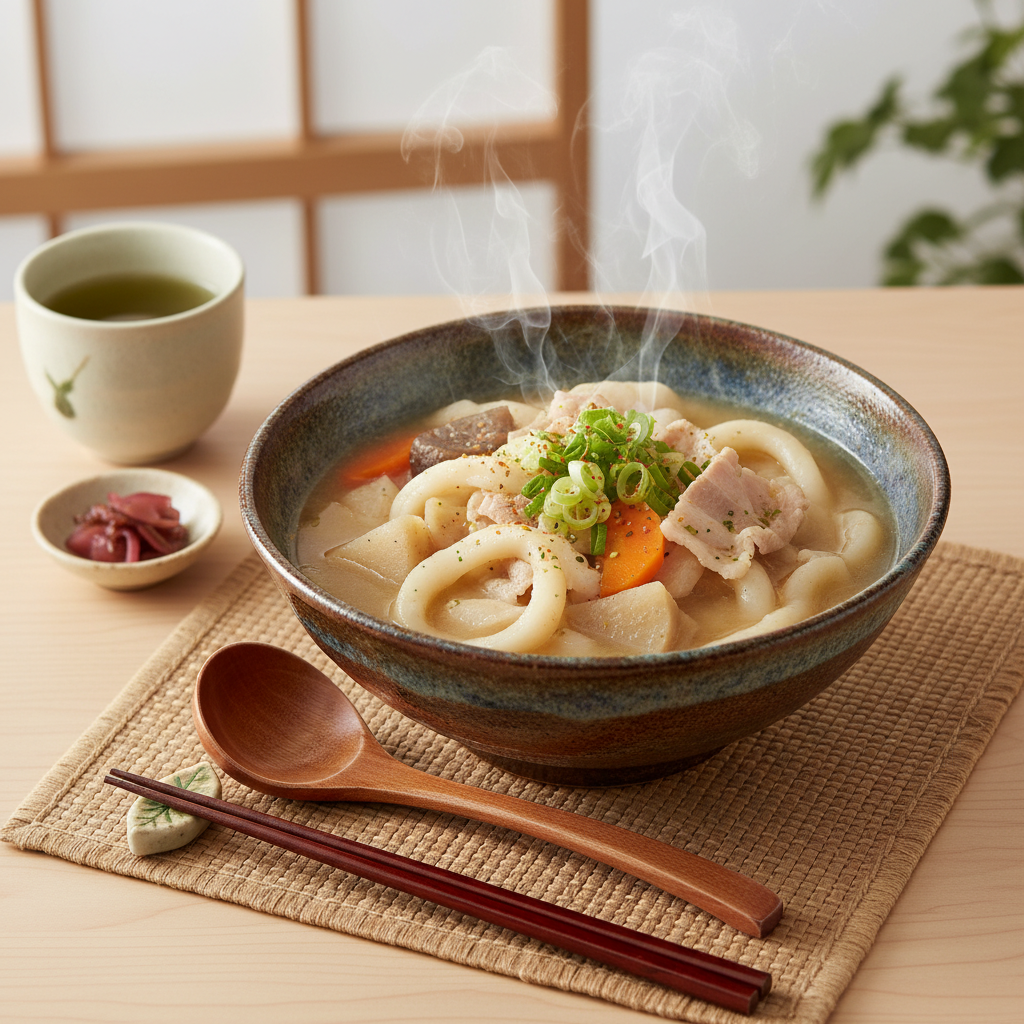
“Dango-jiru,” another representative local dish of Oita Prefecture, is made using the same dough as yaseuuma. The dough is cooked with vegetables (burdock, carrot, taro, shiitake mushrooms, etc.) in a barley miso-based broth and is eaten as a meal rather than a snack.
The versatility of creating both a sweet snack and a meal from the same dough demonstrates the richness of Oita Prefecture’s food culture.
Preservation and Succession Efforts
Household Transmission
Yaseuuma has been passed down from grandmother to mother to child as a home-cooked dish. Each household has its own unique “family taste” in the dough’s consistency, stretching method, and kinako-to-sugar ratio, transmitted across generations.
In recent years, with the trend toward nuclear families and changing eating habits, opportunities to make it at home have declined, but through the revival of local cuisine, younger generations are again paying attention to it.
Commercialization Efforts
There are companies in Oita Prefecture that manufacture and sell yaseuuma adapted to modern taste. “Yaseuuma-honpo” has transformed traditional yaseuuma into bite-sized Japanese confectionery, achieving recognition as a representative confection of Oita Prefecture, even being presented to Meiji Shrine.
Through such commercialization, yaseuuma has become known to people outside the prefecture, contributing to the promotion of Oita’s food culture.
Utilization as a Tourism Resource
Roadside stations, tourism facilities, and local cuisine restaurants provide yaseuuma to offer tourists the opportunity to experience Oita Prefecture’s food culture. Some facilities offer hands-on experience, deepening understanding of local cuisine through the joy of actually making it.
Utilization in School Education
Schools throughout Oita Prefecture provide opportunities for students to learn about local cuisine using yaseuuma as a subject in integrated studies and home economics classes. By actually cooking yaseuuma in cooking practice, children experientially learn about their region’s food culture, contributing to transmission to the next generation.
Yaseuuma is regularly provided in school lunches, becoming an established taste familiar to children.
Information Dissemination and SNS Use
Official websites of Oita Prefecture and municipalities feature pages introducing yaseuuma’s recipes and history, with wide-ranging information distribution. Registration in the Ministry of Agriculture, Forestry and Fisheries’ “Uchi no Kyodo Ryori” (Our Local Cuisine) database contributes to increasing national recognition.
On SNS, an increasing number of people post photos and videos of yaseuuma made at home, raising new interest particularly among younger generations. Many preparation methods are introduced on recipe video sites, creating an environment where people outside the prefecture can easily try making it.
Nutritional Value and Health Aspects of Yaseuuma
Nutritional Components
Yaseuuma is a relatively healthy snack primarily made from plant-based ingredients: wheat flour and kinako.
Wheat flour contains abundant carbohydrates and is excellent as an energy source. Since kinako is made from soybeans, it contains abundant high-quality plant protein, dietary fiber, isoflavones, B vitamins, and other nutrients.
Calorie control is possible by adjusting sugar amounts. Compared to commercial confectionery, it contains fewer additives and features natural sweetness from the ingredients themselves.
Significance in Modern Diet
Yaseuuma, which can be made with simple ingredients, is being reconsidered as a snack that can be safely eaten in modern times where food safety is emphasized.
Making it by hand provides opportunities for food education, allowing children to learn about ingredients and the cooking process. The activities of kneading and stretching dough are enjoyable for children and serve as effective tools for parent-child communication.
Positioning of Yaseuuma in Oita Prefecture’s Food Culture
Oita Prefecture is blessed with a rich natural environment abundant in both sea and mountain products. From seafood products like Sekiji and Sekisaba to livestock products like Bungo beef and agricultural products like shiitake mushrooms, diverse food ingredients are available.
Among these, yaseuuma is rooted deeply in the prefecture’s food life as an approachable and familiar local dish. Its ease of preparation—requiring neither special ingredients nor advanced techniques, makeable in any household—is one reason it has continued to be loved for so long.
While Oita Prefecture has many local dishes including dango-jiru, tori-ten, ryuukyu, and Yoshino chicken rice bowls, yaseuuma is particularly known among them for having clear historical background and narrative quality.
Regional Revitalization Through Yaseuuma
In recent years, local cuisine has drawn attention as part of local creation and tourism promotion. Yaseuuma, as a dish representing Oita Prefecture’s food culture, is being utilized in various contexts.
In tourism brochures and websites, it is introduced as one of the local dishes to taste when visiting Oita Prefecture, contributing to attracting food-focused tourists.
Additionally, yaseuuma is sometimes featured at product exhibitions and food events held outside the prefecture, playing a role in raising awareness of Oita Prefecture.
Conclusion: The Appeal and Future of Yaseuuma
Yaseuuma is a representative local dish of Oita Prefecture with a history spanning more than 1,200 years. Its name derived from a Heian-period legend, simple yet profound cooking method, chewy texture and simple sweetness, and family flavors passed down across generations—all of these form the appeal of yaseuuma.
In modern times, it continues to be enjoyed in diverse forms: made at home, provided in school lunches, commercialized, and utilized as a tourism resource. While preserving tradition, new arrangements and uses are emerging, suggesting the strong vitality of this local dish.
Precisely because modern life shows diverse eating habits and increasing globalization, the value of regionally-rooted food culture is being re-recognized. Yaseuuma is an irreplaceable food heritage through which one can taste Oita Prefecture’s history and culture.
For transmitting this wonderful local dish to future generations, multifaceted efforts are important, including home cooking, school education utilization, and strengthened information dissemination. It is hoped that through yaseuuma, Oita Prefecture’s rich food culture will be passed on to the future.