Complete Guide to Okayama Bara-zushi | Thorough Explanation from History to How to Make It to Famous Restaurants Where You Can Eat It
Bara-zushi, a local specialty dish representing Okayama Prefecture, is a traditional scattered sushi beautifully arranged with abundant seafood from the Seto Inland Sea and seasonal vegetables. This dish, which is indispensable for celebrations and festivals as a special occasion meal, can be said to be a cultural heritage that fuses the wisdom of common people born from the frugality ordinances of the Edo period with Okayama’s abundant food ingredients.
In this article, we will comprehensively convey the charm of this local dish, from the historical background of Okayama bara-zushi to concrete methods of preparation, contemporary preservation efforts, and information about famous restaurants where you can actually taste it.
What is Okayama Bara-zushi | A Splendid Local Dish Also Called Matsuri-zushi
Okayama bara-zushi, also called “matsuri-zushi” or “Bizen bara-zushi,” is a local dish that has long been beloved in the Bizen Okayama region. Compared to regular scattered sushi, it stands out for the overwhelming variety and quantity of ingredients used and its visually stunning appearance.
Main Characteristics
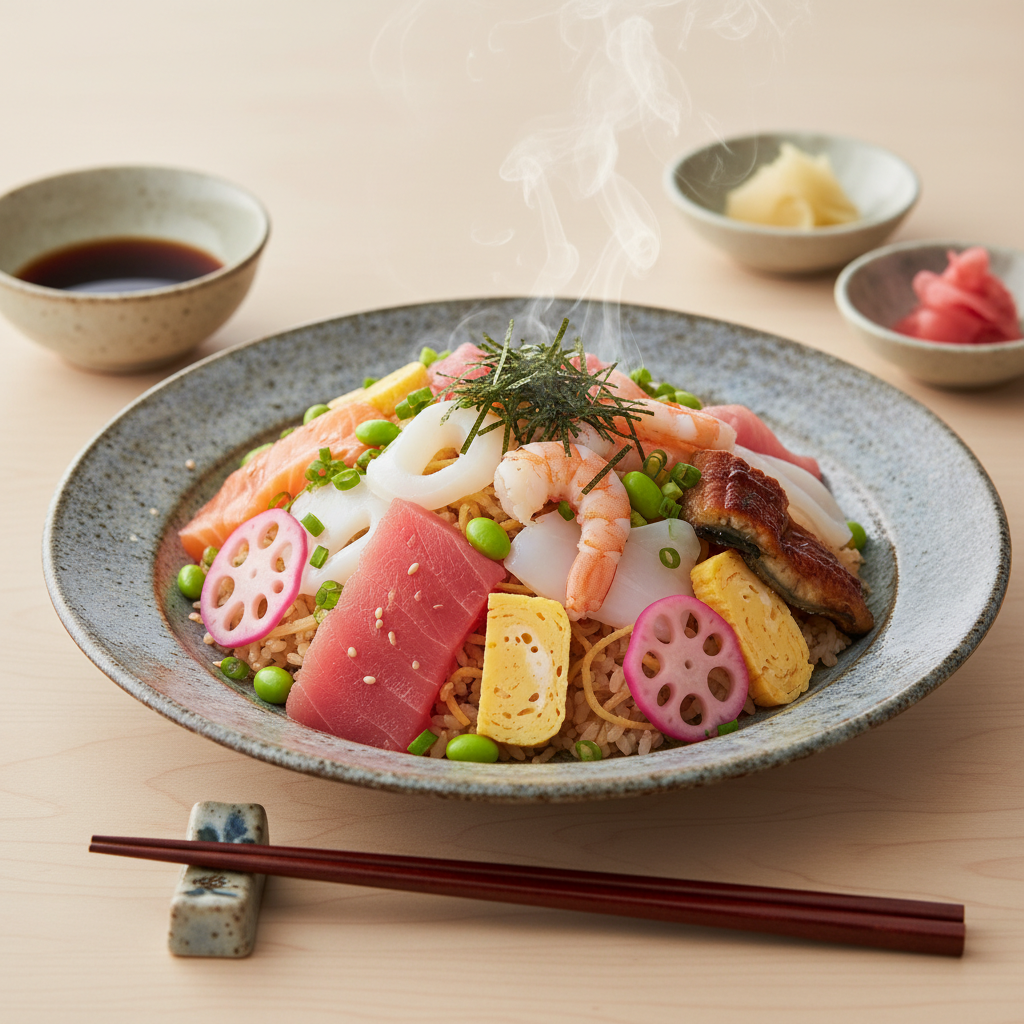
The greatest characteristic of bara-zushi lies in its two-tiered structure: “mixed sushi” where ingredients are mixed into vinegared rice, and “decorative sushi” where ingredients are beautifully arranged on top. Seasoned vegetables and seafood are mixed into the vinegared rice base, and then colorful ingredients such as egg strips, shrimp, Spanish mackerel, conger eel, lotus root, shiitake mushrooms, and snow peas are carefully arranged on top.
This dual structure allows one to enjoy different flavors and textures with each bite, creating a dish truly worthy of the word “feast.”
Main Ingredients Used
The ingredients used in Okayama bara-zushi are centered on the bounty of the Seto Inland Sea and the produce of the Okayama region’s mountains.
Bounty of the Sea:
- Spanish mackerel (sawara): A fish representing Okayama Prefecture, particularly delicious during its spring season
- Conger eel: High-quality varieties from the Seto Inland Sea
- Shrimp: An accent for color and texture
- Mamakari (saury): A local fish of Okayama
- Octopus, squid, and other seasonal seafood
Bounty of the Mountains and Vegetables:
- Shiitake mushrooms: Simmered with sweetness and saltiness
- Lotus root: Prepared as vinegared lotus root
- Burdock root
- Carrot
- Snow peas, green beans, and other green vegetables
- Bamboo shoot (spring season)
Others:
- Egg strips: Yellow coloring for visual appeal
- Nori (seaweed): Sprinkled in shredded form
- Pickled ginger: A flavor accent
The ingredients used vary by region and household, and each family has its own signature “home-style taste,” which is part of the charm of Okayama bara-zushi.
History and Origins | The Wisdom of Common People Born from Edo Period Frugality Ordinances
The birth of Okayama bara-zushi is deeply connected to the historical background of the early Edo period.
Ikeda Mitsumasa’s Frugality Ordinance
During the Kanbun era (1661-1673), Ikeda Mitsumasa, the first daimyo of the Bizen Okayama domain, issued a strict frugality ordinance stating “meals should consist of only one soup and one side dish” to promote financial reconstruction of the domain and encourage frugal living. This law imposed extremely modest eating on common people, allowing only one soup dish and one side dish.
Popular Resistance and Creative Innovation
Faced with this strict ordinance, common people used their ingenuity. Under the interpretation that “if you put various ingredients on rice, many ingredients still count as one side dish,” they developed a colorful and nutritious dish by mixing various foods into vinegared rice and arranging them beautifully on top.
It is said that initially ingredients were hidden under the rice to claim it as “one dish,” but eventually a style of proudly and beautifully arranging the ingredients became established.
Development into a Celebration Dish
As time progressed, bara-zushi transcended its role as resistance to the frugality ordinance and became established as a “special occasion dish” prepared for festivals, celebrations, entertaining guests, and other important days. It developed into a local dish of which Okayama Prefecture residents were proud, making full use of the abundant seafood of the Seto Inland Sea and the agricultural products of the Okayama Plain.
Primary Transmission Regions | From Bizen Okayama to Throughout the Prefecture
Bara-zushi originated in the Bizen Okayama region (present-day Okayama city vicinity) but is now a beloved local dish throughout Okayama Prefecture.
Regional Differences
There are slight variations by region within Okayama Prefecture:
Bizen Region (Okayama City vicinity):
The most traditional style, making abundant use of Seto Inland Sea seafood centered on Spanish mackerel. The greatest variety of ingredients is used.
Bitchu Region (Kurashiki City vicinity):
Similar to the Bizen style but with unique arrangements making use of local ingredients.
Mimasaka Region (Tsuyama City vicinity):
Inland and distant from the sea, the ingredient composition sometimes centers on mountain produce.
In all regions, each household has its own recipe passed down through generations, and each family’s unique “home taste” is cherished.
Occasions and Seasons for Eating | A Special Dish That Adorns Special Days
Okayama bara-zushi is not eaten in everyday life but is positioned as a “special occasion dish” prepared for important days.
Main Occasions for Eating
Festivals:
Bara-zushi is prepared in homes throughout Okayama during autumn and spring festivals held in various regions. In particular, there is a tradition of many households preparing it during the autumn festival season in October.
Celebrations:
- Weddings and receptions
- First festival, Shichigosan (Seven-Five-Three festival)
- Entrance and graduation celebrations
- Long-life celebrations such as the sixtieth birthday
- Housewarming celebrations
Entertaining Guests:
When welcoming important guests, it is prepared as a hospitality dish, prepared with great care.
Buddhist Services:
In some regions, it is also served at memorial services.
Seasonal Variations
The ingredients used change with the seasons. Spring sees Spanish mackerel and bamboo shoots, summer brings conger eel, autumn features chestnuts and matsutake mushrooms, and winter incorporates root vegetables, expressing seasonality through the incorporation of seasonal ingredients.
How to Make It Properly | Recipe for Homemade Okayama Bara-zushi
Here we introduce a proper recipe for Okayama bara-zushi that can be made at home. While it takes effort, carefully preparing each ingredient is the secret to deliciousness.
Ingredients (Serves 4)
Vinegared Rice:
- Rice: 3 cups
- Kombu: One 5cm-square piece
- Rice vinegar: 4 tablespoons
- Sugar: 2 tablespoons
- Salt: 1 teaspoon
Ingredients to Mix In:
- Dried shiitake mushrooms: 4
- Carrot: 1/2
- Burdock root: 1/2
- Lotus root: 100g
- Fried tofu: 1 sheet
Decorative Ingredients:
- Spanish mackerel (or sea bream): 100g
- Conger eel (grilled): 1
- Shrimp: 8
- Eggs: 3
- Snow peas: 10
- Pickled ginger: as needed
- Shredded nori: as needed
Seasonings:
- Dashi stock: 200ml
- Soy sauce: 3 tablespoons
- Mirin: 3 tablespoons
- Sugar: 2 tablespoons
- Rice vinegar: as needed
- Salt: as needed
Instructions
Preparation
- Rehydrate dried shiitake mushrooms: Soak in water the day before. Save the soaking liquid for cooking.
- Cook rice: Cook normally with kombu added.
- Make vinegared rice: Pour combined vinegar mixture (vinegar, sugar, and salt mixed) over hot cooked rice, mix with a cutting motion, and let cool.
Preparing Mixed-in Ingredients
- Cut vegetables: Cut shiitake mushrooms, carrot, burdock root, and fried tofu into thin strips. Slice lotus root thinly and soak in vinegar water.
- Make the simmered mixture: In a pot, add dashi stock (including shiitake soaking liquid), soy sauce, mirin, and sugar, bring to a boil, add shiitake mushrooms, carrot, burdock root, and fried tofu, and simmer until liquid is gone.
- Make vinegared lotus root: In a separate pot, briefly boil lotus root, then marinate in sweet vinegar (vinegar:sugar=2:1).
- Mix into vinegared rice: Mix the cooled simmered ingredients into the vinegared rice. Drain the lotus root and mix in as well.
Preparing Decorative Ingredients
- Make egg strips: Beat eggs, make a thin omelet, and cut into thin strips.
- Boil shrimp: Remove the intestinal vein from shrimp and boil in salt-water, then peel.
- Grill Spanish mackerel: Sprinkle salt on Spanish mackerel, let sit 10 minutes, and grill. Alternatively, you can cure it in vinegar.
- Prepare conger eel: If using store-bought grilled conger eel, cut into easy-to-eat pieces.
- Boil snow peas: Briefly boil in salt water and cut diagonally.
Plating
- Mound vinegared rice in bowl: Spread the mixed vinegared rice evenly in a large bowl or sushi box.
- Arrange ingredients beautifully: Scatter egg strips over the entire surface, then arrange Spanish mackerel, conger eel, shrimp, snow peas, and pickled ginger on top, considering color balance.
- Final touch: Sprinkle shredded nori on top and serve.
Cooking Tips
- Preliminary seasoning of ingredients is important: Each ingredient should be well-seasoned individually, which deepens the overall flavor.
- Balance of colors: Consider the five colors—red (shrimp, pickled ginger), yellow (egg strips), green (snow peas), white (Spanish mackerel), and brown (conger eel)—for a beautiful presentation.
- Cool the vinegared rice: If mixed while hot, the flavors of the ingredients become muted, so cool thoroughly before mixing in.
- Use seasonal ingredients: Incorporating seasonal produce makes the dish more delicious and expresses seasonality.
How to Enjoy It | Manners and Ways of Eating
Okayama bara-zushi is a dish designed to fully enjoy its stunning appearance and abundant ingredients.
Basic Way of Eating
Bara-zushi arranged on a large plate or in a sushi box is typically divided onto individual plates and eaten. Scooping up the decorative ingredients on top together with the mixed vinegared rice allows one to enjoy the flavors and textures of various ingredients all at once.
Accompanying Dishes
While bara-zushi is a complete feast on its own, it is often served with other Okayama local specialties such as “pickled mamakari” or “miso-marinated Spanish mackerel,” and soup.
Pairing with Alcohol
It pairs exceptionally well with Japanese sake, and pairing it with Okayama’s local sake allows you to fully enjoy the regional flavors. Enjoy with your preferred sake, whether sweet or dry.
Preservation and Succession Efforts in Modern Times
Okayama bara-zushi, as a traditional local dish, is being passed on to the next generation in various ways.
Provision in School Lunches
Many schools throughout Okayama Prefecture offer bara-zushi in school lunches as part of food education to learn about local cuisine. This serves as a valuable opportunity for children to experience their region’s food culture.
Cooking Classes and Workshops
Cooking classes teaching how to prepare bara-zushi are regularly held, centered on community centers, JA (agricultural cooperatives), and food life improvement promoters. These provide valuable opportunities to learn traditional preparation methods.
Product Development Efforts
In recent years, ready-made bara-zushi has been sold at supermarkets, department stores, and specialty shops to allow busy modern people to easily enjoy it. Pre-order sales are also available during festival and celebration seasons.
“Hare-zushi” Brand Development
In 2023, JA Group Okayama branded Okayama bara-zushi as “Hare-zushi” (clear-day sushi), a modern Reiwa-era version, launching new initiatives aimed at expanding consumption of Okayama-produced ingredients and promoting tourism. It is attracting attention as a new bara-zushi that preserves tradition while being modernized.
Information Sharing via SNS
Okayama Prefecture, tourism associations, restaurants, and others share beautiful bara-zushi photos, recipes, and event information through Instagram, Twitter, and other social media. This has broadened awareness of Okayama bara-zushi’s appeal among younger generations and people outside the prefecture.
Use as a Tourism Resource
Bara-zushi is positioned as an important tourism resource for visitors to Okayama Prefecture. It is actively promoted on tourism brochures and websites and awareness has grown as “a local dish you must eat when visiting Okayama.”
Famous Restaurants Where You Can Eat Okayama Bara-zushi
There are many restaurants throughout Okayama Prefecture that serve authentic bara-zushi. Here we introduce representative establishments.
Local Specialty Restaurants
Long-established local cuisine restaurants in Okayama City offer traditionally-prepared bara-zushi. The appeal is being able to enjoy it alongside other Okayama local specialties such as mamakari and Spanish mackerel dishes.
Sushi Specialty Restaurants
Some sushi specialty restaurants in Okayama City and Kurashiki City offer bara-zushi as a special menu item in addition to regular nigiri sushi. The beautiful presentation showcases the craftsman’s skill.
Hotels and Inns
Major hotels and hot spring inns throughout Okayama Prefecture serve luxurious bara-zushi as dinner or banquet cuisine for overnight guests. Many facilities can accommodate advance reservations.
Department Stores and Supermarkets
During festival seasons and New Year, bara-zushi for takeaway is sold at prepared food sections of department stores and supermarkets throughout Okayama. It is a popular option for enjoying it casually at home.
Advance Reservation Recommended
Since bara-zushi requires time for ingredient preparation, advance reservation is recommended when eating at restaurants. Especially during festival and tourism seasons when crowds are heavy, early reservation is advised.
Differences Between Okayama Bara-zushi and Scattered Sushi from Other Regions
Various scattered sushi dishes exist throughout Japan, but Okayama bara-zushi has unique characteristics.
Abundance of Ingredients
Compared to ordinary scattered sushi, the overwhelming variety and quantity of ingredients used is a characteristic feature of Okayama bara-zushi. It is not uncommon to use more than ten types of ingredients.
Two-Tiered Structure
The two-tiered structure of mixing ingredients into vinegared rice and then arranging them beautifully on top is unique to Okayama bara-zushi. This structure allows different flavors to be enjoyed with each bite.
Historical Background
A local dish with a historical background of common people’s resistance to frugality ordinances is rare, and this origin itself becomes a major characteristic of Okayama bara-zushi.
Regional Character
The point of maximizing use of local ingredients—the Seto Inland Sea’s seafood and Okayama Plain’s agricultural products—is particularly characteristic. Spanish mackerel especially has become an indispensable ingredient in bara-zushi as a fish representing Okayama.
Arrangement Ideas for Homemade Preparation
While based on traditional recipes, modern ingredients and cooking methods can also be incorporated for fun arrangements.
Time-Saving Arrangement
- Use commercially-prepared sushi vinegar
- Utilize store-bought grilled conger eel or prepared side dishes
- Use the rice cooker’s sushi mode
Western-Style Arrangement
- Add smoked salmon or avocado
- Top with mayonnaise-based sauce
- Add Western flavoring with capers or dill
Healthier Arrangement
- Use brown rice or mixed grain rice
- Increase the proportion of vegetables
- Select low-calorie ingredients
Child-Friendly Arrangement
- Add ingredients children enjoy such as imitation crab or tuna
- Serve in individual small cups
- Arrange decoration sushi-style
Conclusion | A Treasure of Okayama Food Culture Symbolizing the Region
Okayama bara-zushi is Okayama Prefecture’s representative local dish, born from the historical context of Edo period frugality ordinances and developed by making full use of the abundant food ingredients of the Seto Inland Sea and the Okayama Plain.
Bara-zushi, carefully prepared ingredient by ingredient and beautifully plated, has been passed down across generations as a special dish that adorns important occasions. Its splendid appearance, abundant ingredients, and the complex flavors that unfold with each bite are truly worthy of the word “feast.”
Even in modern times, succession to the next generation is being pursued in various forms including school lunches, cooking classes, commercialization, and SNS information sharing. It continues to exist as a symbol of Okayama’s food culture, and its value will continue to be passed down in the future.
When visiting Okayama, be sure to taste authentic bara-zushi. Also, trying to make it at home allows one to experience the depth of this traditional dish and the thoughts of its preparers. Okayama bara-zushi transcends mere cuisine—it is a “treasure of food” packed with the region’s history and culture.