Complete Guide to Yokosuka Navy Curry|History and Charm of Kanagawa Prefecture’s Representative Local Cuisine
What is Yokosuka Navy Curry (Yokosuka Kaigun Curry)?
“Yokosuka Navy Curry” is a local dish of Yokosuka City, Kanagawa Prefecture, restored to modern times based on a recipe published in the “Naval Cooking Reference Book” issued by the former Japanese Imperial Navy in Meiji 41 (1908). This military food, said to be the origin of Japan’s curry rice, was created in 1999 (Heisei 11) as part of Yokosuka City’s community revitalization and regional activation efforts.
Today, it is widely known nationwide as a signature local gourmet of Yokosuka City, served at numerous restaurants in the city. In addition, products such as retort curry have been commercialized, and it is enjoyed as a local cuisine that can be savored at home.
History, Origin, and Related Events
The Japanese Navy’s Encounter with Curry
In the Meiji era, the Japanese Navy modernized itself by following the British Navy as a model. At that time, the Japanese Navy’s diet centered on white rice, but this led to a serious problem of beriberi, caused by vitamin B1 deficiency. Beriberi was also called “Edo ailment,” and many military personnel suffered from this disease.
To solve this problem, the Japanese Navy focused on curry stew, a military food of the British Navy. Curry was relatively easy to cook, nutritionally balanced, and an ideal menu where vegetables and meat could be consumed at once. Initially it was eaten with bread, but it gradually evolved to match Japanese physiology and preferences, with wheat flour used as a thickening agent and served over rice. This became the prototype of present-day Japanese curry rice.
The Role of the Naval Cooking Reference Book
The “Naval Cooking Reference Book” published in Meiji 41 was an official recipe collection created for Japanese Navy cooking personnel. It contains a detailed curry recipe, specifying the amount of ingredients used and concrete cooking procedures.
This recipe was used uniformly at various Navy ships and bases, and many servicemen became familiar with this taste. After discharge, military personnel returning to their hometowns carried this recipe with them and spread it throughout the country, leading to curry rice’s development into Japan’s national dish.
Modern Restoration and Community Revitalization
In 1999, Yokosuka City capitalized on its historical background as a place with Navy connections and launched the “Yokosuka Navy Curry” project as part of regional revitalization efforts. While faithfully recreating the recipe from the Naval Cooking Reference Book, the city added arrangements suited to modern food culture, establishing it as a new local dish.
This initiative was a major success, and Yokosuka City became nationally recognized as the “City of Curry.” The annual “Yokosuka Curry Festival” attracts many tourists and has become an important tourism resource for the region.
The Tradition of Friday as Curry Day
The Navy had a tradition of serving curry every Friday to prevent loss of time sense during long voyages. This tradition has been passed down to the current Japan Maritime Self-Defense Force, and curry is sometimes served on Fridays in school lunches in Yokosuka City. This custom continues to be cherished today as a uniquely Japanese food culture.
Main Regions of Transmission
The main region where “Yokosuka Navy Curry” is transmitted is Yokosuka City, Kanagawa Prefecture. Yokosuka City has developed as a naval city since Commodore Perry’s arrival in the late Edo period and currently hosts a major base of the Japan Maritime Self-Defense Force.
As a provision rule, in principle, the name “Yokosuka Navy Curry” can only be used in certified restaurants within Yokosuka City. This is an effort to preserve the value of the regional brand and appropriately manage it as a tourism resource for Yokosuka City.
In the city, centered around Yokosuka Central Station, numerous certified restaurants exist, each offering navy curry with their own unique touches. Specialty shops such as Yokosuka Navy Curry Honpo offer more than ten types of curry dishes at any given time.
Main Ingredients Used
The basic ingredients of Yokosuka Navy Curry are based on the recipe in the Naval Cooking Reference Book.
Main Ingredients
- Meat: Beef or chicken (beef was the main ingredient in the Navy)
- Vegetables: Onions, carrots, potatoes
- Roux ingredients: Curry powder, wheat flour, butter (or lard)
- Seasonings: Salt, soy sauce, Worcestershire sauce
- Others: Bouillon or dashi stock
Set Menu Composition
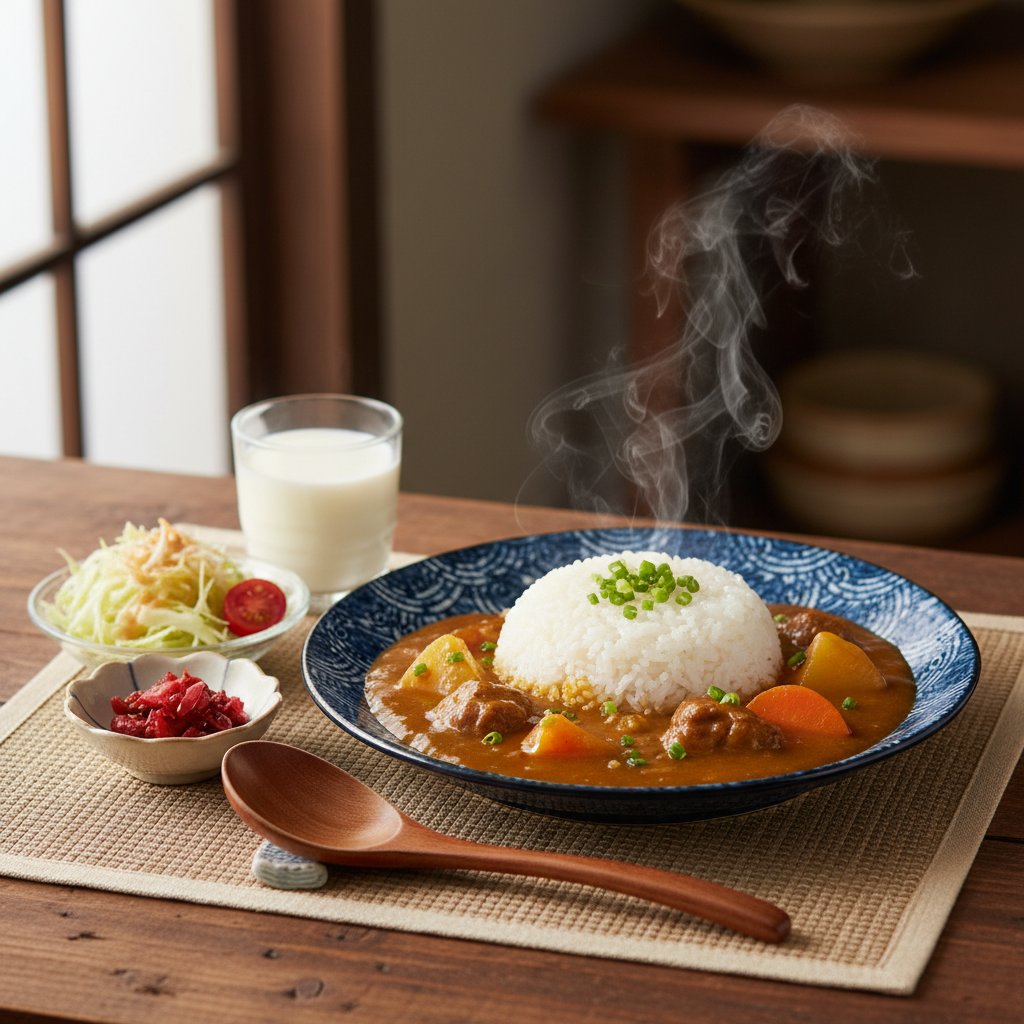
The basic rules for serving “Yokosuka Navy Curry” define the following set:
- Curry rice (rice and curry)
- Milk (provided in the Navy for calcium replenishment)
- Salad (for vitamin replenishment)
This three-item set conveys the Navy’s nutritional thinking to modern times.
Ingredients (Serves 4)
Here are the ingredients to authentically recreate Yokosuka Navy Curry at home.
Curry Base
- Beef (or chicken): 400g
- Onion: 2 medium (about 400g)
- Carrot: 1 medium (about 150g)
- Potato: 3 medium (about 450g)
- Curry powder: 3-4 tablespoons
- Wheat flour: 4 tablespoons
- Butter: 50g
- Salad oil: 2 tablespoons
- Water or bouillon: 800ml
- Salt: 1 teaspoon
- Soy sauce: 1 tablespoon
- Worcestershire sauce: 1 tablespoon
Accompaniments
- Rice: for 4 people (about 600g)
- Milk: 4 glasses (200ml each)
- Salad vegetables: lettuce, tomato, cucumber, etc., as desired
Cooking Method
Here is how to prepare authentic Yokosuka Navy Curry based on the recipe from the Naval Cooking Reference Book.
Preparation
- Vegetable preparation: Slice onions thinly, and cut carrots and potatoes into bite-sized pieces. The Navy recipe is characterized by relatively large cuts.
- Meat preparation: Cut beef into bite-sized pieces and season lightly with salt and pepper.
Cooking Steps
- Making the roux: Melt butter in a thick-bottomed pot, add wheat flour, and cook slowly over low heat. Stir for 10-15 minutes until golden brown, being careful not to burn it. This is the foundation of the Navy curry’s distinctive deep flavor.
- Adding curry powder: When the roux turns golden brown, add the curry powder and cook for another 2-3 minutes. Once the aroma of the curry powder rises, remove from heat and let cool slightly.
- Searing the meat: Heat salad oil in another pot and sear the beef over high heat until the surface browns.
- Adding vegetables: Once the meat is browned, add onions and cook until transparent. Then add carrots and cook until oil coats everything.
- Simmering: Add water or bouillon and bring to a boil, removing any scum. Add potatoes and simmer over medium heat for 20-30 minutes until vegetables are tender.
- Adding the roux: Once vegetables are tender, gradually add the prepared roux while dissolving it. To avoid lumps, it is helpful to take some broth with a ladle, mix it with the roux, and then return it to the pot.
- Seasoning: Adjust the flavor with salt, soy sauce, and Worcestershire sauce. Navy curry is characterized by a simpler, more robust taste with slightly stronger saltiness compared to modern curry.
- Finishing: Simmer for about 10 more minutes over low heat to blend all flavors together.
Serving
Serve warm rice on a plate and pour curry over it. In Navy style, rice and curry were sometimes served separately. Serve with milk and salad to complete.
Eating Method
The traditional way of eating Yokosuka Navy Curry reflects Navy dining etiquette.
Basic Way of Eating
- Eating the set together: Eating curry rice, milk, and salad together ensures balanced nutrition. This was a scientifically designed meal method by the Navy.
- Pairing with milk: Milk moderates the spiciness of the curry and provides calcium supplementation. The Navy valued milk for both beriberi prevention and maintaining physical strength.
- Role of salad: The fresh vegetable salad was intended to supplement vitamin C, which tends to be lost in heat-cooked curry dishes.
Modern Arrangements
Each restaurant in Yokosuka City adds its own unique touches while maintaining the basic recipe. You can enjoy a variety of navy curries, including those topped with cheese, seafood reflecting the area’s naval heritage, and variations in spiciness levels.
Occasions and Seasons for Eating
Yokosuka Navy Curry is a local dish that can be enjoyed year-round, but it holds special significance on particular occasions and seasons.
Friday Tradition
The Navy designated every Friday as curry day. This custom, which began as a way to maintain a sense of time during long voyages, has been passed down to the current Japan Maritime Self-Defense Force. In Yokosuka City, the tradition of eating curry on Fridays has taken root in school lunches and homes, becoming established as a regional food culture.
Events and Festivals
The “Yokosuka Curry Festival” is held annually in Yokosuka City. At this event, certified restaurants from throughout the city gather together to serve their signature navy curries. With tens of thousands of visitors, it has become an important opportunity to promote Yokosuka’s food culture nationwide.
Tourism and Daily Life
For tourists, Yokosuka Navy Curry is a signature dish when visiting Yokosuka, and for residents, it is a daily dining option. The curry is enjoyed in various settings.
Preservation and Transmission Efforts (Overview of Transmitters, Preservation Societies, Use of SNS, Commercialization and Other Modern Initiatives)
The preservation and transmission of Yokosuka Navy Curry involve multifaceted efforts by government, private enterprises, and citizens working together.
Yokosuka City’s Efforts
Yokosuka City positions “Yokosuka Navy Curry” as an important tourism resource and has established a certification system. Restaurants in the city that meet certain standards (being based on recipes from the Naval Cooking Reference Book, serving milk and salad as a set, etc.) are certified as “Yokosuka Navy Curry” serving establishments. This system maintains brand quality.
Popularization Through Commercialization
Local businesses, including Chomisakata Co., Ltd., have actively promoted commercialization as retort curry. This allows people who cannot visit Yokosuka to enjoy authentic navy curry flavor at home. Retort products are sold at supermarkets and online shops nationwide and are widely recognized as Kanagawa’s local cuisine.
Restaurant Expansion and Accessibility
Yokosuka Navy Curry Honpo operates 9 locations throughout Yokosuka City, providing not only restaurant service but also retort curry and souvenir sales at merchandise corners. By strategically placing stores around Keikyu Yokosuka Central Station, the company enhances tourist convenience.
Information Dissemination in the Digital Age
Active information dissemination using SNS is also underway. Official accounts of each restaurant and Yokosuka City regularly post information about new menus, event updates, and the history of navy curry, aiming to raise awareness among younger generations. On Instagram and Twitter, many posts can be seen with the hashtag “#Yokosuka Navy Curry,” and word-of-mouth from visitors spreads the charm of the local dish.
Collaboration with Education
In schools in Yokosuka City, Yokosuka Navy Curry is featured as part of classes teaching local history and food culture. By having children learn about the history and significance of the local dish, transmission to the next generation is promoted. Additionally, by serving navy curry in school lunches, opportunities to actually taste it are provided.
Recognition by the Ministry of Agriculture, Forestry and Fisheries
It is officially registered in the Ministry of Agriculture, Forestry and Fisheries “Our Regional Cuisine” database and is recognized at the national level as an important local cuisine of Kanagawa Prefecture. This recognition guarantees the value of the regional food culture and supports preservation and transmission efforts.
Utilization as a Tourism Resource
The prefecture’s tourism site “Tourism Kanagawa NOW” has also featured special coverage, positioning it as a tourism resource for the entire prefecture. For tourists visiting Yokosuka City, navy curry has become established as a must-try local gourmet, contributing to regional economic revitalization.
Nutrition and Health Benefits of Yokosuka Navy Curry
Curry, which the Navy adopted as a measure against beriberi, is an excellent dish from the perspective of modern nutrition.
Nutritional Balance
Curry contains carbohydrates (rice), protein (meat), and vitamins and minerals (vegetables), allowing all three major nutrients to be consumed in one serving. Furthermore, by supplementing with milk for calcium and protein, and salad for vitamin C and dietary fiber, perfect nutritional balance is achieved.
Efficacy of Spices
Turmeric (curcumin) contained in curry powder has antioxidant properties, and cumin and coriander have digestion-promoting effects. These spices are said to be beneficial for maintaining health.
As an Energy Source
For Navy personnel engaged in heavy labor, curry was an efficient energy source. Even today, Yokosuka Navy Curry is an ideal choice when a substantial meal is needed.
Major Serving Establishments in Yokosuka City
There are numerous certified restaurants in Yokosuka City, each offering navy curry with its own distinctive character.
Yokosuka Navy Curry Honpo
This specialty shop operates 9 locations throughout the city and offers more than 10 types of curry menus at any given time. With both a restaurant and merchandise corner, you can enjoy both dining and shopping. It is within walking distance of Yokosuka Central Station with excellent accessibility.
Other Certified Establishments
Various restaurants in Yokosuka City are certified, including Western restaurants, cafes, and hotel restaurants, allowing you to enjoy navy curry in diverse settings. While respecting basic rules, each restaurant exercises its own unique ideas, and comparing different curries is part of the fun.
Influence on Japan’s Curry Culture
Yokosuka Navy Curry has had a major impact on Japan’s entire curry culture.
Spread of Curry Rice
Military personnel who learned Western cuisine in the Navy brought recipes home after discharge, and curry rice began to be made throughout the country. This became a major catalyst for curry spreading nationwide.
Pioneer of the Local Curry Boom
The success of Yokosuka Navy Curry in 1999 became a catalyst for the birth of local curries throughout the country. Diverse local curries using regional specialty products or based on local history have emerged and become established as a method for regional revitalization.
Status as a National Dish
Curry rice has become so established that it is now called Japan’s national dish. At its origin lies the existence of navy curry, which combined nutritional consideration with practicality.
Conclusion: Value as a Local Cuisine
Yokosuka Navy Curry is not merely a local specialty food but an important local cuisine in which Japan’s modern history, development of food culture, and regional identity are concentrated. It is noted nationwide as a successful case of restoring a Meiji-era Navy recipe to modern times and achieving regional revitalization.
When visiting Yokosuka City, Kanagawa Prefecture, be sure to taste authentic Yokosuka Navy Curry and contemplate its history and traditions. Also, by using retort products, you can enjoy authentic navy curry flavor at home.
The tradition of eating curry on Friday holds meaning beyond mere dining—it is a cultural act. Why not rediscover the richness of Japanese food culture and regional history through Yokosuka Navy Curry?