Complete Guide to Gunma Prefecture’s Konjac Cuisine | Thorough Explanation from Local Dishes to Home-Cooked Flavors
The Deep Connection Between Gunma Prefecture and Konjac
Gunma Prefecture is known as Japan’s leading konjac producer, accounting for approximately 90% of the national market share. In particular, in regions such as Shimonita Town, Kanra Town, and Showa Village, the traditions of konjac cultivation that have continued since the Edo period still thrive today.
Due to the climate and soil suitable for growing konjac plants, as well as manufacturing techniques passed down through generations, Gunma Prefecture has become the center of Japan’s konjac culture. Local dishes made with this abundant konjac are an indispensable part of the dining tables of Gunma residents.
The History of How Konjac Became Gunma Prefecture’s Specialty Product
Large-scale cultivation of konjac plants in Gunma Prefecture began in earnest during the mid-Edo period. The method of making konjac flour, devised by Fujuemon Nakajima of the Mito Domain, was transmitted to Gunma Prefecture. This made it possible to make konjac from powder rather than just from fresh tubers, leading to a dramatic increase in production volume.
During the Meiji era, commercial cultivation expanded centering on Shimonita, and with mechanization progressing in the Showa period, the current large-scale production system was established. Gunma Prefecture’s konjac industry is a traditional industry with over 300 years of history.
Signature Konjac Local Dishes of Gunma Prefecture
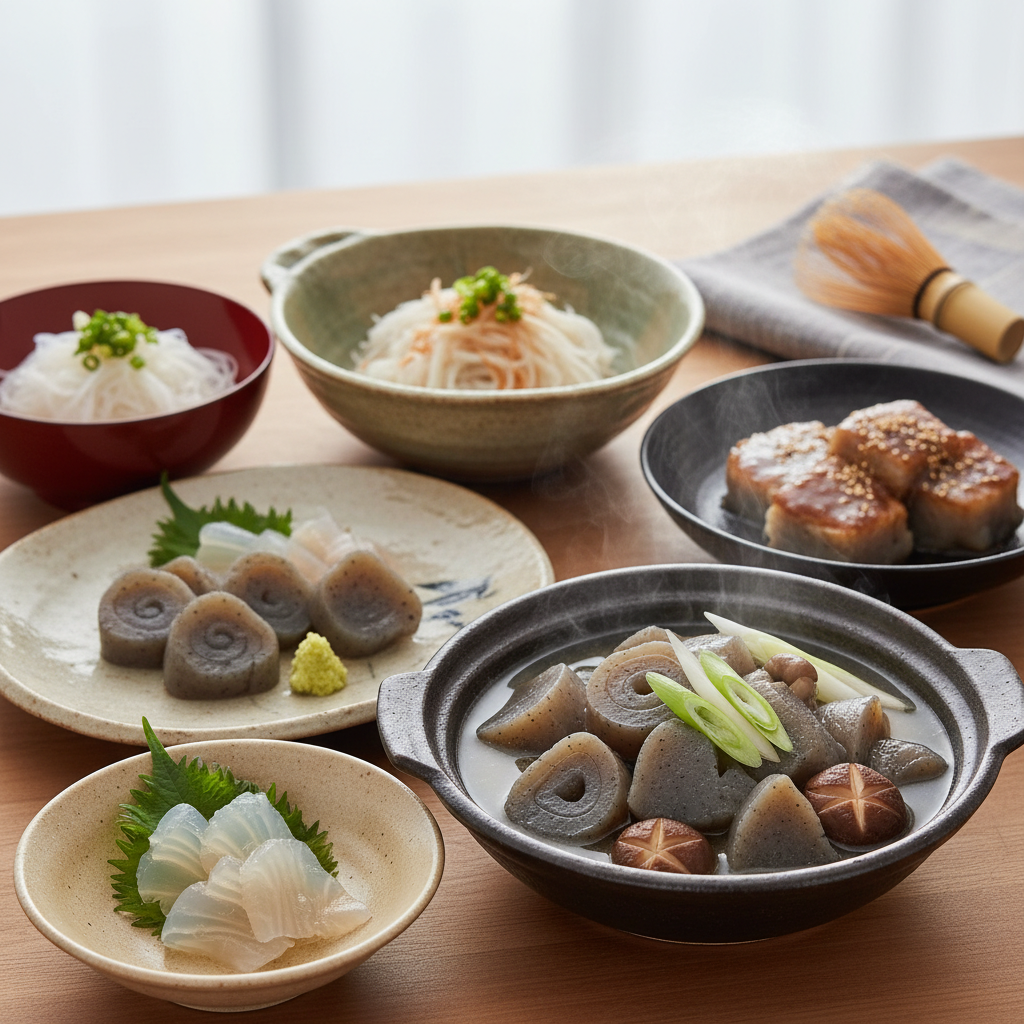
Oden with Konjac
Gunma Prefecture’s oden almost always contains konjac. In addition to standard block konjac, many households also use ball konjac or thread konjac, and there is particular attention paid to the types and cutting methods of konjac.
Gunma Prefecture-produced konjac is characterized by its elasticity and how easily it absorbs flavor. By making crosshatch cuts on the surface, the broth clings well and provides an enjoyable texture. Konjac simmered slowly in soy sauce-based broth is the soul food of Gunma residents.
Konjac Dengaku with Miso
Dengaku is one of the representative konjac dishes of Gunma Prefecture. Thickly-cut konjac is skewered and grilled over charcoal or direct heat, then finished with sweet and spicy miso.
The miso used varies by region, with versions made from red miso bases, those using white miso, yuzu miso, and various other variations. Miso finished with a sweet taste using sugar or mirin brings out the delicate flavor of the konjac.
At tourist attractions and roadside stations, many shops offer freshly grilled miso dengaku, making it a popular dish among visitors to Gunma Prefecture.
Simmered and Stir-fried Dishes
Simmered dishes with konjac are a standard home-cooked dish in Gunma Prefecture. Variations range from simple, sweet and spicy konjac simmered alone to hearty stews simmered with root vegetables such as daikon, carrots, and taro.
In particular, “spicy stewed konjac” is a popular dish made in many households, characterized by a sweet and spicy flavor made from a base of soy sauce, sugar, and mirin with the addition of chili peppers. Since it tastes good even when cooled, it is also valued as a side dish for lunch boxes.
Konjac Sashimi
Gunma Prefecture has a culture of eating konjac sashimi on a daily basis. In addition to the typical gray konjac, colorful varieties of sashimi konjac are sold, including green versions with aonori seaweed, red versions with chili peppers, and versions with yuzu.
It is generally eaten thinly sliced with vinegar miso or wasabi soy sauce, though some households eat it with wasabi soy sauce or ponzu. Due to its low calorie and healthy nature, it has also gained attention as a diet food.
Thread Konjac in Sukiyaki
Gunma Prefecture never fails to include thread konjac in sukiyaki. When simmered together with meat and vegetables, the thread konjac absorbs the umami and serves as an accent to the texture.
However, due to the theory that substances contained in konjac harden meat, some households place meat and konjac separately or cook them separately. Even so, for Gunma residents, thread konjac in sukiyaki is an absolutely necessary ingredient.
Shirataki Stir-fry
Stir-fried dishes made with shirataki (thread konjac) are also a standard Gunma dish. “Shirataki Kinpira” is a dish made by stir-frying shirataki together with carrots and burdock, seasoned with soy sauce and sugar, and is enjoyed as a rice side dish or drinking appetizer.
Modern-style arrange recipes that stir-fry shirataki with mentaiko or tuna are also popular, and a culture of enjoying traditional ingredients in new forms has taken root.
Regional Characteristics of Konjac Cuisine
Konjac Cuisine of the Shimonita Region
Shimonita Town is a major production area for konjac plants and is known by the brand name “Shimonita Konjac.” In this region, many shops serve homemade konjac, allowing visitors to taste elastic konjac made using traditional methods.
Dishes combining Shimonita leek and konjac are also popular, utilizing both regional specialties for the local taste.
Konjac Cuisine of the Kanra Region
Kanra Town is also an active konjac production area. This region is also making efforts to develop processed products using konjac plants, with new types of konjac products such as konjac chips and konjac jelly being created.
As a traditional dish, miso oden using local miso is famous, a winter standard in which various ingredients including konjac are simmered in a miso-based broth.
Konjac Cuisine of Showa Village
Showa Village is known as the “konjac plant village” and has many konjac manufacturing facilities within the village. This region continues to maintain traditional methods of making konjac from fresh tubers, with many craftspeople whose work is characterized by rich flavor.
Showa Village also hosts “konjac cooking contests” and similar events, with new konjac recipe ideas being created one after another.
Nutritional Value and Health Benefits of Konjac Cuisine
Low in Calories and Rich in Dietary Fiber
Konjac is extremely low in calories, at approximately 5-7 kcal per 100g. Its main component, glucomannan, is a soluble dietary fiber that helps regulate the intestinal environment.
Due to its rich dietary fiber content, it helps with constipation relief and improvement of intestinal flora, and is attracting attention as food material suited to maintaining the health of modern people.
Diet Effect
Konjac is easy to feel full on and has low calories, making it an excellent diet food. In Gunma Prefecture, it has long been said that “eating konjac makes your body feel lighter,” and it has been embraced as part of a healthy lifestyle.
Calcium Supplementation
Through the addition of coagulating agents (calcium hydroxide or calcium carbonate) used in the konjac manufacturing process, konjac contains calcium. With approximately 43mg of calcium per 100g, it contributes to the maintenance of bone health.
Gunma-Style Konjac Cooking Recipes You Can Make at Home
Basic Konjac Preparation Method
Proper preparation is important for cooking konjac deliciously. First, cut the konjac into appropriate sizes and boil in boiling water for 2-3 minutes to remove impurities. This process removes the characteristic odor of konjac and makes it easier for flavors to be absorbed.
After boiling, drain the water thoroughly, and then dry-roast to further evaporate moisture, making it even easier for flavors to be absorbed.
Recipe for Sweet and Spicy Stewed Konjac
Ingredients (Serves 4)
- Konjac 1 block (250g)
- Soy sauce 2 tbsp
- Mirin 2 tbsp
- Sugar 1 tbsp
- Sake 1 tbsp
- Sesame oil 1 tsp
- Chili pepper 1 (to taste)
- White sesame seeds as needed
Instructions
- Cut konjac into bite-sized pieces and make crosshatch cuts on the surface
- Boil in boiling water for 2-3 minutes to remove impurities
- Dry-roast konjac in a frying pan to evaporate water
- Add sesame oil and all seasonings, simmer over medium heat
- Once the liquid has reduced completely, sprinkle with white sesame seeds and serve
Recipe for Konjac Steak
Ingredients (Serves 2)
- Konjac 1 block
- Garlic 1 clove
- Butter 10g
- Soy sauce 1 tbsp
- Mirin 1 tbsp
- Sake 1 tbsp
- Salt and pepper to taste
- Green onion as needed
Instructions
- Cut konjac into 1cm-thick slices and make crosshatch cuts on both sides
- After pre-boiling, wipe away moisture thoroughly with paper towels
- Fry konjac in a frying pan on both sides until browned
- Add minced garlic and butter to create aroma
- Add seasonings and coat, adjust flavor with salt and pepper
- Plate and scatter green onion on top to serve
Recipe for Konjac Dengaku with Miso
Ingredients (Serves 4)
- Konjac 1 block
- Red miso 3 tbsp
- Sugar 2 tbsp
- Mirin 2 tbsp
- Sake 1 tbsp
- White sesame seeds as needed
Instructions
- Cut konjac thickly and pre-boil
- Skewer and grill both sides in a grill or toaster
- Mix miso, sugar, mirin, and sake and heat over low heat, stirring
- Coat grilled konjac with miso and grill lightly again
- Sprinkle with white sesame seeds and serve
Famous Shops and Tourist Spots Where You Can Enjoy Konjac Cuisine in Gunma Prefecture
Konjac Park (Kanra Town)
Konjac Park is a popular tourist facility where visitors can observe the konjac manufacturing process and try various konjac dishes free of charge. Unique konjac dishes such as konjac ramen, konjac yakisoba, and konjac curry can be enjoyed.
The facility includes a factory tour course, a buffet corner, and a souvenir shop, making it popular with families.
Shimonita Roadside Station
The roadside station in Shimonita Town serves dishes made with locally-produced konjac. Sales of homemade konjac and demonstration sales of konjac dishes are held, where you can taste freshly-made konjac dengaku.
“Negi Konjac,” a combination of Shimonita leek and konjac, is also a local specialty where you can experience the local taste.
Long-Established Konjac Specialty Restaurants
Within Gunma Prefecture, there are also konjac specialty restaurants with a history of over 100 years in operation. These establishments serve kaiseki cuisine and course meals using konjac made by traditional methods, allowing visitors to experience the depth of konjac.
Konjac sashimi, konjac dengaku, konjac stew, konjac steak—it is surprising that so many varied dishes can be enjoyed from a single ingredient.
Types of Konjac and How to Use Them in Cooking
Block Konjac
The most common type of konjac, it can be used in a wide variety of dishes including stews, oden, and stir-fries. It comes in both gray and white varieties, with the gray version containing seaweed powder and having a richer flavor.
Thread Konjac and Shirataki
These have a long, thin shape and are suitable for sukiyaki, hot pots, and stir-fries. Shirataki is thinner than thread konjac and is characterized by a more delicate texture. In Gunma Prefecture, the two are often treated as virtually the same thing.
Ball Konjac
While Yamagata Prefecture is famous for it, ball konjac is also made in Gunma Prefecture and is used in oden and stews. Its round shape is cute, and it is characterized by the ease with which flavors are absorbed.
Konjac Sashimi
This konjac is made specifically for eating raw and is characterized by a smooth texture. There are colorful variations with aonori seaweed, yuzu, chili peppers, and other ingredients mixed in.
Fresh Tuber Konjac
Made from fresh konjac tubers rather than konjac powder, it is characterized by rich flavor and elasticity. It is treated as a premium product and allows you to enjoy the true flavor of konjac.
Modern Arrangements of Konjac Cuisine
Konjac Pasta and Konjac Noodles
In recent years, konjac noodles, which have gained attention as a diet food, originated in Gunma Prefecture. By using konjac instead of pasta or ramen noodles, calories can be significantly reduced.
Various arrange recipes have been developed, including Carbonara-style, Peperoncino-style, and Dandan noodle-style versions.
Konjac Pizza
Healthy pizza using thinly-sliced konjac instead of pizza dough is also popular. By topping with cheese and vegetables and baking in an oven, you can enjoy low-carb pizza.
Konjac Chips
Chips made by drying thinly-sliced konjac are popular as a substitute for snack foods. There are various flavor variations, and they are also popular as souvenirs.
Konjac Sweets
While konjac jelly is famous nationwide, Gunma Prefecture is also making progress in developing Japanese and Western confectionery using konjac. Unique sweets such as konjac dumplings, konjac warabimochi, and konjac tiramisu are appearing one after another.
Tips for Making Delicious Konjac Cuisine
Carefully Remove Impurities
Removing the characteristic odor of konjac requires proper impurity removal. A method of rubbing with salt before boiling also removes odor more effectively.
Season Properly
Since konjac itself has no flavor, it is important to season it well. By allowing it to marinate in seasoning longer, you can achieve a deeper flavor.
Make Cuts on the Surface
Making crosshatch cuts on the surface makes it easier for flavors to be absorbed and improves the texture. The method of tearing by hand also creates an irregular surface that helps flavors cling better.
Dry-Roast
Dry-roasting after boiling evaporates water, making it easier for seasonings to be absorbed. This extra step is the secret to deliciousness.
Freeze
When konjac is frozen once, it acquires a meat-like texture after thawing. This property is utilized in the traditional food “frozen konjac,” allowing you to enjoy a new texture.
Passing Konjac Culture to the Next Generation
In Gunma Prefecture, efforts are being made to pass on konjac culture to the next generation. Various activities are underway, including konjac-making experiences at elementary schools, cooking classes, and recipe contests.
Additionally, the development of new products using konjac is active, and the attitude of preserving tradition while continuing to innovate is the source of the strength of Gunma Prefecture’s konjac industry.
In the modern era of health consciousness, konjac, which is low in calories and high in nutritional value, is receiving increasing attention as a food material. Konjac cuisine, passed down as a local dish of Gunma Prefecture, will continue to be loved by many people in the future.
Summary
Gunma Prefecture’s konjac cuisine is a traditional local dish with over 300 years of history. It is enjoyed through various cooking methods including oden, miso dengaku, stews, and konjac sashimi, and is deeply rooted in the daily lives of Gunma residents.
The abundant variety unique to Japan’s leading konjac production area and the distinctive regional dishes are something you should definitely try when visiting Gunma Prefecture. Additionally, since many recipes are easy to prepare at home, try recreating Gunma’s konjac cuisine in your own kitchen and experience its deliciousness and health benefits.
Konjac, which is low in calories and rich in dietary fiber, is an ideal food material for a healthy diet for modern people. From traditional local dishes to modern arrangements, the possibilities of konjac are endless. We hope that many people will come to know and enjoy the konjac culture that Gunma Prefecture takes pride in.