Okonomiyaki: Osaka Prefecture’s Local Cuisine – Complete Guide to History, Preparation, and Tradition
Introduction
Okonomiyaki is a symbol of Japanese food culture, known throughout Japan and around the world as the representative local cuisine of Osaka Prefecture. This dish, made by mixing ingredients such as cabbage, pork, and squid into a batter dissolved in water or broth, then grilling it on an iron plate, has formed the center of Osaka’s “konamon culture” (wheat flour-based food culture). Together with takoyaki, it is cherished as Osaka’s soul food and is consumed daily both as home cooking and when dining out.
This article provides a detailed explanation centered on the local cuisine aspects of okonomiyaki, including its historical background, regional transmission, specific preparation methods, and modern efforts in preservation and continuation.
What is Okonomiyaki
Basic Definition and Characteristics
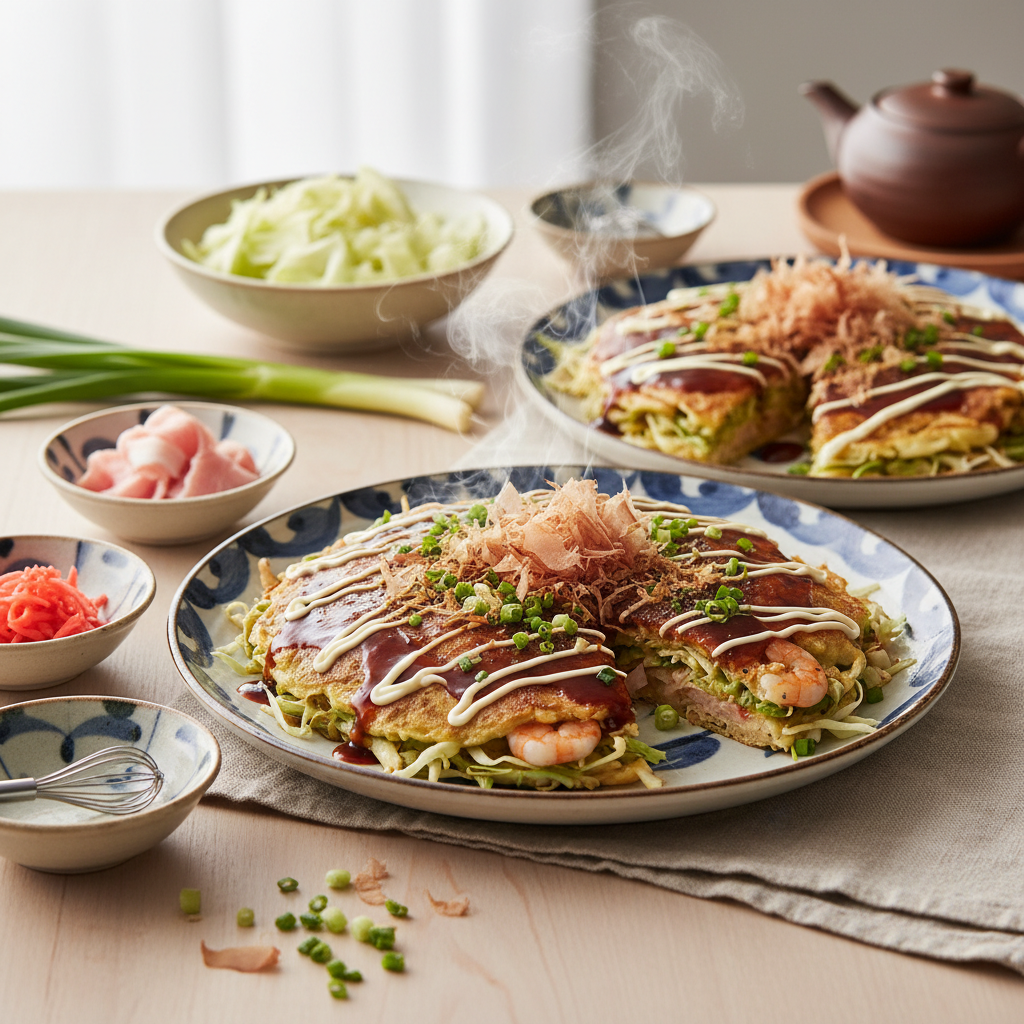
Okonomiyaki (お好み焼き) is a dish made by mixing finely chopped vegetables centered on cabbage, as well as meat and seafood such as pork and squid, into a batter made from wheat flour as the main ingredient, then grilling it flat on both sides on an iron plate. After cooking, it is finished with toppings such as sweet and thick okonomiyaki sauce, mayonnaise, bonito flakes, and aonori (seaweed powder).
Osaka’s okonomiyaki is also called “Kansai-style okonomiyaki” or “Osaka-yaki,” and is characterized by a cooking style where the batter and ingredients are mixed together before grilling. This differs from Hiroshima-style okonomiyaki, and the fluffy texture and cohesion of the batter are the charms of Osaka style.
Positioning in Osaka’s Konamon Culture
Osaka has long been called “Japan’s Kitchen” and developed as a commercial city. Within this context, a unique food culture developed around wheat flour-based dishes, known as “konamon” culture. Okonomiyaki, along with takoyaki, ika-yaki (squid grilled), and negi-yaki (scallion grilled), serves as the core of this culture.
Throughout Osaka Prefecture, specialty shops line the streets, and many homes have iron plates built in. It can be eaten anytime, regardless of season, and is cherished both as everyday home cooking and as a menu item for special occasions when dining out.
History, Origins, and Related Events
The Origins of Okonomiyaki
The history of okonomiyaki has various theories, but according to one account, it can be traced back to the Azuchi-Momoyama period. It is said that one of the prototypes was “fu no yaki,” a confection born with the development of the tea ceremony—a simple dish made by thinly grilling wheat flour dissolved in water and wrapping it with miso.
During the Edo period, dishes called “sukeso-yaki” and “dondon-yaki” became popular among the common people. These were simple dishes made by grilling batter made from wheat flour dissolved in water with chopped scallions and similar ingredients, and they were sold at food stalls.
The Establishment of Modern Okonomiyaki
The okonomiyaki as we know it today was established from the early Showa period through the post-war era. From the late Taisho period to the early Showa period, a dish called “issem yoishoku” became popular in Osaka. This was a dish made by grilling batter made from wheat flour dissolved in water with scallions and tempura scraps, then spread with sauce—a humble dish that could be eaten for one sen, a very inexpensive price.
During the post-war food shortage period, wheat flour-based dishes were invaluable as a substitute for staple grains. During this time, the modern style of okonomiyaki, which made abundant use of ingredients such as cabbage, meat, and seafood, became established. As the economy grew, ingredients became more abundant, and unique recipes developed in individual homes and shops.
Development and Cultural Background in Osaka
The reason okonomiyaki developed particularly in Osaka lies in the merchant culture and popular culture. As a commercial city thriving in trade, Osaka demanded meals that were convenient, inexpensive, and voluminous. Okonomiyaki was precisely the dish that met those requirements.
Additionally, Osaka’s “kuidaore” culture—an attitude that emphasizes enjoying food—also accelerated the development of okonomiyaki. The freedom to choose ingredients according to one’s preferences, the enjoyment of watching it grill on the iron plate before you, and its role as a communication tool while enjoying conversation—okonomiyaki came to have cultural value beyond merely being food.
Major Areas of Transmission
Widespread Prevalence Throughout Osaka Prefecture
Okonomiyaki is a local cuisine widely transmitted throughout Osaka Prefecture. In particular, within Osaka city, many specialty shops are concentrated in bustling districts such as Dotonbori, Sennichimae, Umeda, Tenma, and Fukushima. In residential neighborhoods too, long-established shops rooted in the community are scattered about and cherished by local residents over many years.
Even outside Osaka city, in areas such as Sakai, Higashi-Osaka, Toyonaka, and Suita, unique shop cultures have developed. There are subtle differences in grilling methods and seasoning traditions in each region, reflecting local characteristics.
Transmission in the Home
In Osaka, okonomiyaki is deeply rooted not only as a dining-out option but also as home cooking. Many homes have hotplates or tabletop iron plates, and it is common to grill okonomiyaki at home on weekends or when family gathers.
Each home has its own recipes passed down through generations, with the proportions of the batter, selection of ingredients, and cooking tips being transmitted from parent to child. This in-home transmission supports the diversity and continuity of okonomiyaki culture.
Primary Ingredients Used
Basic Ingredients
The basic ingredients for okonomiyaki are as follows:
Batter ingredients:
- Wheat flour: okonomiyaki-specialty flour or cake flour
- Water or broth: liquid for dissolving the batter
- Eggs: for binding the batter and adding flavor
- Mountain yam (grated): to create a fluffy texture (used in some shops and homes)
Main ingredients:
- Cabbage: the star vegetable of okonomiyaki, cut into rough minced pieces
- Pork: thinly sliced belly pork is standard
- Squid: a seafood that adds umami along with tempura scraps
- Tempura scraps (agedama): adds texture and flavor
- Red pickled ginger: adds color and flavor as an accent
- Scallions: chopped green onions are used
Toppings:
- Okonomiyaki sauce: a sweet and thick specialized sauce
- Mayonnaise: adds creaminess
- Bonito flakes: their movement in the heat is also part of the enjoyment
- Aonori: adds aroma and color
Points on Ingredient Selection
Choose fresh cabbage with ample moisture and sweetness. Spring cabbage is tender, while winter cabbage has strong sweetness, allowing enjoyment of seasonal differences. The standard cutting method is coarse mincing, which is important for preserving texture.
Using specialized okonomiyaki flour results in fewer failures, but regular cake flour can also be used by adding broth stock powder or seasonings. Using authentic broth made from kombu seaweed or bonito flakes results in a richer flavor.
Pork belly with fat marbling is standard, though some shops use loin pork or beef. Fresh squid should be used and cut to an appropriate size to enjoy both texture and umami.
Ingredients (for 2 servings)
Ingredients for a Standard Recipe
Batter:
- Wheat flour (cake flour or okonomiyaki flour): 150g
- Water or broth: 180ml
- Eggs: 2
- Mountain yam (grated): 50g (optional)
Ingredients:
- Cabbage: 300g (about 1/4 of a head)
- Pork belly (thinly sliced): 100g
- Squid: 50g
- Tempura scraps: 4 tablespoons
- Red pickled ginger: 2 tablespoons
- Green scallions (cut into small rounds): to taste
Toppings:
- Okonomiyaki sauce: to taste
- Mayonnaise: to taste
- Bonito flakes: to taste
- Aonori: to taste
Other:
- Salad oil: to taste (for the iron plate)
These proportions make a standard 2 servings. Depending on the household or shop, the amount and type of ingredients vary, with various variations including shrimp, scallop, cheese, mochi, and more.
Preparation Method
Preparation
- Preparing the cabbage: Remove the core from the cabbage and cut into rough minced pieces. Cutting too finely causes moisture to release, so pieces about 1cm in size are the target.
- Preparing the ingredients: Cut squid into bite-sized pieces. Cut pork belly to an appropriate length. Cut green scallions into small rounds, and coarsely chop the red pickled ginger.
- Preparing the batter: Place wheat flour in a bowl and gradually add water or broth while mixing with a whisk until there are no lumps. If using mountain yam, grate and add it.
Mixing the Batter and Ingredients
- Adding the ingredients: Place chopped cabbage, squid, tempura scraps, red pickled ginger, and green scallions in a larger bowl.
- Adding the batter: Add the prepared batter and beaten egg to the bowl of ingredients and lightly mix everything together. Overmixing causes moisture to release from the cabbage, so mix just until the batter coats the ingredients.
Grilling Method
- Heating the iron plate: Heat an iron plate or hotplate to medium heat (180-200°C) and lightly oil it with salad oil.
- Pouring the batter: Pour the batter onto the iron plate with a ladle and spread it into a circle about 15-18cm in diameter. The thickness should be about 2-3cm. It’s important not to spread it too thinly.
- Adding pork: Arrange pork belly slices in a radial pattern on top of the batter. The fat from the pork will seep into the batter, increasing umami.
- Grilling one side: Cover with a lid and grill for 3-4 minutes. It’s time to flip when the surface of the batter begins to dry slightly and the edges have firmed up.
- Flipping: Using two spatulas, flip all at once. The pork should end up on the bottom.
- Grilling the other side: Cover with a lid and grill for 3-4 minutes. At this point, it’s important not to press down. Pressing causes the fluffy texture to be lost.
- Finishing: When both sides are nicely browned, it’s done. If a wooden skewer inserted comes out clean, it’s fully cooked.
Sauce and Toppings
- Applying the sauce: Apply okonomiyaki sauce generously. Using a brush allows even application.
- Drizzling mayonnaise: Drizzle mayonnaise in a grid or spiral pattern.
- Toppings: Generously top with bonito flakes and aonori to finish. The sight of the bonito flakes dancing in the heat is also part of the enjoyment.
Grilling Tips and Points
- How to mix the batter: When mixing ingredients and batter, it’s important not to overmix. If cabbage releases too much moisture, the batter becomes watery and the fluffy texture is lost.
- Grilling temperature: If the temperature is too high, the surface burns while the inside remains undercooked; if too low, it takes too long and moisture evaporates. Medium heat with slow cooking is key.
- Don’t press down: Pressing with a spatula during cooking removes air from the batter and loses the fluffy texture. “Don’t touch, don’t press” is the golden rule.
- Timing for flipping: If too early, the batter isn’t cohesive and breaks easily; if too late, it burns. The optimal time is when the edges are firm and the surface has begun to dry slightly.
Dining Occasions and Seasons
Positioning as Everyday Food
Okonomiyaki is eaten year-round, anytime of year, without regard to season. In Osaka, it appears frequently on the dinner table as everyday food, as the main dish for lunch or dinner.
It’s particularly common to have an okonomiyaki party at home on weekends or when family gathers, with each person selecting their favorite ingredients and enjoying the fun of grilling their own. The meal becomes a place for family communication.
Food for Special Occasions
While an everyday dish, okonomiyaki is also popular as a dining-out menu item for special occasions. It is chosen for gatherings with friends, dates, and entertaining guests from out of town.
In Osaka, visiting a famous local shop becomes an event in itself, and many popular shops have lines of waiting customers. Many are long-established, operating for over 40 or even 70 years, and people from distant places visit to taste that particular shop’s flavor.
School Lunches and Community Events
Okonomiyaki occasionally appears on school lunch menus in some schools within Osaka Prefecture, with an educational aim of transmitting local food culture to children.
Food stalls serving okonomiyaki appear at local festivals and events, becoming places for community exchange. Additionally, events and competitions themed around okonomiyaki are held, contributing to the promotion of local culture.
Dining Methods
Basic Way of Eating
The best way to eat okonomiyaki is to eat it freshly grilled on the iron plate. At specialty shops, okonomiyaki grilled on the iron plate in front of you is eaten directly on the plate while dividing it with a kote (small spatula).
At home, the common style is to grill on a hotplate and have each person take their portion. Eating while piping hot allows you to enjoy the crispy outside and fluffy inside texture.
How to Use the Kote
A “kote” is a specialized tool for eating okonomiyaki. Shaped like a small spatula, it is used to cut okonomiyaki into pieces and bring it to the mouth. At Osaka specialty shops, eating with a kote is the standard style.
Using a kote allows the okonomiyaki to be divided into appropriate portions without breaking apart, and eating directly off the iron plate lets you enjoy it piping hot until the end.
Eating with Chopsticks
At home and in some shops, okonomiyaki is served on a plate and eaten with chopsticks. In this case too, eating while hot is the secret to deliciousness.
Side Dishes and Beverages
Okonomiyaki may be served with sides such as shredded cabbage salad or other salads. Adding miso soup or pickles creates a well-balanced meal.
Beer and highball are popular beverage choices. Carbonated drinks and tea also pair well. It is said that lighter drinks go well with the rich flavor of okonomiyaki.
Nutritional Value and Health Aspects
Nutritional Balance
Okonomiyaki is a well-balanced dish containing carbohydrates, protein, vegetables, and fat. Wheat flour provides carbohydrates and energy, pork and squid provide protein and B vitamins, and cabbage provides dietary fiber, vitamin C, and vitamin K.
Particularly because large amounts of cabbage are used, okonomiyaki is an efficient way for modern people, who often lack vegetables, to consume vegetables. A single okonomiyaki may contain over 200g of cabbage, which corresponds to more than half of the daily vegetable intake goal.
Calories and Nutritional Components
A standard okonomiyaki (about 300g) has approximately 500-700 kcal. This varies depending on the ingredients used and the amount of sauce and mayonnaise.
Major nutritional components are as follows:
- Carbohydrates: approximately 60-80g from wheat flour
- Protein: approximately 20-30g from pork, eggs, and squid
- Fat: approximately 20-30g from pork, eggs, and oil
- Dietary fiber: approximately 3-5g from cabbage
- Vitamins: particularly B vitamins, vitamin C, and vitamin K
- Minerals: iron, calcium, potassium, and others
Points for Enjoying Okonomiyaki Healthily
To enjoy okonomiyaki more healthily, consider the following points:
- Increase vegetable amounts: Adding more cabbage or including vegetables such as bean sprouts or carrots increases fiber and vitamin intake.
- Be creative with meat choices: Selecting leaner cuts or using chicken reduces calories.
- Adjust sauce amounts: Since sauce and mayonnaise are high-calorie, using less reduces total calories.
- Increase seafood: Squid and shrimp are low-calorie and high-protein, so using them abundantly is beneficial.
- Be creative with sides: Adding salad or miso soup further improves nutritional balance.
Preservation and Continuation Efforts
Transmission by Specialty Shops
Many okonomiyaki specialty shops in Osaka Prefecture have histories of 40 years or more, with some operating for over 70 years. These long-established shops continue to preserve unique recipes and techniques passed down through generations.
At many shops, techniques are transmitted from parent to child or from master to apprentice. Techniques based on long experience—such as batter proportions, ingredient selection, and timing of grilling—are transmitted through actual on-site training.
Some famous shops are listed in the Michelin Guide, maintaining quality standards of international caliber and playing a role in promoting Osaka’s food culture worldwide.
Activities of Industry Organizations
To protect and develop okonomiyaki culture, various industry organizations are active. Organizations such as the Osaka Okonomiyaki Association engage in activities to promote okonomiyaki, conduct training seminars for skill improvement, and hold events.
These organizations work to spread correct knowledge and techniques about okonomiyaki while putting effort into transmission to new generations. Various initiatives are undertaken, such as holding okonomiyaki certification tests and offering cooking classes.
Efforts in Educational Settings
At some schools in Osaka Prefecture, opportunities to experience okonomiyaki-making are provided as part of lessons on local food culture. Classes have been held where local okonomiyaki shop craftspeople are invited as instructors to teach actual preparation methods.
Through such educational activities, children deepen their understanding of local food culture and develop attachment to their hometown. Additionally, when parents and children make okonomiyaki together at home, the transmission of culture across generations occurs naturally.
Utilization as a Tourism Resource
Okonomiyaki has become an important element of Osaka tourism, with many tourists visiting Osaka to experience authentic okonomiyaki. Many okonomiyaki shops are concentrated in tourist areas such as Dotonbori and Sennichimae, with enhanced services for tourists.
For foreign tourists, English-language menus are provided, and okonomiyaki-making experience programs are offered. Sometimes introduced as “Japanese pancakes” or “Japanese pizza,” international recognition is increasing.
Utilization of SNS and Digital Technology
In modern times, the transmission of okonomiyaki culture using SNS is actively conducted. Many shops share information on Instagram, Twitter, and other platforms, successfully appealing to younger generations.
The visual appeal of beautiful plating and the sight of bonito flakes dancing in the heat are well-suited to SNS circulation, leading to the acquisition of new fan bases. Additionally, on video platforms such as YouTube, numerous videos explaining how to make okonomiyaki have been published, supporting cooking at home.
Commercialization and New Developments
While preserving okonomiyaki culture, commercialization adapted to modern lifestyles is progressing. Okonomiyaki sold as frozen foods or retort products allows people to enjoy authentic flavors conveniently at home.
Also, related products such as okonomiyaki-specific seasonings, flour, and sauce have become abundant and are popular as Osaka souvenirs. Products that recreate the taste of famous shops are sold, increasing opportunities for people far away to experience okonomiyaki culture.
International Expansion
In recent years, okonomiyaki specialty shops have increased overseas. Osaka-style okonomiyaki shops have opened in the United States, Europe, and countries throughout Asia and are being accepted by local populations.
Many of these overseas shops receive technical guidance from the main store in Osaka or are opened by craftspeople who trained in Osaka, with the authentic taste and techniques of Osaka spreading throughout the world. Okonomiyaki, as a representative of Japanese food culture, is increasing in international recognition.
Regional Differences and Variations
Regional Differences Within Osaka Prefecture
Even within Osaka Prefecture, subtle differences exist by region. Shops within Osaka city generally follow a relatively standard style, but shops in areas such as Sakai have their own grilling methods and flavoring.
Additionally, each household has its own recipes, with diverse variations in batter consistency, ingredient combinations, and sauce types. This diversity exemplifies the richness of okonomiyaki culture.
Comparison with Okonomiyaki from Other Regions
Okonomiyaki exists in regions other than Osaka, but the styles differ. The most famous is Hiroshima-style okonomiyaki, characterized by layering batter and ingredients and incorporating yakisoba (grilled noodles) or yakiudon (grilled wheat noodles).
“Monjayaki,” found in the Kanto region, is also made with wheat flour, but with high water content and a style of spreading thinly on an iron plate, it has developed as a different dish from okonomiyaki.
Osaka’s okonomiyaki is characterized by a “mixed-grilling” style where batter and ingredients are combined before cooking, with the appeal of fluffy texture and cohesive batter.
The Spread of Creative Okonomiyaki
While based on traditional okonomiyaki, increasingly creative okonomiyaki incorporating new ingredients and cooking methods are appearing. Variations adding cheese, mochi, mentaiko (spicy cod roe), and kimchi are seen, as well as high-end okonomiyaki using truffle and foie gras.
These creative dishes are popular with younger generations and foreign tourists, demonstrating new possibilities for okonomiyaki culture. The flexibility to preserve tradition while evolving with the times is the strength of okonomiyaki culture.
Information for Enjoying Okonomiyaki
Characteristics of Famous Shops
Osaka has numerous okonomiyaki specialty shops, each with unique characteristics. At long-established famous shops, you can enjoy the traditional taste maintained over many years. Each shop has its own commitment—unchanged manufacturing methods since founding, carefully selected ingredients, original sauce.
At high-end shops listed in the Michelin Guide, you can experience okonomiyaki made with quality ingredients and refined techniques. Conversely, at community-oriented casual shops, you can enjoy generous portions of okonomiyaki at reasonable prices.
Points When Making at Home
When making okonomiyaki at home, attention to the following points results in more delicious results:
- Use fresh cabbage and cut it immediately before eating
- Mix the batter without overmixing, just enough to coat ingredients
- Heat the iron plate or hotplate thoroughly before beginning to grill
- Don’t touch while grilling and don’t press down
- Flip only once
- Eat the freshly grilled okonomiyaki while hot
By following these points, you can enjoy okonomiyaki as delicious as at specialty shops in your own home.
Experiencing Okonomiyaki Culture
When visiting Osaka, be sure to experience authentic okonomiyaki. Watching it made by a craftsperson’s hands at a specialty shop while eating is enjoyable, and trying a self-grilled style shop where you cook it yourself is also recommended.
Additionally, participating in okonomiyaki-making experience classes allows deeper understanding of okonomiyaki culture. Through interaction with local people, you can experience Osaka’s food culture and the warmth of its people.
Conclusion
Okonomiyaki, as the representative local cuisine of Osaka Prefecture, possesses a long history and rich culture. From its origins dating back to the Azuchi-Momoyama period to diverse modern styles, it has developed over time.
Made from simple ingredients such as wheat flour, cabbage, pork, and squid, okonomiyaki has good nutritional balance and is cherished both as home cooking and dining out. As the center of Osaka’s konamon culture, it has become an important element forming regional identity.
Okonomiyaki culture is being passed to the next generation through diverse methods: transmission at specialty shops, continuation in homes, efforts in educational settings, and modern dissemination using SNS. Additionally, through international expansion, okonomiyaki is being enjoyed around the world.
With its flexibility to preserve tradition while incorporating new attempts, okonomiyaki culture will continue to be cherished by many as the symbol of Osaka’s food culture. When visiting Osaka, please taste authentic okonomiyaki and experience this profoundly rich culture.